Pyre is the year’s most affecting love story from the hills
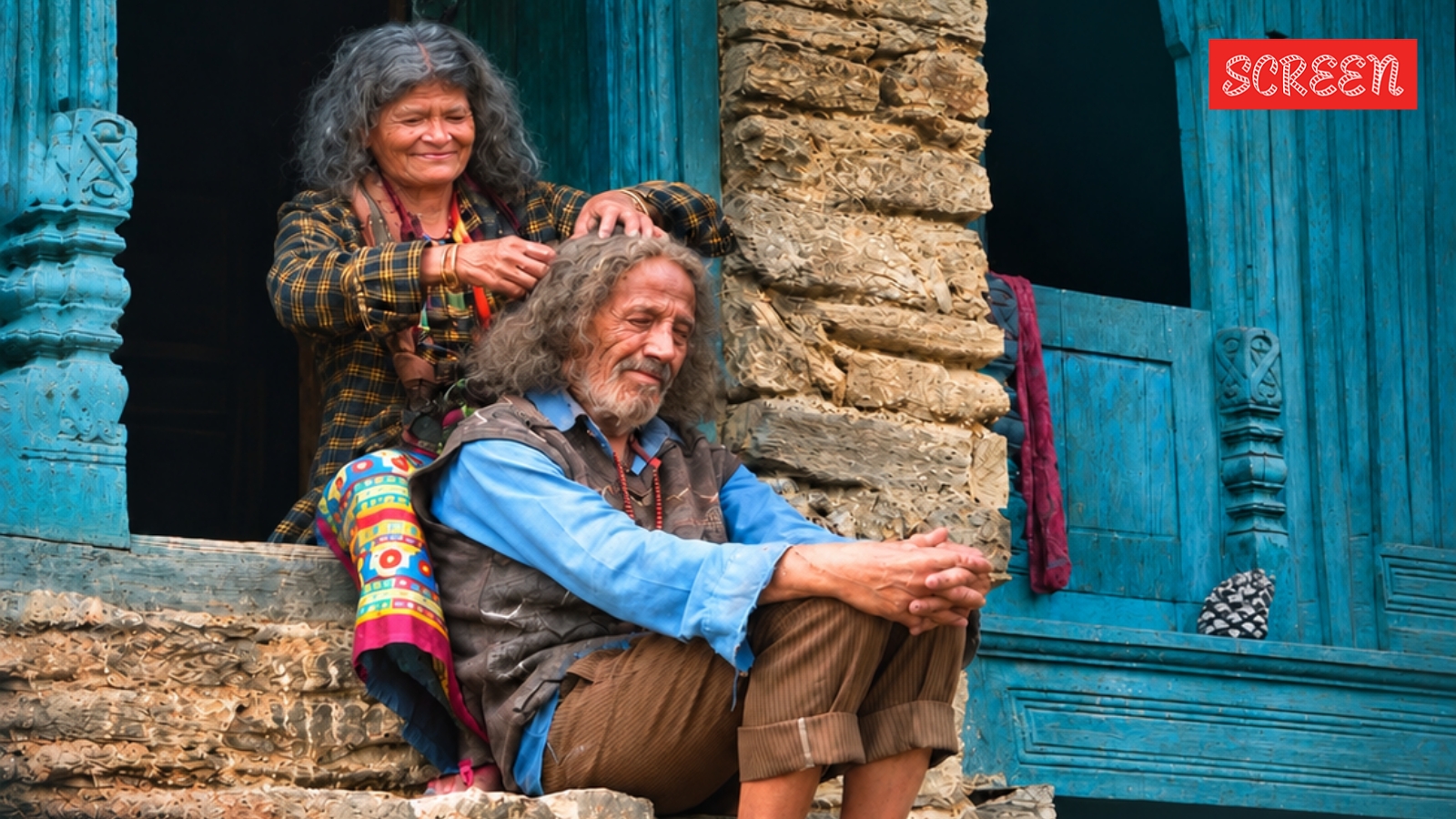
The hills are often romanticised. The couple who make a life there are exoticised. Their romance held up as something purer, freer, untouched by the cynicism of city life. Theirs is imagined as an almost ideal love, something that seems to have wandered into Rumi’s field beyond right and wrong. A love in which lovers do not simply plan to meet, but to stay, forever. But watching Vinod Kapri’s independent feature Pyre makes you realise that perhaps life in the hills is less idyllic than we imagine, and considerably more exhausting. There is little of the city’s cynicism, but there is solitude, and the burden of having to invent hopes for yourself in the vastness of a landscape that offers no assurance of tomorrow.
There are many ways to read Pyre. As a story of loneliness and endurance; as an elegy for a hilltop village slowly surrendering its people to the cities. It can also be seen as a horror film. A mountain that once knew the sound of many lives falls silent, leaving behind two people who have grown almost spectral in their solitude, haunted by the one ghost neither can escape: the dread of simply continuing to exist. But to me, Pyre is the year’s most affecting love story, an unlikely romance between Tulsi (Heera Devi) and Padam (Padam Singh). Married for over 60 years, theirs is a love that has shed the language of romance without ever losing its meaning.
Their love language is as simple as getting under each other’s skin. Padam delights in ragebaiting Tulsi, who returns the favour with equal relish. Their bickering is less a sign of discord than the tenderness of two people who have spent a lifetime learning the other’s ways. They rarely speak to each other directly, preferring to air their grievances to themselves, but always just loudly enough for the other to hear. They quarrel until one gives way to affectionate teasing; sing to each other until one grows weary of hearing the other’s voice; sit down to eat together, only for one to find fault with the food. They go on walks until one tires and threatens to push the other off a cliff, only for both to instinctively reach for each other as they approach the edge. Perhaps this is what love looks like after sixty years: having exhausted every way of expressing it, only to keep finding new ways of belonging to each other.
Death is perhaps the only subject they return to with any regularity. In their eighties, they seem to await it with an impatience almost greater than the one with which they once waited for their son, who left for the city 28 years ago and never returned. There is something almost hauntingly romantic about the moment, towards the latter half of the film, when Padam begins building a pyre for Tulsi. He fears that once she is gone, there will be no one left to build one for her. So he decides to do it himself, while he still can. It is in keeping with the small acts through which he has learnt to love her: pulling on her socks, making sure she takes her medicines before they retire for the night.
But beyond these everyday rituals lies a fear neither knows how to articulate: what becomes of the one who is left when the other is gone? Every night, before falling asleep, they speak of meeting again in the afterlife. Tulsi imagines heaven; Padam, with his characteristic mischief, insists on hell. They make plans to find each other there, too, as though a lifetime spent together has only made them greedy for more time. Time itself becomes a testament to their love. In the vastness of these mountains, in the long company of each other, they have slowly lost their hold on it. They no longer know which day it is, which year they are living in, or what is happening beyond the walls of their home.
Also Read – Pyre movie review: An affecting tale of love, loneliness and resilience
And, to survive, they do what lovers have always done: invent reasons to hope, even when there is little left to hope for. They fictionalise possibilities for each other, hold on to futures that may never come, and imagine light as a promise of dawn. In doing so, their love becomes an unlikely source of light in a landscape slowly surrendering to darkness. Because love, at its most selfless, is to keep wishing for a tomorrow together, even when you know that one day all that will remain of you is a pyre.
KioskNews shows a cleaned-up reading view extracted from the publisher’s page — the original always lives on their site, not ours.