Four more Taiwanese are missing or have been detained in China: report
By Chung Li-hua and Fion Khan / Staff reporter, with staff writer


Four more Taiwanese have gone missing or been detained or had their freedom of movement restricted in China compared with the previous week, with the total reaching 449 since Jan. 1, 2024, the Mainland Affairs Council (MAC) said in a weekly report on Saturday.
Of the 449 cases, 168 people have been reported missing, up from 165 from the previous week, and 39 have been detained for questioning, unchanged from the previous week, the council said.
Another 242 people are suspected of having their freedom of movement restricted in China, up by one, it said.
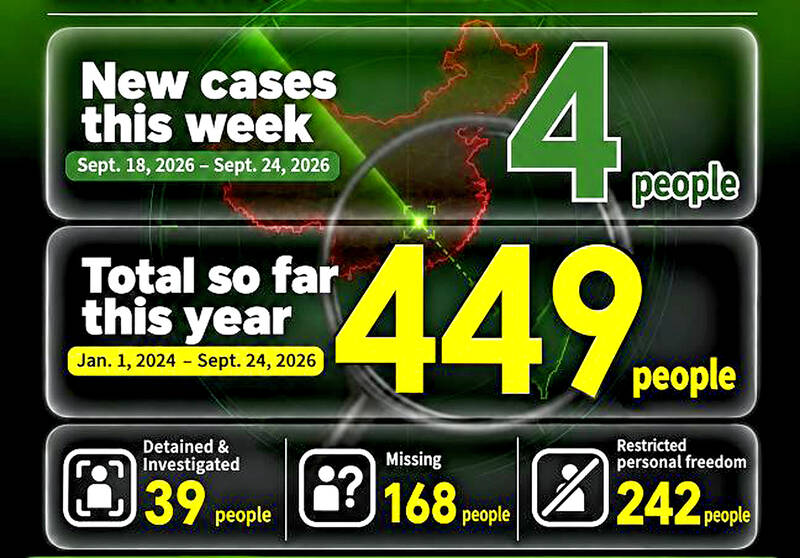
A Mainland Affairs Council infographic enumerates Taiwanese who have gone missing or are being detained in China since 2024.
Photo: Screen grab from the Mainland Affairs Council’s Facebook page
With the new Chinese entry and exit regulation that took effect on Sept. 15, five groups should exercise caution when traveling to China, the MAC said.
First, people in the semiconductor and technology industries, should be aware of risks arising from the overlap of technical, commercial and national security regulations, it said.
Second, Taiwanese businesspeople and senior corporate executives could become entangled in investigations, judicial proceedings or exit bans stemming from commercial disputes, patent issues or contractual conflicts, it said.
Third, civil servants and people traveling to participate in cross-strait exchanges, whether traveling on official business or privately, should ensure they are in compliance with regulations governing travel to China.
Fourth, people engaging in religious exchanges, including attending religious gatherings or delivering sermons, should be aware of local regulations concerning religion and national security, it said.
Fifth, people who have publicly expressed their views on politics, human rights or other issues through social media, overseas events or related organizations should be mindful of uncertainties in the application and enforcement of local laws, the council said.
The US Department of State on Sept. 4 updated its Level 2 travel advisory for China, urging US citizens to “exercise increased caution” in China due to “the arbitrary enforcement of local laws, the use of exit bans without a fair and transparent process under the law, and the risk of unjust arrest or detention,” the MAC said.
The travel advisory highlighted five categories of US citizens who could be targeted by Chinese authorities: US citizens of Chinese heritage or origin; anyone involved in business disputes or who has ties to US corporate entities involved in business disputes in China; anyone with a current or prior affiliation with US law enforcement, military or intelligence agencies; anyone traveling on US government-funded programs; and people with current or former connections to the US government.
“Expansive national security, counterespionage and data security laws grant Chinese officials broad discretion to detain or interrogate foreign nationals,” the department said.
That places US citizens at risk for conducting even routine business, research or expression in the public domain, it said.
Local authorities have detained and charged US citizens involved in civil business disputes with criminal offenses under the laws, it added.
KioskNews shows a cleaned-up reading view extracted from the publisher’s page — the original always lives on their site, not ours.