Notes from Central Taiwan: Taiwan’s wartime data plan
Taiwan is backing up critical systems overseas, but foreign tech dependence and political obstruction at home could undermine its digital defenses
By Michael Turton / Contributing reporter


The Ukrainian government on Oct. 14 broke the news that Elon Musk’s Starlink services to Ukraine had been throttled, severely impairing Ukraine’s ability to defend itself against Russian attacks. The controversy had erupted amid US criticism of Ukraine’s attacks on Russian energy production infrastructure. Although Musk denied it at first, the decision to cut off Ukraine was apparently his own.
This use of private, for-profit services to conduct wars is as old as warfare, but it has taken on a new urgency as private tech businesses run by billionaires with bizarre personal politics assume increasing importance in national defense planning. Taiwan has since 2024 been building an alternative satellite network to Starlink, a wise move in view of recent events. It is unlikely that Musk would permit Taiwan to access Starlink in time of war, given his massive investments in the People’s Republic of China (PRC) and his belief that Taiwan should become a special administrative zone of the PRC.
COMMUNICATION STRATEGY
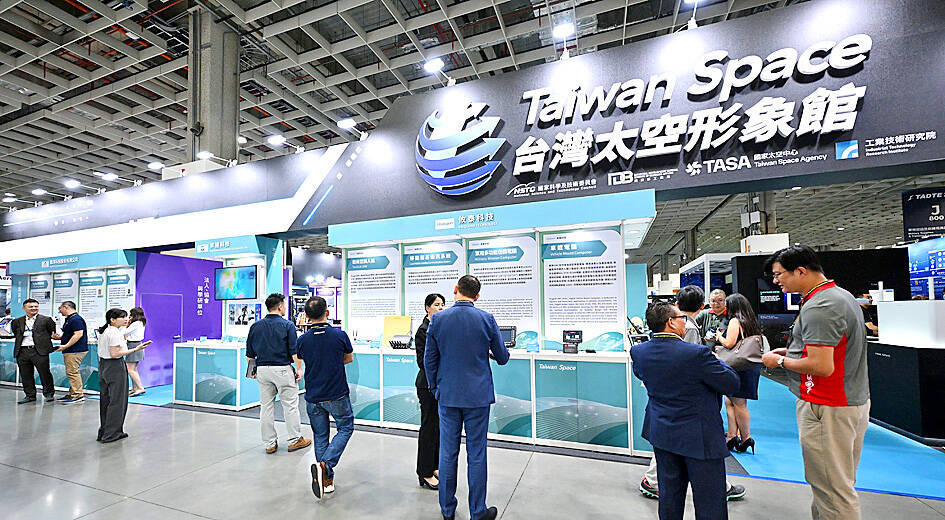
The Taiwan Space booth at the Taipei Aerospace & Defense Technology Exhibition in Taipei is pictured in an undated photograph.
Photo courtesy of the Industrial Technology Research Institute
As part of Taiwan’s alternative communications strategy, the Ministry of Digital Affairs (MODA) has installed 773 low-earth orbit (LEO) satellite reception stations at key military, police and fire department locations across the country, to serve as back-up channels for nation’s disaster response and critical infrastructure protection. Additionally, MODA has developed Taiwan’s first high-altitude communications balloon, to provide domestic emergency network support.
However, Taiwan is still depending on the tech giants in other ways.
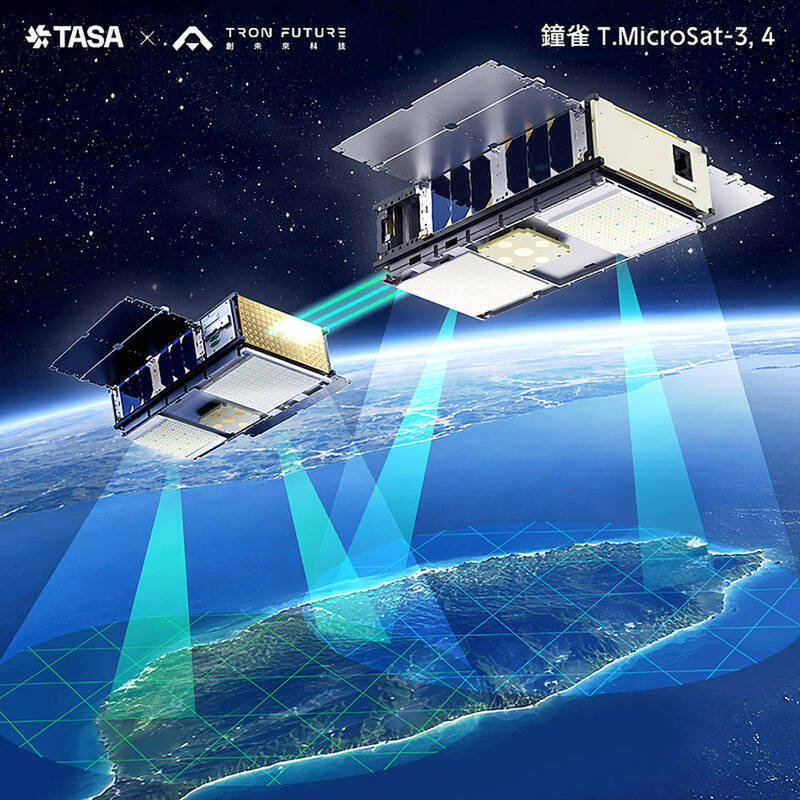
The T-Microsat-3 is pictured in an undated photograph.
Photo courtesy of Taiwan Space Agency
“MODA has identified 18 critical public systems and expects to invest NT$1.34 billion (US$41.9 million) over the next four years (2024 to next year) to promote cryptographic splitting and data backup mechanisms,” the government said in 2024.
Via the nation’s National Digital Resilience Initiative (NDRI), Taiwan has been migrating 18 critical civilian systems, including the household registration and conscription system, land registration and land use system, land survey and land price System, national health records, tax records and defense communications, onto cloud platforms provided offshore by hyperscalers Amazon Web Systems (AWS), Microsoft and Google Cloud Platform (GCP).
The government encrypts this data and then disperses it across data centers located in Japan, Australia and elsewhere. The encryption keys securing the dispersed information remain in Taiwanese hands. Because of the threat to undersea cables from the PRC, the systems are linked by satellite backups.
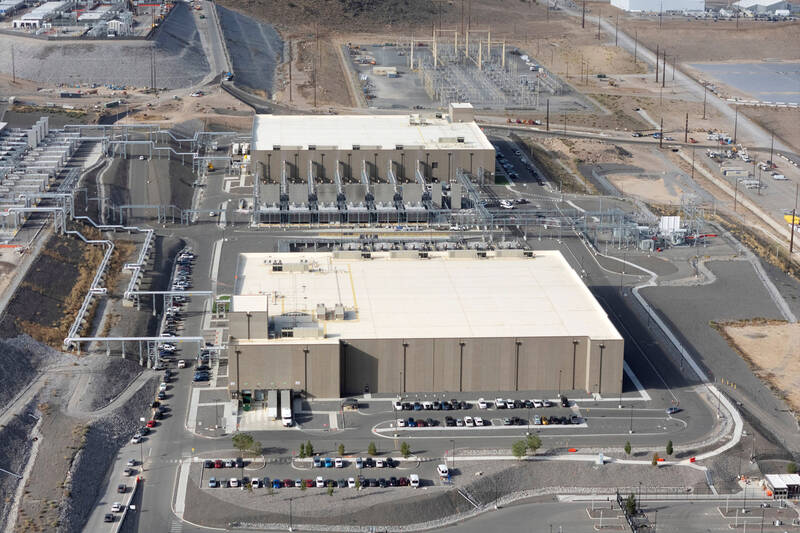
A drone view on Oct. 9 shows a data center at the Google Storey County Campus in the Tahoe-Reno Industrial Center in Sparks, Nevada, US.
Photo: Reuters
This program is directly based on Ukraine’s war programs, which were initiated in cooperation with AWS, and by the experiences of the Pacific island of Tonga after its cables were cut during a volcanic eruption. It is intended to enable the government to function in the event that cables are slashed and communications are jammed, isolating Taiwan from the world and the government from its people. In 2023-24 the government explored working with UK’s Eutelsat OneWeb low-Earth orbit satellite and Luxembourg’s SES medium-Earth orbit satellite, according to local media.
Information backup is not the only service provided by these firms. AI tools hosted on these hyperscaling platforms are used by military planners to engage in automated satellite imagery recognition and predictive risk analytics, along with Internet of Things (IOT)-enabled combat systems such as smart naval mines and missile batteries. Taiwan in 2024 began operating a unified digital environment that linked all the branches of the military.
Although the hyperscalers do not do much business in the PRC, and Taiwan prohibits PRC staff or technology in its systems, these systems are at the mercy of regulators and business pressures that Taiwan cannot control. This is noted in an interesting paper by Mahmoud Javadi published last year in the journal Contemporary Security Policy on this topic, which observes that not only are regulatory and business pressures key issues, but “operational tempo and military outcomes become tied to hyperscaler compute and analytics.”

An artilleryman of the Special Rifle Police Battalion of Zaporizhzhia region on Oct. 16 sets up Starlink satellite internet system, at a position, amid Russia’s attack on Ukraine, near the frontline in Donetsk region, Ukraine.
Photo: Reuters
The underlying assumption is that in time of war Taiwan will have access to those resources, but whether even a large hyperscaler like Amazon can maintain multiple services across several nations involved in wars is an untested question.
KMT INTERFERENCE
Readers will recall that the Chinese Nationalist Party (KMT) held up this year’s government budget until Aug. 14, passing it only after substantial cuts. The digital ministry was among the many government departments to see its discretionary expense allocations slashed to zero. The budget included NT$349.22 million for the cloud backup plan, which covered 16 systems across seven ministries.
The KMT, along with its sock puppet in the legislature, the Taiwan People’s Party (TPP), has already directed its budgetary ire at the MODA backup information program. The ground station network was sharply reduced when the KMT-TPP coalition froze and cut parts of last year’s budget. MODA’s NT$8.659 billion budget was cut by NT$3.582 billion, about 41 percent, Athena Tong (唐若凌) reported at Thinking Taiwan. She added that the “digital resilience line item supporting non-geostationary satellite communications was hit particularly hard, losing NT$300 million from an original allocation of NT$530 million, a reduction of 56 percent.”
Early last month I wrote about the National Communications Commission (NCC) and its oversight of the radio frequency spectrum (“Taiwan’s drone bill has a kill switch,” Sept. 3). The NCC has been paralyzed by the KMT, which has defunded its operations and blocked new commissioners. Note that the NCC also has authority over the satellite systems that the government’s information resilience program depends on.
On July 13 the Legislative Yuan’s Transportation Committee approved an amendment to Article 36 of the Telecommunications Management Act (電信管理法) that authorized the NCC to grant satellite network operators exemptions from requirements restricting their chairperson’s nationality and foreign ownership, on a case-by-case basis. It was promulgated on Aug. 5. The amendment is expressly intended to support the satellite links necessary to operate the information back up systems. It is clear that the NCC in its current state is probably unable to respond to the complicated demands of case-by-case reviews of satellite operators, which appears to be the intention of the KMT and the TPP. The KMT derailment of governance in Taiwan benefits only the PRC.
Of course, any satellite-based communication system is vulnerable to systems Beijing is putting in place. Not only is jamming the ground systems a solvable problem that Beijing’s researchers have already publicly modeled, but Beijing plans to pressure satellite operators and businesses. It probably already possesses the ability to kill satellites in space.
While the PRC has only limited pressure over firms that do little business in China, it can sometimes muster great leverage over national government regulators. Imagine what pressure Beijing can bring to bear on, for example, the Australian regulators of cloud hyperscalers’ platforms physically present in Australia, especially in time of war. Taiwan and its allies overseas must be ready.
Notes from Central Taiwan is a column written by long-term resident Michael Turton, who provides incisive commentary informed by three decades of living in and writing about his adoptive country. The views expressed here are his own.
KioskNews shows a cleaned-up reading view extracted from the publisher’s page — the original always lives on their site, not ours.