Pope Leo in Argentina – Pontiff to take the journey Francis never made
Pope Leo XIV's upcoming trip to Argentina – the first papal visit in 39 years – is something of a consolation prize for the homeland of his predecessor Francis, who disappointed his compatriots by never returning home as pontiff.
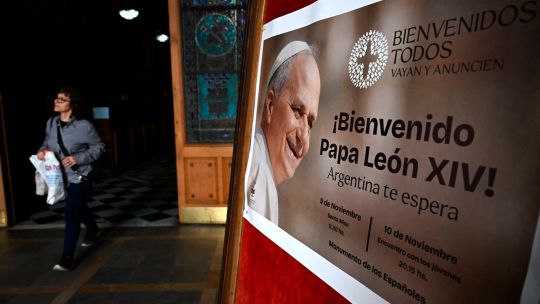
At the entrance to Buenos Aires Metropolitan Cathedral, where the then-Jorge Bergoglio served as archbishop for 15 years, a TV screen shows images of him kissing the feet of the faithful.
Next to it, a poster advertises the open-air mass that US-born Leo will celebrate next Monday in Buenos Aires, on the second-leg of his South American tour.
The memory of Francis, Latin America's first pope, looms large over the visit of his successor.
For 23-year-old Sol Burgos, his arrival is a source of solace.
"Argentina was deeply hurt to lose its pope," she said at the door of the cathedral.
But Pope Leo's close ties to the world's most Catholic continent, cultivated over long years as a missionary and then archbishop in Peru, helped smooth the transition, she said.
"Thank God the new pope has also had a connection with Latin America!"
Francis visited several countries in Latin America, including neighbouring Brazil, during his 12 years as leader of the world's 1.4 billion Catholics.
But he studiously avoided his own, an absence that disappointed many and fuelled ongoing speculation about why.
The most widely held view is that he feared a visit would be seen as endorsing the divisive centre-left Peronist movement in power for much of his papacy, until libertarian President Javier Milei's win in 2023.
"He couldn't or didn't want to come," Ruben Lozano, a 73-year-old from Santa Fe Province, said on a recent visit to the capital.
"In order to avoid creating divisions he [Francis] said to himself: 'OK, I won't go to Argentina for the moment and everything will remain peaceful.'"
Milei, who before becoming president copiously attacked Francis over his criticisms of capitalism and perceived leftist political stances, took the same view.
"I have no doubt that Pope Francis wanted to come, and I think he didn't come because he knew that if he did, it would cause a political earthquake," Milei told Argentina's Radio Mitre last month.
In a 2023 book-length interview, Francis argued being pope was a political role but that he drew the line at party politics.
The current Archbishop of Buenos Aires, Jorge García Cuerva, has downplayed comparisons between the current and former Vatican leaders.
"The successor of Peter [regarded as the first pope] is coming, not the successor of Francis," he said in August.
Leo will be greeted by Milei at the foot of his plane when he arrives on Sunday from Uruguay.
After a giant open-air Mass in the capital he will travel to the central city of Cördoba and to a basilica in Luján, near Buenos Aires, that attracts millions of pilgrims each year.
The last pope to visit Argentina was John Paul II in 1987.
Archbishop García Cuerva has billed the new papal visit as a chance to mend divisions in Argentine society, between the rich and poor, left and right.
“The wound that exists amongst Argentines can heal, through the gentleness of tenderness, kindness, cordiality and forgiveness,” he recently told the La Nación newspaper.
Leo XIV arrives in an Argentina battered by economic difficulties, where growth in sectors such as energy contrasts with the weakness of industry and consumer spending. Poverty affects a third of the population, whilst the ultra-liberal Milei maintains his severe policy of fiscal austerity and economic liberalisation.
Leo will land in a country reeling after three years of biting austerity – Milei's cure for years of overspending and rampant inflation.
The Catholic Church has fiercely criticised the price paid by the poor for Milei's swingeing budget cuts and deregulation.
Taking a leaf from Francis's book, Leo has put the poor and marginalized at the center of his papacy.
"I see Leo as a sort of continuation...of the imprint that Francis left on the Vatican and the Church," said Lozano.
KioskNews shows a cleaned-up reading view extracted from the publisher’s page — the original always lives on their site, not ours.