Jannik Sinner ruled out of Australian Open with knee injury

Organisers have confirmed that two-time Australian Open champion Jannik Sinner has been ruled out of the grand slam at Melbourne Park in January after surgery on a persistent knee injury.
Sinner said on Tuesday that he had had a minor operation, with Italian sports daily Corriere dello Sport reporting he was facing up to four months out, extending his long absence from the tour.
The 25-year-old has been out of action since claiming his fifth grand slam title at Wimbledon in July, but the Italian had initially been expected to return in time for next year’s Australian Open, which starts on 17 January.
“We’ve been in regular touch with Jannik’s team and they’ve confirmed he won’t be joining us for the AO in January following his recent surgery,” Tennis Australia CEO Andrew Abdo said.
“Jannik loves competing here in Melbourne and is looking forward to returning for AO 2028. We wish him all the very best with his recovery and look forward to seeing him back on court soon.”
Sinner, who recently parted ways with coach Darren Cahill after more than four years together, won the Australian Open in 2024 and 2025 and lost to Novak Djokovic in this year’s semi-finals.
He began the season in good form, winning all five Masters events he played in and running up a 44-3 win-lose record before cutting his season short.
after newsletter promotion
Quick GuideGB down Germany in Davis Cup quarter-final
Show
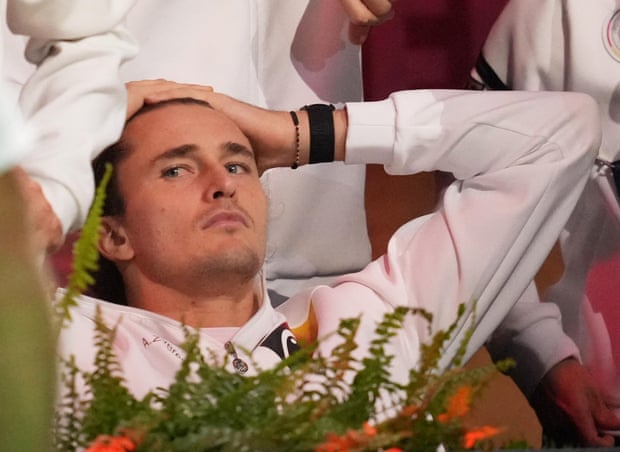
Great Britain booked their place in the semi-finals of the Davis Cup with a 2-1 victory over Alexander Zverev’s Germany in Bologna on Thursday.
The world No1, pictured above as his team went out, won his singles match as he saw off Arthur Fery, the man he beat in the Wimbledon semi-finals, 6-3, 6-2.
But that was only good enough to level the tie after Cameron Norrie had seen off Jan-Lennard Struff 6-3, 3-6, 6-2 in the opening singles.
The tie came down to the doubles which pitted Britain’s Henry Patten, the world No1 in doubles, and Neal Skupski, ranked No3, against the German pair of Kevin Krawietz and Tim Puetz.
The Britons sailed through the first set 6-2 but had to work harder in the second as it went all the way to a tie-break.
Skupski served for the match at 6-5 but a nervy volley went wide to give the German's a lifeline. His next serve was clean and gave GB their second match point.
This time a brisk cross-court backhand sealed a 6-2, 7-6 (8/7) victory to send Britain into the semis for the first time in seven years.
"It helps having a guy who can hit a return like that on match point," said Patten. "It makes it a lot easier for me."
Britain, who last won the Davis Cup with Andy Murray in 2015, will face Austria or Spain in Saturday’s semi-final.
"We regroup, we relax tomorrow and practise a little bit, and then get ready for whoever we play on Saturday," said Skupski.
Three-time reigning champions Italy will take on the Czech Republic in the first semi on Friday. AFP
Photograph: Antonio Calanni/AP
Alexander Zverev replaced Sinner as world No 1 earlier this month after the German won his first two grand slam titles at Roland Garros and the US Open.
World No 3 Carlos Alcaraz, who missed several months of action due to a wrist injury, will be the defending champion in Melbourne. The Spanish seven-time grand slam winner has enjoyed a thrilling rivalry with Sinner over the last few years and said on Wednesday that the sport is missing the Italian.
Year-end fundraiser
$0 of $2,000,000 goal
A moment full of possibility – and risk
We hope you appreciated this article. Before you close this tab, can we ask you to support the Guardian at this crucial time for democracy in the US? With Black Friday approaching, our most impactful monthly support option is just $7.50 a month for six months.
In the last two years alone, Donald Trump has eroded many of the pillars of US democracy – slashing funds for universities, undermining science, shutting down arts institutions, and attacking the free press as an “enemy of the American people” and “a threat to our national security”. While he and his allies have enriched themselves and spread lies, federal forces have harassed and imprisoned innocent people and violated the constitutional rights of many Americans.
Now, in a sweeping change election, the American people have spoken: Donald Trump, Pete Hegseth, RFK Jr, Elon Musk and the tech oligarchs may finally be held to account. A majority of American voters have demanded an end to the costly and immoral wars, the flagrant profiteering, and the corrosive attacks on communities and democratic institutions.
It’s a moment full of possibility, with more stories than we can possibly cover. New leaders are emerging from Texas and Michigan to Iowa and South Carolina – and heading to Washington to fight for affordability, against wealth inequality, and for human survival in the face of AI and the climate crisis.
These new leaders will be facing a cornered Trump and his hardline chief of staff, Stephen Miller, who have nothing left to lose. The next few years are critical for the future of the country. Journalism that covers the epic clash between these forces has a vital role to play right now.
Investigative journalism provides a fact-based paper trail for an emboldened Congress to follow. Members of Congress – and the American public – often rely on our in-depth reporting to inform the tough questions, to connect the dots and to pursue accountability for wrongdoing.
At the Guardian, our newsroom is devoted to uncovering the truth and conveying it to as many people as possible. We’re not alone in this mission, but this kind of journalism faces unprecedented hurdles: big tech threatening our financial stability and stealing our work for AI, billionaire owners telling journalists what to publish, and a hostile executive branch intent on suppressing our reporting.
The Guardian is free to dig deep without fear because we’re funded by our readers. Our readers hold us to account, and we hold the powerful to account.
However, this only works when enough of our readers contribute. Against the advice of most industry analysts, we’ve refused to put up a paywall – we believe good journalism should be freely available to all people, regardless of ability to pay. If you’re counting on our reporting, and you can’t afford to pay, please stop reading this message and go back to our articles.
If you can afford to contribute, please know that your support is not only helping yourself – from voters in Kansas to immigrants in Minnesota and families in Gaza, your generosity is bringing factual news to people around the globe.
Today is among our most important fundraising days of the year. To sustain our unique financial model, our goal is to raise $2,000,000 before the new Congress is seated on 3 January. More than 19,000 people have contributed already. All gifts are gratefully received, but for the next several days only, our most impactful monthly support option is $7.50 a month for the first six months. If you can afford 37 seconds, please join our ranks – and show your support for the rekindling of democracy in the US and around the world.
KioskNews shows a cleaned-up reading view extracted from the publisher’s page — the original always lives on their site, not ours.