Chinese microdrama distorts history: academic
POLITICAL STUNT: The state-funded drama purposely misinterprets Taiwanese history to evoke the feeling of ‘shared ancestry’ among Taiwanese, the academic said
By Chen Yun and Esme Yeh / Staff reporter, with staff writer


A Taiwanese academic yesterday slammed Chinese drama Emperor Jiaqing and the Journey to Taiwan (嘉慶君遊臺灣), saying it distorted history and promoted a cross-strait unification narrative.
The microdrama is funded and presented by Jingcai Taiwan, a Chinese state-run media platform of the Beijing Municipal Taiwan Affairs Office, with its premiere held in Beijing on Friday last week.
The Taiwanese academic, specializing in Qing and Taiwan history, said on condition of anonymity that historical records clearly show that during the more than 200 years of Qing rule over Taiwan, no Qing emperor, including Emperor Jiaqing (嘉慶), ever set foot in the nation.
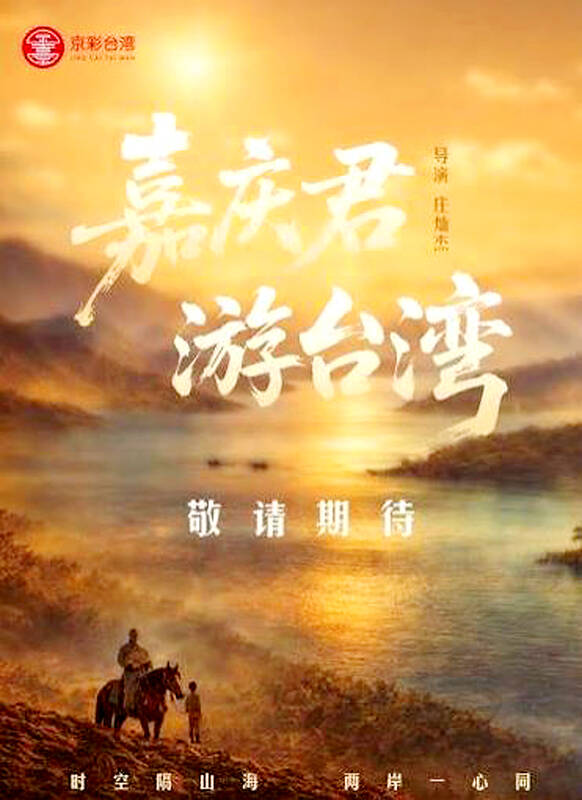
A promotional poster for the microdrama Emperor Jiaqing and the Journey to Taiwan.
Photo: Screen grab from Pekingimage’s X account
The folktale, which circulated in Taiwan in the 19th century, was similar to Chinese legends such as “Emperor Zhengde’s Tour of Jiangnan” (正德皇帝遊江南) and “Qianlong’s Tour of Jiangnan” (乾隆下江南). At their core, the stories were fictional fantasies and a form of psychological compensation born out of authoritarian rule, repression and the frustrations of the era, they said.
Taiwanese in the 19th century created the story of Emperor Jiaqing traveling secretly to Taiwan mainly because the Beijing-based Qing Dynasty adopted a repressive policy that prioritized guarding against Taiwan over governing Taiwan, the academic said.
At the time, the Qing court regarded Taiwan as a hotspot of rebellion and strictly restricted cross-strait travel with a ban on bringing family to Taiwan, as the nation was primarily populated by remnants of the previous dynasty, they said.
That resulted in severe gender imbalance and many displaced people, the academic said.
The situation was compounded by exorbitant taxation for Taiwan, exclusion of Taiwanese from official positions and the deployment of garrison forces using only troops from China’s Fujian or Guangdong provinces, they said.
The populace had no choice but to pin their hopes on the imaginary arrival of a savior monarch, they said, adding that the folktale was not only a psychological compensation during years of hardships, but a silent indictment and satire of the local officials’ tyranny.
It is not a story that sings the glory of the ruler, they said.
The Chinese Communist Party (CCP) misrepresented the folktale out of the historical context and framed it as “Taiwanese longing for the grace of the Chinese emperor,” the academic said.
That reflects China’s feudal patriarchal mindset and “celestial empire” arrogance, they added.
The CCP is naive to believe that such a soap opera would evoke the feeling of “shared ancestry” among Taiwanese, the academic said.
China’s attempt to use the micro drama to bring the two sides of the Strait closer would only backfire, the scholar said.
The political stunt not only reopens the wounds of discriminatory treatment and unequal policies imposed on Taiwan by China’s central authorities throughout history, but also demonstrates to the international community and the Taiwanese public that Beijing neither understands Taiwan’s history nor the mindset and democratic values of modern Taiwanese society, they said.
KioskNews shows a cleaned-up reading view extracted from the publisher’s page — the original always lives on their site, not ours.