Nobel Prize 2026: Three Science Discoveries That Sound Straight Out Of Sci-Fi
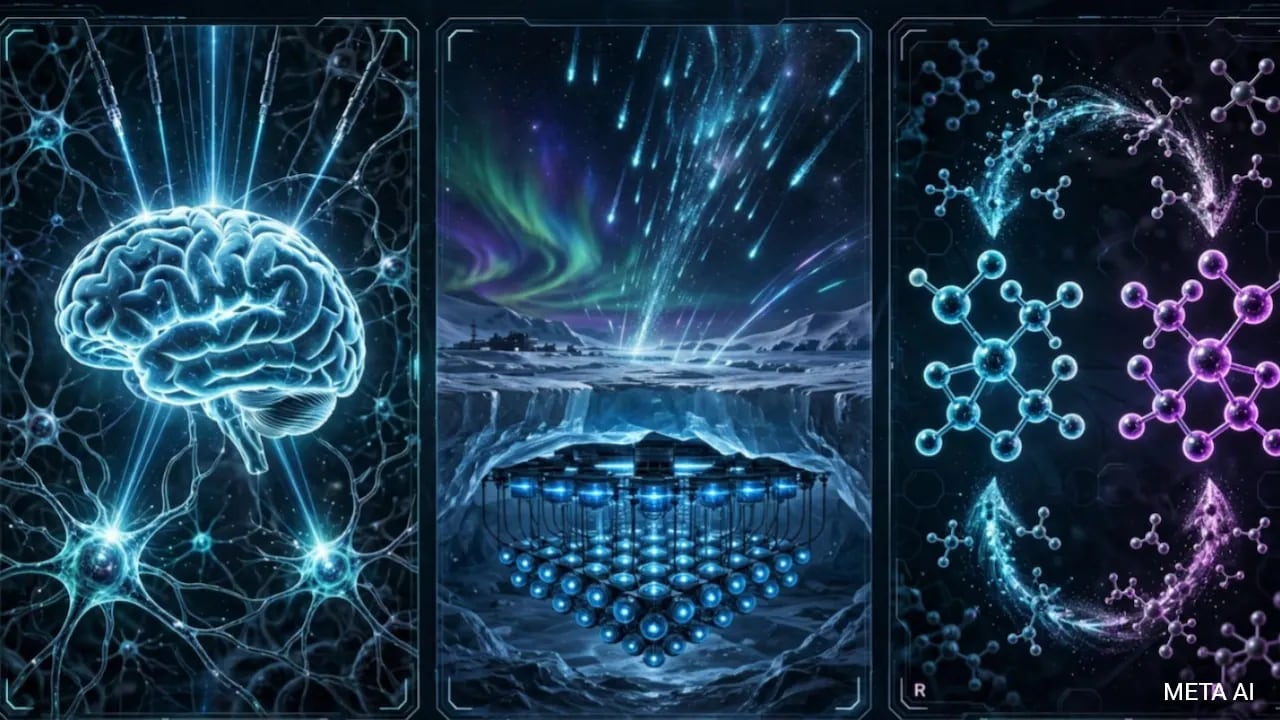
The 2026 Nobel science prizes have recognised discoveries that mirror something straight out of sci-fi films. This year's Nobel science winners were honoured for their research on tiny particles from space, using light to control brain cells, and studying mirror-image molecules.
Nobel Prize in Physics
Nobel Prize in Physics has been awarded to Francis Halzen for his work on the IceCube Neutrino Observatory, a giant detector built into the ice near the South Pole.
The observatory is designed to detect neutrinos, tiny particles that rarely interact with ordinary matter. This allows them to travel through space and matter over long distances without being easily detected.
BREAKING NEWS The Royal Swedish Academy of Sciences has decided to award the 2026 #NobelPrize in Physics to Francis Halzen “for decisive contributions to the IceCube Neutrino Observatory and the discovery of high-energy neutrinos of astrophysical origin.” https://t.co/UcPBWk0RiK
— The Nobel Prize (@NobelPrize) October 6, 2026
Neutrinos are found throughout the universe. The Sun produces them through nuclear reactions, and billions of them pass through our bodies every second without us noticing. Detecting these particles is difficult because they have no electric charge and rarely interact with ordinary matter.
Halzen realised in the 1980s that scientists could use these particles to study some of the universe's most powerful objects. The challenge was to build a detector large enough to catch them. Construction of the IceCube observatory began in 2004 and was completed in 2011. Within two years, it had detected 28 high-energy cosmic neutrinos.
Nobel Prize in Physiology or Medicine
Nobel Prize in Physiology or Medicine has been awarded to Karl Deisseroth, Peter Hegemann and Georg Nagel for their research on using light to control brain cells.
BREAKING NEWS The 2026 #NobelPrize in Physiology or Medicine has been awarded to Karl Deisseroth, Peter Hegemann and Georg Nagel “for their discoveries concerning light-gated ion channels and optogenetics.” https://t.co/pkDDEBWtkz
— The Nobel Prize (@NobelPrize) October 5, 2026
The research began in the 1990s when Hegemann was studying a type of single-celled algae called Chlamydomonas. He noticed that the algae responded to light much faster than the human eye. He suspected that the algae had a special protein that helped them react quickly to light. With the help of Nagel, he studied two genes that produced light-sensitive proteins.
The researchers later found that these proteins could make cells respond to light. Deisseroth then came up with the idea of using one of these proteins in neurons, the cells that carry electrical signals in the brain.
When the neurons were exposed to light, they responded and passed signals to nearby cells. This showed that scientists could use light to control the activity of brain cells.
Scientists now use it to study conditions such as depression, schizophrenia, dementia, anxiety and addiction. They are also exploring whether it could help restore vision in people with certain types of blindness.
Nobel Prize in Chemistry
Nobel Prize in Chemistry has been awarded to Henri Kagan of the University of Paris-Saclay and Kenso Soai of the Tokyo University of Science for their work on mirror-image molecules, called chirality. It refers to a property in which a molecule and its mirror image cannot be perfectly placed on top of each other. The two forms are similar to a person's left and right hands.
BREAKING NEWS The Royal Swedish Academy of Sciences has decided to award the 2026 #NobelPrize in Chemistry to Henri B. Kagan and Kenso Soai “for the discovery of non-linear effects and autocatalysis in asymmetric organic synthesis.” https://t.co/nH090ql1Xc
— The Nobel Prize (@NobelPrize) October 7, 2026
For example, amino acids, which make up proteins, are generally left-handed, while sugars used by living organisms are right-handed. Scientists have long tried to understand how this difference developed.
Kagan made an important discovery in 1986. He showed that chemical reactions could increase the difference between the two forms of a molecule beyond what scientists had expected.
Soai took the research further in a study published in 2003. He showed that even a very small difference between the two forms could grow much larger through repeated chemical reactions. In one example, repeating a reaction three times increased the imbalance between the two forms by 630,000 times.
This year's Nobel-winning research shows how scientists are finding new ways to answer questions that once seemed impossible to solve.
KioskNews shows a cleaned-up reading view extracted from the publisher’s page — the original always lives on their site, not ours.