Food meets art, books greet readers at Iranian Mehfil Cafe, once a library storage
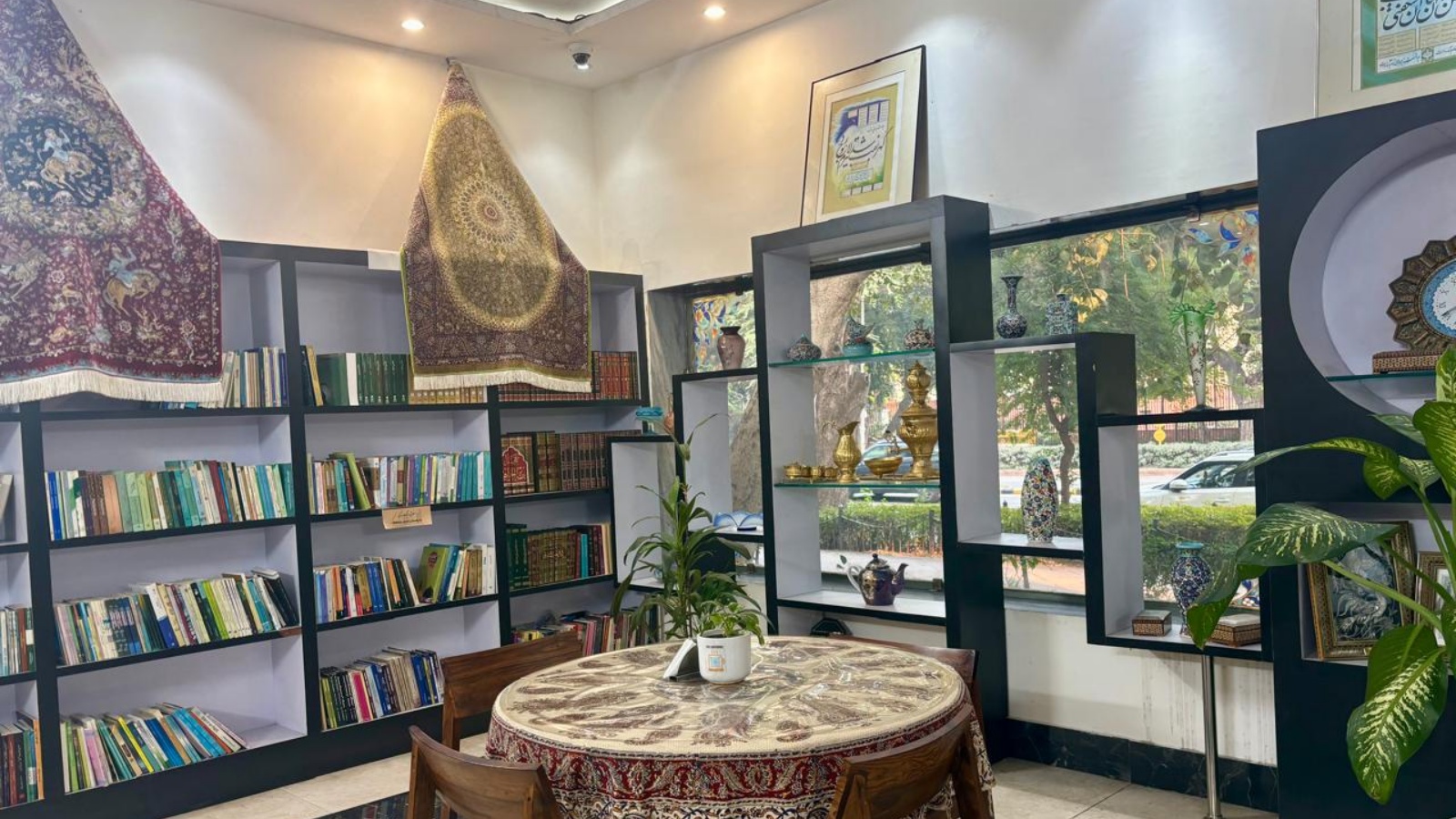
Through the glass window, the ceramics are a little blurry, but the colours catch the eye. Behind it, a group of people sit at a table. The books on the shelves behind them are stocked in order, and the lights on the ceiling reflect on the paintings.
At Irani Mehfil Cafe, there are white concentric circles on the ceiling. A vivid ring of green traces the outer edge, while another illuminated red circle sits at the core. Separated by the white plaster of the inner rings, the colours of the Iranian flag glow above the tables.
“In Iran, everything is artistic,” says the owner and founder of the cafe, Mehdi Shirmohammadi, and this ceiling and the decor of the cafe are proof.
Six tables are widely spread, enough to navigate through the space comfortably. A hot Persian herbal saffron tea sits on the table occupied by two young men with its wispy steam condensing on the glass pot.
The cafe is located at the Iran Culture House, inside the cultural wing of the Embassy. Close to the India Gate, the Supreme Court, and the Delhi College of Art, it witnesses a steady stream of tourists, lawyers, students, and government officials.
The space is small and intimate. The chef, Viketou, stands at the kitchen counter, making a cheesy chicken burger. “We get orders for a lot of continental dishes. Among the Iranian items, the herbal teas are the most ordered. The Iranian falafel as well,” he says, adding that Sholeh Zard, which is only available on Mondays, Tuesdays, Thursdays and Fridays, is the most favourite dessert.
Sholeh Zard is one of Iran’s most iconic saffron rice puddings, with a silky texture. There are still limited Iranian dishes on the menu. Continental dishes were added on the request of customers who frequent the cafe. “I want to expand the cafe and introduce a lot more Iranian dishes. But for that, we need a proper kitchen as the cuisine’s preparation time is quite long,” says Shirmohammadi.
With roughly 600 books lining the shelves and a small archive of rarer volumes, the cafe opened about 14 months ago. Before this, the room held only books. It was a book storage, a part of a much larger library that was run inside the Iran Culture House. It was a closed space, and one requires permission to enter.
Story continues below this ad
About two years ago, Dr Fariduddin Faridasr, the Cultural Counsellor for the Embassy of the Islamic Republic of Iran in India and Head of the Iran Culture House in New Delhi, was looking for a way to introduce people to Iranian culture. Shirmohammadi, who had come to India to start a dry fruit business, was pulled into the conversation. He had two plans, but was too busy with his own business to execute those. But there was no one who could work on the plans.
Two months later, Shirmohammadi was ready to invest. But he had a condition: the cafe should be open to the public and the security policies should be changed.
What was once a sealed storage space became Irani Mehfil — a place where people can read and buy books, and eat.
Shirmohammadi holds a PhD in economics, and his family runs a dry fruit business — a popular trade in Iran. He came to India to start his own brand, Shiro, and built packaging and cold storage facilities for it. He also runs a travel agency. But the cafe allowed him to bring a different side of his culture to the city.
“Mehfil,” Shirmohammadi says, “in Farsi, means a place for a warm gathering.”
Story continues below this ad
He aims at dispelling the propaganda built around his country, “Iran, like India, is a big country with different religions, different cultures, different languages. The North of Iran is a lush, green region filled with rice farms, while the Northwest is a cold, mountainous region where temperatures drop down to -26°C,” he says, sitting at the cafe with a blueberry shake.
The war and sanctions in his country, however, have weighed heavily on his life and business. A direct flight from Delhi to Tehran no longer exists, forcing him to travel through Moscow with an 11-hour layover just to see his family. Importing and exporting goods, on which his dry fruits business relies, is now a hassle.
When the war began, instead of fleeing, the Iranian diaspora — including Shirmohammadi and his wife — tried desperately to find a way back. “When the war started, all of us wanted to go back to Iran,” he says. “Our parents are there … All of our people are our family.” For him, the political divisions fade when the country is under attack. “If you ask any Iranian, we die for our country,” he says. “Iran is our main brand.”
Irani Mehfil Cafe also plans to host storytelling events that explore Iran’s diverse culture — highlighting distinct foods, architecture, clothing, and agricultural traditions across regions. “We will also be looking at putting some Iranian handicrafts for sale,” Shirmohammadi adds. While currently, rugs collected by Shirmohammadi hang above the bookshelves — some draped from the ceiling like tents — the walls are lined with framed Persian calligraphy. Inside glass cabinets, turquoise-inlay plates and brightly coloured vases catch the light.
Story continues below this ad
A favourite of Shirmohammadi is a half-silk rug painted by Mahmoud Farshchian, an artist whose works are considered a pinnacle of Persian art. There is also a heavy, richly illustrated book of Farshchian’s paintings. Many books in Farsi also occupy the shelves. The Culture House holds weekend Farsi classes, and students from Delhi University and Jamia who attend often come looking for Persian books.
KioskNews shows a cleaned-up reading view extracted from the publisher’s page — the original always lives on their site, not ours.