Senegal, Morocco replay their title match in court
Senegal and Morocco played a chaotic Africa Cup of Nations final in January and they were contesting the title again yesterday — this time at the Court of Arbitration for Sport.
A turbulent match, provoking violent clashes between Senegal fans and Moroccan police, and a controversial fallout was being relitigated at sport’s highest court in Switzerland nearly nine months after the referee’s final whistle blew in Rabat.
The authority of that referee, Jean-Jacques Ndala of the Democratic Republic of the Congo, could be decisive in Senegal’s appeal to regain the trophy that was stripped from players who earned it on the field of play with a 1-0 win over Morocco after extra-time.
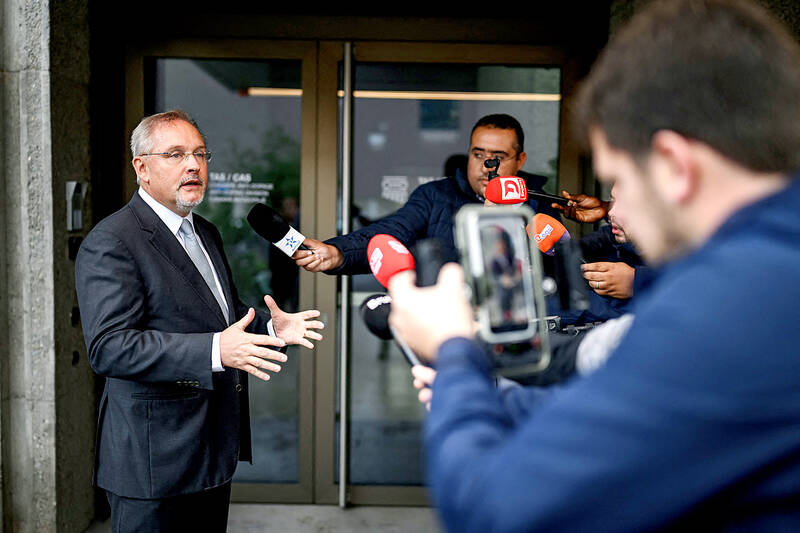
Court of Arbitration of Sport director-general Matthieu Reeb speaks to media in Lausanne, Switzerland, yesterday.
Photo: AFP
The result was overturned in March to a 3-0 win for Morocco by a Confederation of African Football (CAF) appeals panel because Senegal’s team walked off to protest a penalty being awarded, causing a 15-minute delay in play.
A one-day appeal hearing was scheduled with three judges behind closed doors yesterday at CAS’ headquarters in Lausanne.
No target date has been set by the court for a verdict that should finally crown the champions of African men’s soccer. The next Africa Cup of Nations tournament is scheduled to start in June next year, cohosted by Kenya, Tanzania and Uganda.

Royal Moroccan Football Federation Secretary-General Tarik Najem arrives at the Court of Arbitration for Sport in Lausanne, Switzerland, yesterday.
Photo: AFP
Leaders of the Senegalese and Moroccan soccer federations were expected to skip the hearing that clashes with a three-day CAF soccer summit in Cape Verde being attended by FIFA president Gianni Infantino.
Soccer’s rule book, The Laws of the Game, is clear about the referee’s decisionmaking power.
“The decisions of the referee regarding facts connected with play, including whether or not a goal is scored and the result of the match, are final,” Law 5.2 states.
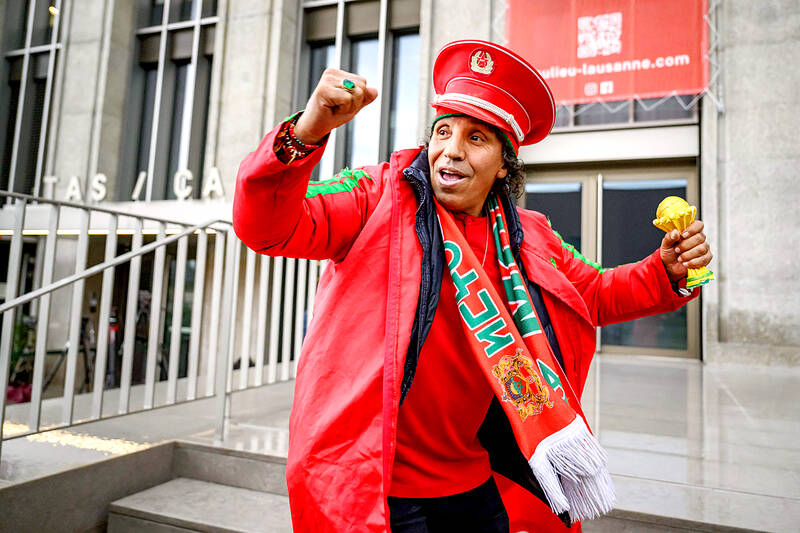
Moroccan supporter Noureddine Falah holds a replica Africa Cup of Nations trophy outside the Court of Arbitration for Sport in Lausanne, Switzerland, yesterday.
Photo: AFP
Senegal beat hosts Morocco in a game eventually completed to referee Ndala’s satisfaction, despite the chaos.
The referee restarted play once Senegal’s players had returned to the field after protesting a penalty-kick awarded to Morocco deep in stoppage-time.
Before the referee could decide to abandon the game, which would have gifted the title to Morocco, Senegal’s Sadio Mane helped persuade his team to finish the game as tensions rose in the stadium.
The game restarted with the spot-kick that could have won Morocco a first title since 1976.
What Brahim Diaz did next entered soccer history. The Real Madrid forward placed a delicate slow chip shot, designed to deceive the goalkeeper who typically dives to one side and watches the ball slowly arc into the middle of the goal.
Senegal goalkeeper Edouard Mendy stood up straight and easily caught the ball.
The game went into extra-time and four minutes later Senegal midfielder Pape Gueye surged forward to fire a rising shot into the Morocco net. It was the only goal.
More than US$1 million in total fines for the two federations, plus players and Senegal coach Pape Thiaw, were imposed 11 days after the game by Cairo-based CAF disciplinary judges.
The judges dismissed a request by Morocco to have the result annulled and be declared the winners because of the Senegalese walk-off.
There were appeals to CAF and, two months after the final, Senegal were ruled to have forfeited the game.
CAF appeal judges cited tournament rules that if a team “refuses to play or leaves the ground before the regular end of the match without the authorization of the referee, it shall be considered loser and shall be eliminated for good from the current competition.”
Senegal’s government promised to help “pursue all appropriate legal avenues” to regain the title and called for an investigation “into suspected corruption” within African soccer.
The case fueled the sense that 2030 FIFA World Cup cohost Morocco has extensive influence within CAF and FIFA.
KioskNews shows a cleaned-up reading view extracted from the publisher’s page — the original always lives on their site, not ours.