SME association says Budget 2027 offers support, but warns of ‘cumulative’ cost pressures
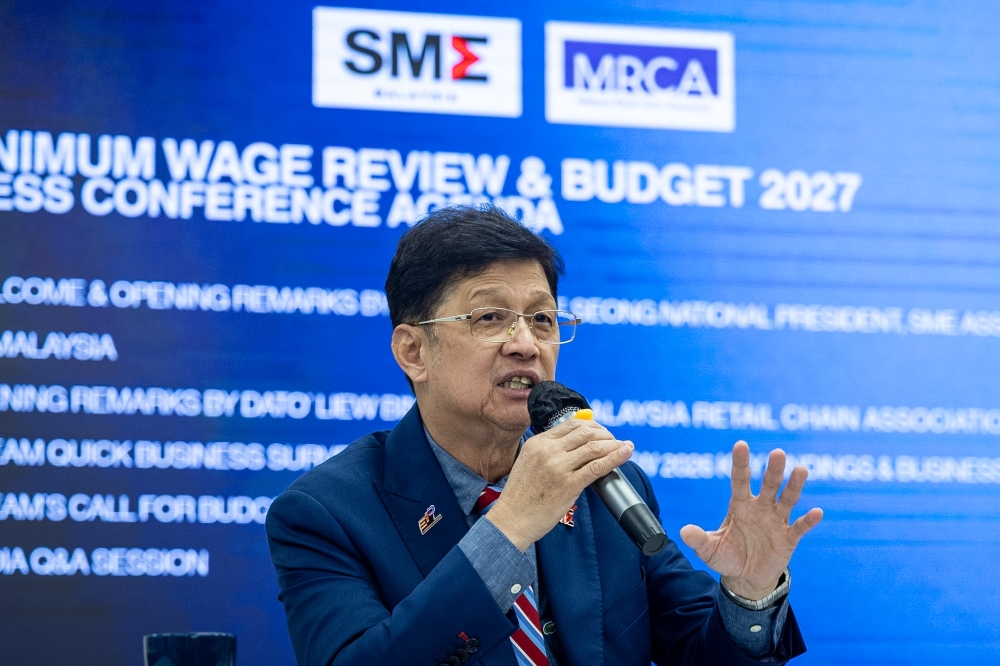

SME Association of Malaysia national president Dr Chin Chee Seong speaks during a joint press conference with the Malaysia Retail Chain Association (MRCA) on minimum wage at Menara G-Vestor in Kuala Lumpur on October 2, 2026. — Picture by Firdaus Latif
By Milad Hassandarvish
First Published: Saturday, 10 Oct 2026 10:28 AM MYT
KUALA LUMPUR, Oct 10 — The Small and Medium Enterprises (SME) Association of Malaysia has welcomed the government’s Budget 2027 initiatives aimed at bolstering domestic consumption and promoting investment but cautioned that the cumulative cost of doing business remains the sector's most significant hurdle.
The association's president Chin Chee Seong said that while the Budget introduces various measures to support businesses, the government must ensure these initiatives deliver measurable improvements to SME cash flow, productivity and competitiveness.
“SMEs are not asking simply for more money. We are asking for policies that deliver real and measurable results,” Chin told Malay Mail following the Budget announcement yesterday.
“Judge the Budget by actual outcomes, not the amount of money allocated. We must look at how many SMEs genuinely benefit, how many jobs are sustained, and whether Malaysian businesses become more productive, resilient, and competitive.”
Regarding the minimum wage increase from RM1,700 to RM2,000, Chin welcomed the exemption for micro, small and medium enterprises (MSMEs) with annual sales below RM50 million.
However, he warned that smaller businesses would still face indirect cost pressures through supply chains.
“The 17.6 per cent wage increase could affect business margins, hiring, consumer prices, and employment.
“Higher wages must not come at the expense of jobs, business survival, and competitiveness,” he said, calling for a phased, sector-sensitive implementation supported by productivity improvements.
On the corporate tax reduction, Chin noted that the one-percentage-point cut provides limited relief, with maximum annual savings of RM6,000 — equivalent to RM500 monthly — which he argued does little to offset rising operating expenses.
“SMEs need direct operating-cost relief and better cash flow, not just lower taxes,” he added.
Chin also addressed the funding allocated for artificial intelligence (AI) and automation, as well as technical and vocational education and training (TVET).
While appreciative of the RM30 million allocation for 4,000 SMEs for AI and automation, he suggested the average allocation of RM7,500 per enterprise might be insufficient for meaningful transformation.
“AI success must be measured by actual cost savings, efficiency improvements, and productivity gains, not adoption numbers alone,” he stated.
Similarly, regarding the RM8 billion TVET allocation, he urged the government to allow businesses to participate directly in curriculum design and practical training to ensure the output matches industry needs in sectors such as electrical and electronics, precision manufacturing and logistics.
The association also raised concerns regarding financing.
While welcoming the increase in total loans and financing guarantees from RM50 billion to RM57 billion, Chin pointed out that strict eligibility requirements and slow approvals remain persistent barriers.
“Financing availability means little if SMEs cannot access it when needed. We urge the government to strengthen SJPP and CGC guarantees, simplify applications, and accelerate approvals,” he said.
Ultimately, Chin stressed that the business community faces simultaneous pressures from rising costs in utilities, rental, logistics and compliance.
He proposed that the government conduct a “cumulative SME cost and regulatory impact assessment” before implementing future major policy changes.
Chin also called for stronger enforcement against non-compliant foreign e-commerce sellers, including checks on import declarations, tax payments, SIRIM compliance and product safety standards to safeguard local businesses.
“We welcome foreign competition, but Malaysian SMEs must compete on a level playing field,” he said.
KioskNews shows a cleaned-up reading view extracted from the publisher’s page — the original always lives on their site, not ours.