The $3.74 Task: Why Grok 4.7’s Cheap Rate Card Isn’t A Cheap Bill
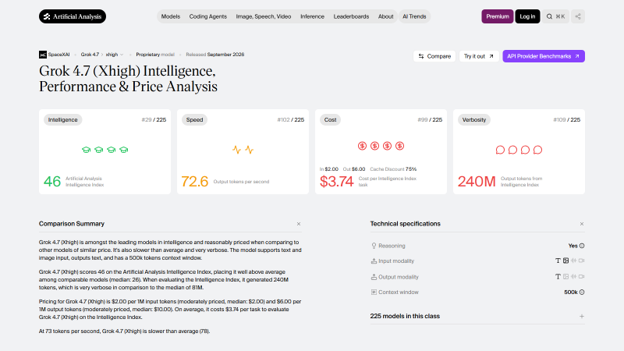
Grok 4.7 carries the cheapest headline output rate in its comparison set — $6 per million tokens against $10 and $50 for the OpenAI models here — and a finished task on it costs $3.74, more than five times what a task costs on GPT-6.1 Sol at the *same $2 input rate*. Grok 4.7 pricing is carried here at list rate with no markup, so the arithmetic below is the arithmetic of the rate card rather than of a reseller’s margin.
Both numbers are real, both are from the same independent harness at the same read date, and the gap between them is the most expensive misreading in this series.
Two ways to price a model, and which one budgets from
A rate card prices a token. A bill prices a task. The two are connected by a quantity — how many tokens a task consumes — and that quantity is not on the rate card, is not in the vendor’s marketing, and is not the same between two models that look similar on paper.
| Grok 4.7 | GPT-6.1 Sol | |
| input rate (per M) | $2.00 | $2.00 |
| output rate (per M) | $6.00 | $10.00 |
| cost per finished task | $3.74 | $0.72 |
| of which input tokens | $3.255 | $0.343 |
Watch: Super Eagles Review: Talking Points From AFCON Qualifiers And Russia Friendly
Read the first two rows, then the third. The input rate is identical. The output rate favours Grok 4.7 by a wide margin. And the task costs five times more.
The fourth row explains it. Of Grok 4.7’s $3.74, $3.255 is input tokens — about 87% of the bill sits on the side of the card where the two models charge the same price. Sol spends $0.343 on the same line. Multiply either by the same $2 and the difference is entirely a difference in how many input tokens each model consumes to finish a task, not in what it charges for them.
That is the whole inversion. A model with a cheaper rate card can be the more expensive model to run, and the mechanism is quantity rather than price.
Why the output rate barely matters here
There is a second surprise in the same table, and it runs the other way.
If input is 87% of the bill, then the headline number most comparisons lead with — the output rate — is doing almost none of the work. Grok 4.7’s $6 output rate against GPT-6.1 Sol’s $10 is a real advantage, and on this harness it is worth about five cents of the $3.74. The remaining three dollars and sixty-nine cents are decided by input volume and by that identical $2 rate.
The same arithmetic explains something that otherwise looks like an error. GPT-6 Astra charges $10 in and $50 out — five times Grok 4.7’s input rate and more than eight times its output rate — and on the same harness its cost per finished task is $3.26, slightly *below* Grok 4.7’s $3.74.
A model charging eight times as much per output token delivering a cheaper task is not a paradox. It is the quantity effect again, running in the opposite direction: Astra consumes far fewer tokens to finish the same task, and on a per-task basis the two land within about 15% of each other. Quote the rate cards side by side and Astra looks unaffordable; price the task and the gap nearly disappears.
Which model this leaves as the actual outlier is worth stating plainly. On the same board, read 2026-10-07, the four comparison models price per finished task at:
| model | per-task cost |
| GPT-6.1 Sol | $0.72 |
| GPT-6 Astra | $3.26 |
| Grok 4.7 | $3.74 |
| Claude Opus 5.5 | $5.98 |
Grok 4.7 has the cheapest rate card in that set and the third-cheapest task. Sol, on the same input rate, is five times cheaper per task. That is the finding, and no amount of rate-card comparison surfaces it.
The comparison that matters most is the predecessor
If you are migrating rather than starting fresh, the relevant question is what the move costs, and here the picture is unusually clean.
Grok 4.6 carried the same $2 and $6 rates — the card did not change between the two rungs at all. The per-task cost did: $1.48 on the predecessor against $3.74 on Grok 4.7, read 2026-10-07, a factor of about 2.5.
A version bump with an identical rate card and a 2.5× larger bill is the clearest possible statement of the point this article is making: the price of a token held still while the number of tokens a task consumes went up. Anyone budgeting a Grok 4.6 migration from the rate card — where nothing changed — would have budgeted for no cost increase and got one of two and a half times.
Four checks before you budget a Grok 4.7 workload
Four checks, ordered by how much of the bill each one moves.
Convert the rate card to a task before you compare anything. Pick three tasks you already run, count the tokens each consumes, and price them at both rates. A comparison built on rates alone will rank these four models in almost the opposite order to their real cost.
Look at the input side first. It is 87% of the bill here. Optimising output — shorter answers, tighter max-tokens settings — moves the small number. Prompt assembly, tool schemas and conversation history move the large one.
Price the migration, not the model. If you are coming from Grok 4.6, the rate card tells you nothing changed and the harness says the bill rose about 2.5×. Budget from the second number.
Re-measure on your own traffic. Every figure above is a task decomposition chosen by somebody else’s harness. Your tasks may consume a different multiple. An afternoon of counting tokens on your own logs beats any table in this article.
The takeaway
Grok 4.7 charges $2 in and $6 out per million tokens — the cheapest headline output rate in its comparison set — and costs $3.74 to finish a task on the independent harness, read 2026-10-07, against $0.72 for GPT-6.1 Sol at the identical input rate. About 87% of that $3.74 is input tokens, at a rate the two models share, so the difference is quantity rather than price. GPT-6 Astra, charging more than eight times Grok 4.7’s output rate, finishes a task for $3.26 — less.
A cheap rate card is not a cheap bill, and the models that look most expensive on a rate card can be mid-pack on a task. The Grok 4.6 predecessor makes the same point in one line: the card did not move, and the per-task cost rose about 2.5×.
Compare these models on a task you actually run. The rate card is where you start the arithmetic, not where you finish it.
OrcaRouter carries Grok 4.7 at list rate on the same key as the rest of the xAI line, so pricing a real task across all four of these models is a model-string change rather than four integrations.
Sourcing note: the per-task costs ($3.74 for Grok 4.7, $0.72 for GPT-6.1 Sol, $3.26 for GPT-6 Astra, $5.98 for Claude Opus 5.5, $1.48 for Grok 4.6), the input-token components of $3.255 and $0.343, the approximately 87% input share, the roughly five-cent output-rate difference and the 2.5× predecessor ratio are from Artificial Analysis’ live pages, read 2026-10-07. The $2 / $6 rates for Grok 4.7, the $10 / $50 rates for GPT-6 Astra and the unchanged Grok 4.6 rates are the vendors’ own published claims. The reading that the per-task divergence is a quantity effect rather than a price effect, the observation that the output rate contributes a negligible share of the bill at this token mix, and the conclusion that a rate card orders these models differently from their real cost are this article’s own analysis of those published figures. All checked 2026-10-07; re-check before 2026-11-01.
KioskNews shows a cleaned-up reading view extracted from the publisher’s page — the original always lives on their site, not ours.