Many Ramayanas in Malayalam cinema: One would be banned today, one from Bharata’s POV
Ever since early reports surfaced a few years ago that the Hindu epic Ramayana was poised to get a grand Bollywood adaptation, one thing was certain: it would create massive headlines, and definitely not just for the best of reasons. While one section was sure to be excited to catch the spectacle on the big screen, some would take offence at the “misportrayal” of the Ramayana, arguing that the depiction of certain events or characters wasn’t “accurate.”
As director Nitesh Tiwari’s Ramayana: Part 1 gears up for release, social media is already flooded with such discussions. From Ranbir Kapoor’s look as Rama to Sai Pallavi’s styling as Sita, many aspects of Ramayana have drawn ire even before the epic mythological actioner’s release.
Memories of Blunder | Sakthi: ‘A1 star’ NTR Jr’s masterclass in going from 0 aura points to -1,000 effortlessly
While many use the term “accuracy” to criticise Ramayana — with comparisons mainly to Ramanand Sagar’s epic television series Ramayan (1987) — one can’t help but ask: which Ramayana is “the one”? Besides, this issue arises when the Ramayana is approached as a story, tale, or even “history,” as some claim. When focusing on the content, it becomes clear that there isn’t one Ramayana, but many.
Early Malayalam adaptations of Ramayana
For instance, although Malayalam cinema has rarely produced out-and-out adaptations of the epic, the industry has created interpretations of the Ramayana that focus more on its content, philosophy and essence than on its story.
Since it was a small industry with a limited market, Malayalam cinema couldn’t afford to adapt the Ramayana with the production quality the story deserved for a long time. A look at the two early movies based on the epic underscores this.
Director-producer Kunchacko and his Udaya Studio’s Seeta (1960) is arguably the earliest adaptation of the Ramayana in Malayalam. However, the movie, starring Prem Nazir and Kusalakumari in the lead roles, explores Rama and Sita’s lives after their return from 14 years of exile following the battle against Ravaṇa, and Rama’s subsequent abandonment of Sita. An overly dramatic film, it also placed significant emphasis on the music composed by V Dakshinamoorthy.
Story continues below this ad
In two years, Udaya Studio’s rival Merryland Studio released Sreerama Pattabhishekam (1962), which touches upon all the key plot points in Rama’s story, ranging from the Sita Swayamvar and their 14-year exile in the forest to the kidnapping of Sita by Ravana, the battle at Lanka, and Rama’s coronation upon his return to Ayodhya.
Helmed by GK Ramu under the supervision of Merryland Studio’s owner Subramaniam, Sreerama Pattabhishekam offers a more comprehensive, less dramatic take on the epic, with stronger production design and performances. It primarily follows the popularly accepted story of Rama as narrated in the Valmiki Ramayana and portrays him more as a righteous king than a god. Nevertheless, Malayalam cinema did not stop there.
How many Ramayanas are there?
In his widely acclaimed essay “Three Hundred Ramayanas: Five Examples and Three Thoughts on Translation,” renowned translator, folklorist, and poet AK Ramanujan points out that the “Rama story” exists in languages such as Annamese, Balinese, Bengali, Cambodian, Chinese, Gujarati, Javanese, Kannada, Kashmiri, Khotanese, Laotian, Malaysian, Marathi, Oriya, Prakrit, Sanskrit, Santali, Sinhalese, Tamil, Telugu, Thai, and Tibetan, among others. Besides, it exists in multiple forms such as kavya, puranas, and more. However, he prefers to call them “tellings,” and he has a very specific reason behind this choice.
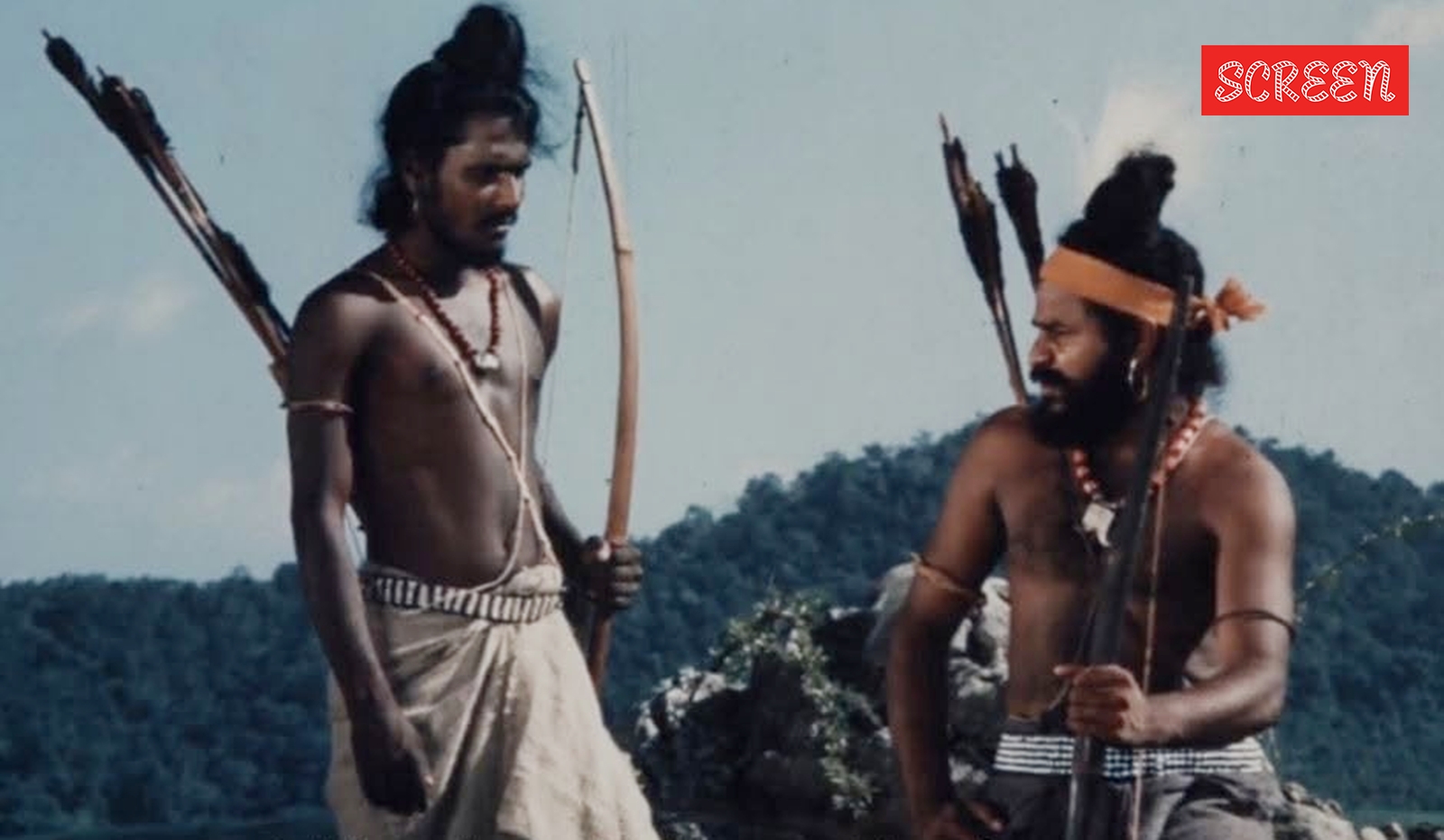 A still from Kanchana Sita. (Screenshot: YouTube/potatoeaterscollective)
“I have come to prefer the word ‘tellings’ to the usual terms ‘versions’ or ‘variants’ because the latter terms can and typically do imply that there is an invariant, an original or Ur-text — usually Valmiki’s Sanskrit Ramayana, the earliest and most prestigious of them all. But it is not always Valmiki’s narrative that is carried from one language to another,” he points out.
Story continues below this ad
Explaining further, Ramanujan states that in Valmiki’s telling, Rama’s character “is that not of a god, but of a god-man who has to live within the limits of a human form with all its vicissitudes.” In contrast, in Kampan’s telling, “he is clearly a god,” influenced by the Tamil bhakti tradition.
Kanchana Sita: Re-imagining Rama without grand spectacle
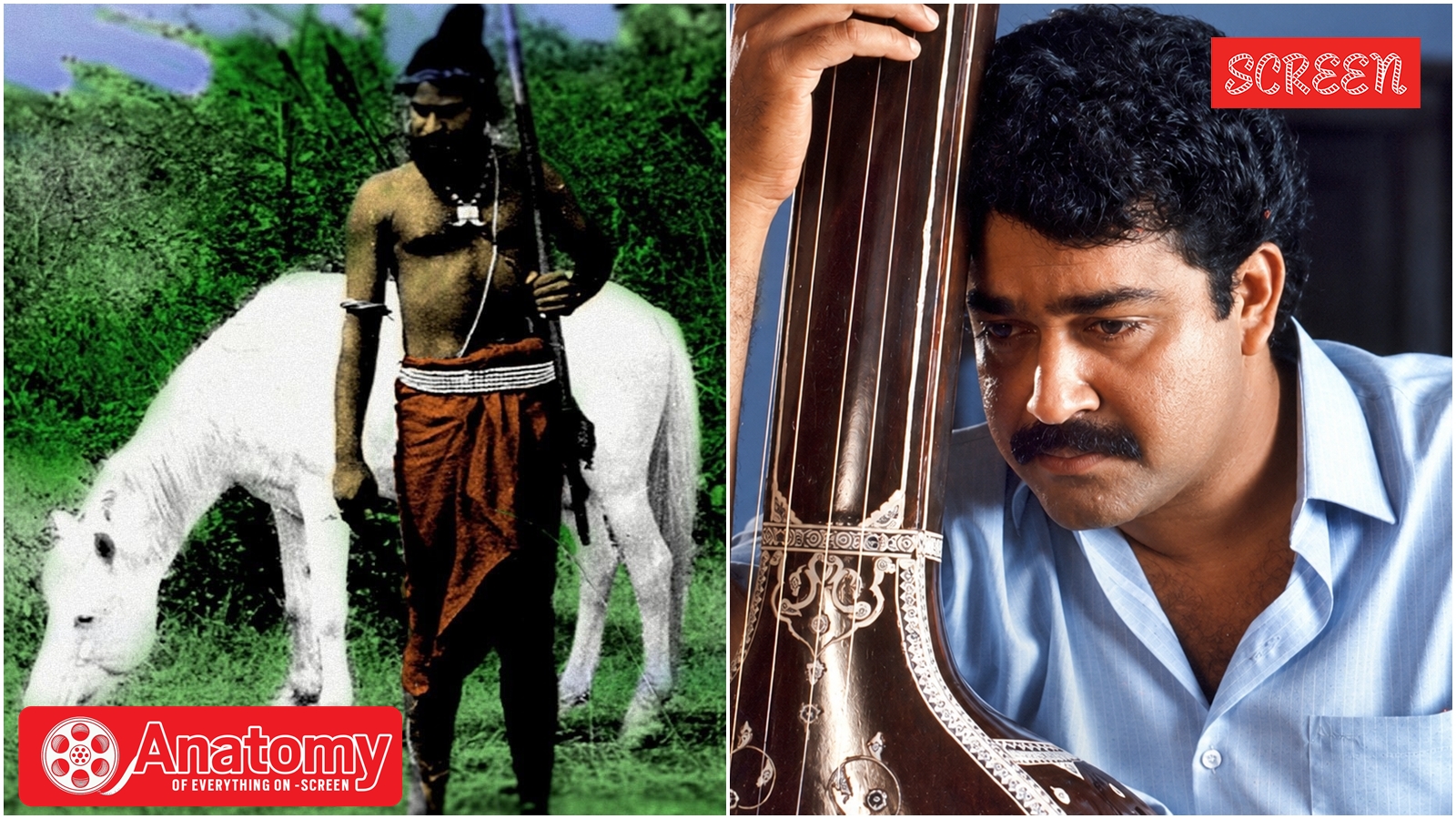
Cinema auteur G Aravindan’s Kanchana Sita (1977), adapted from CN Sreekantan Nair’s play of the same name, is one of those rare Indian movies that can be called an absolute “re/telling of the Ramayana.” One of the most powerful films based on the epic, Kanchana Sita is a testament to the power of cinema and imagination. There’s no Ravana in the movie, nor Hanuman. Interestingly, we don’t even see Sita, although the film is named after her.
Yet, Aravindan makes her presence felt throughout the film through nature, allowing the audience to sense her in the wind and the sounds of the surroundings. Kanchana Sita focuses more on Rama’s internal battle after abandoning Sita, which is depicted as heavier for him than the one he fought at Lanka. “The King’s throne is a hearth of fire. Sita’s husband is only a servant of the public,” he says, highlighting the real reason behind his decision.
His actions aren’t glossed over. Urmila, Lakshmana’s wife, indirectly denounces him. Bharata, the younger half-brother of Rama, raises his voice at the latter for abandoning Sita. “My sword would have been the reply to all those who call a woman like Sita unfaithful,” Bharata tells Rama, emphasising how he should have fought such claims. “I cannot accept your interpretation of Rama Rajya,” Rama replies, underscoring that “Rama Rajya” isn’t a fixed idea. “The Rama who could sacrifice Sita is powerful enough to sacrifice anything,” he adds, as a strong breeze envelops them, exemplifying Sita’s presence.
Story continues below this ad
According to a 2014 report by The Hindu, the roles of Rama, Lakshmana, and others were played by tribal people belonging to the Rama Chenchu community, which claims lineage to Rama. Kanchana Sita was shot in the forests on the banks of the Godavari River in Andhra Pradesh. Shaji N Karun’s masterful cinematography features picturesque, empty wide shots in which Rama appears as a tiny human traversing seemingly endless rocky terrain.
This is particularly fascinating as, in the latest adaptations of the Ramayana, including the Nitesh Tiwari directorial, frames are never allowed to remain vacant. They are filled with props, people, or VFX, simply to flaunt grandeur without serving any real purpose.
However, it’s doubtful anyone would even dare to create something like Kanchana Sita now, where dark-skinned tribals play Rama and others — defying savarna norms — and they don’t possess any so-called godly powers, don’t engage in battles all the time, or deliver overly philosophical and quotable lines. Considering where Indian society stands now and how hypersensitive the right-wing is about the Ramayana and all things Rama, it’s not an overstatement to say that Kanchana Sita would have been banned — or at least stuck in a web of censorship troubles, with no possibility of escape for the longest time — had it been made today.
The art of capturing the soul of Ramayana
Another significant retelling of the Ramayana in Malayalam cinema is director Sibi Malayil’s musical drama Bharatham (1991), penned by AK Lohithadas. Rather than directly drawing from the story, the movie picks up the core idea of a man, Bharata, having to take over the kingdom after his elder brother, Rama, steps away. It not only focuses on Bharata’s struggle to live up to his brother’s legacy but also explores the emotional toll of filling his brother’s shoes.
Story continues below this ad
Bharata here is Kalloor Gopinathan (Mohanlal), while Rama is Kalloor Ramanathan (Nedumudi Venu), both of whom are Carnatic singers, and the “kingdom” is their family. However, unlike the Ramayana, Gopinathan is forced to step into his brother’s shoes when Ramanathan falls into alcoholism and fails to keep his commitments. Lohithadas also introduces elements of the Perumthachan complex, as Ramanathan becomes jealous of Gopinathan when all eyes are on the latter and no longer on him. Mohanlal, who produced the movie, earned his first National Film Award for Best Actor for his performance here.
Lohithadas explored the Ramayana once again in his directorial venture Chakram (2003), starring Prithviraj Sukumaran and Meera Jasmine in the lead roles. Here too, he drew not from the story, but from the essence of the Ramayana, showing how far a man would go to save the love of his life, no matter what evil he must battle.
In a way, Malayalam cinema has consistently shown that the true strength and significance of the Ramayana lie in its soul, not its flesh and bones. Even then, the industry has never reimagined the epic from the perspectives of Sita or Ravana, not even to the extent of Mani Ratnam’s Raavan/Raavanan (2010).
Cinema cannot exist in a vacuum; it’s all about the discussions that follow. In the Cinema Anatomy column, we delve into the diverse layers and dimensions of films, aiming to uncover deeper meanings and foster continuous discourses.
KioskNews shows a cleaned-up reading view extracted from the publisher’s page — the original always lives on their site, not ours.