STUDENT SUCCESS: UCT medical student wins top award but debt threatens graduation
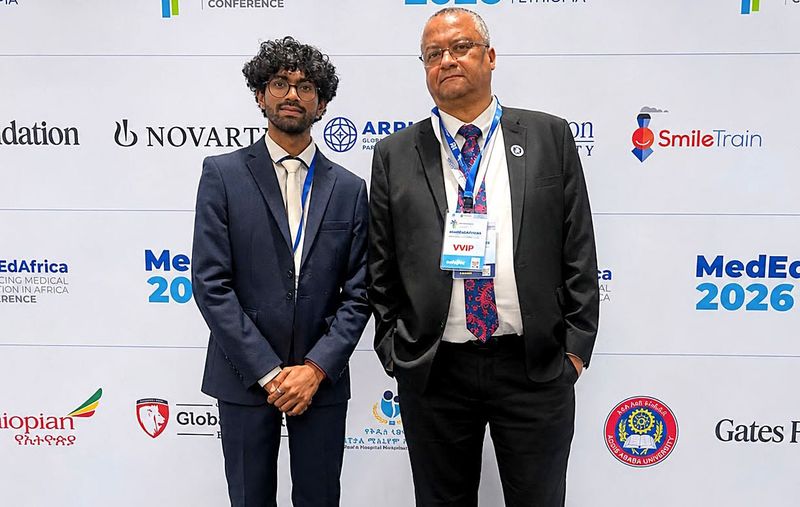
As a matric pupil in KwaZulu-Natal, Sayuran Pillay printed a picture of the University of Cape Town (UCT), photoshopped the word “accepted” across it and stuck it on his wall. “I guess I learned how to manifest,” he says, laughing. UCT turned out to be the only university to offer him a place to study medicine.
Now a fifth-year MBChB student, Pillay is the founding convenor of the Student Curriculum Lekgotla (SCL), a student-led platform that helps shape curriculum transformation at UCT. On 16 October he won the Vice-Chancellor’s Award, and the SCL was named Team of the Year.
Yet he told Daily Maverick the recognition has been “a little difficult to reconcile” with a yearly worry: whether he will be allowed to keep studying.

From interpreter to convenor
Raised by his parents who are both deaf, as a child he acted as their informal interpreter at doctors’ and bank appointments.
“I was the first point of contact for most things,” he said. His sister taught him sign language.
The Student Curriculum Lekgotla began in his second year, when he asked senior students to apply their energy to the curriculum. Some staff asked why another group was needed when a student council existed. Pillay said the council, busy “picking up fires”, lacked the capacity to design curriculum with staff. He modelled the idea on a Canadian paper but built it around the lekgotla, a community-participatory form of deliberation.

The group presented in Kigali in early 2025, then at the Association for Medical Education in Europe’s AMEE conference in Barcelona, where, by his account, it was one of 12 presentations shortlisted from 72 submissions. The recognition lent credibility: before it, course convenors asked “by whose authority” a student group came knocking. Pillay is now “completely hands off”, and other universities are setting up branches.
Between recognition and registration
Pillay said his parents cannot afford for him to be at UCT, so he relies on support to study there.
“At the start of every year there’s this huge anxiety: Am I even going to be able to continue my studies?” he said. “This university is recognising me in this way, but there’s a strong possibility I might not be able to even study here next year.
“We encourage students to excel, but do we really create the environment for them to sustain that excellence? For a lot of us, that’s a financial question,” he said. “What’s the point of getting the Vice-Chancellor’s Award if I can’t graduate?”
The Dean of the Faculty of Health Sciences, Professor Lionel Green-Thompson, says Pillay’s strength is “his capacity to see beyond the immediate”. He was part of the group that organised the faculty’s first Diwali celebration, he noted. “He’s really this quintessential citizen for the 21st century. We are better because of him as a faculty.”
Dignity and identity
As a fellow in general surgery, he is studying how deaf and hard-of-hearing patients experience surgical care.
“People are getting access, now they’re in the theatre, but is their dignity preserved throughout the experience?” he asks. He remembers his mother in hospital: “She didn’t really know what was going on. She was just in hospital, moving where they told her to move.”
He is also Tamil, a descendant of indentured labourers who lost language and traditions as they assimilated, and has started a community at UCT for staff and students of South Indian heritage.
“What’s the point of being a good scholar or graduate if I’m unable to know myself truly?” he asks.
Next year, his final one, he plans to step back from some leadership roles.
“My big focus is just trying to be a really good doctor by the time I graduate.” DM
KioskNews shows a cleaned-up reading view extracted from the publisher’s page — the original always lives on their site, not ours.