All the ways the Alberta referendum could result in an October surprise
With just days to go before Albertans vote on whether to pursue independence, polls suggest residents who want to stay in Canada have a safe lead. Support for remaining is in the high 60s, while the leave sentiment is in the low 20s. But it could go differently. Pollsters have been wrong before, even on separatist votes. The National Post’s Joseph Brean surveys various possibilities for how this referendum on a referendum could turn out to be an October surprise.
Sign In or Create an Account

Get a dash of perspective along with the trending news of the day in a very readable format.
By signing up you consent to receive the above newsletter from Postmedia Network Inc.
A welcome email is on its way. If you don't see it, please check your junk folder.
The next issue of NP Posted will soon be in your inbox.
We encountered an issue signing you up. Please try again
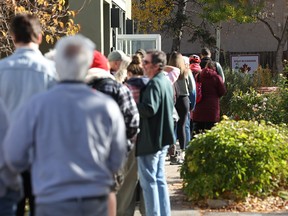
This is a question of confidence, both in the polls and in the broader issue. Confidence is a subjective attitude, shifting and hard to measure or predict. If turnout is low, public opinion polling could be a less reliable guide to the actual results.
“Fervent separatists will crawl across broken glass to make their vote count,” said remain campaigner and former Alberta deputy premier Thomas Lukaszuk in a recent speech. The danger, he meant, is that a pro-Canada majority will think they have it in the bag and stay home.
In 1980, Quebec’s sovereignty movement under a Parti Québécois government soundly lost a referendum that would have given it a mandate to “negotiate a new constitutional agreement with the rest of Canada, based on the equality of nations.” In 1995, however, the PQ came within a single percentage point of a vote to leave. Turnout of over 90 per cent is thought to have boosted the remain numbers such that projections of a leave victory by a few points turned out to be wrong. Now, another vote seems likely, and is at least promised by the newly elected PQ government.
In Scotland, separatists lost their referendum in 2014 by fully 10 percentage points, with voter turnout at more than 80 per cent.
Alberta’s voter turnout in the last provincial election was 60 per cent, and in the last federal election 67 per cent, but this is obviously a different sort of ballot question.
Curiously, the referendum is not a simple “Yes/No” question. It is a rambling offer of two numbered options. You can almost ignore the setup and get straight to the options, which are clear enough on their own without the wordy question, which reads: “Should Alberta remain a province of Canada, or should the Government of Alberta commence the legal process required under the Canadian Constitution to hold a binding provincial referendum on whether or not Alberta should separate from Canada?”
Still here? Did you drift off a bit at “commence the legal process”? Did you need to be told “the Constitution” is “Canadian”? Did you already assume the “legal process” would be “required”? This referendum has more words than it needs.
Eventually, it gets to the key parts: “Option 1: Alberta should remain a province of Canada. Option 2: The Government of Alberta should commence the legal process required under the Canadian Constitution to hold a binding provincial referendum on whether or not Alberta should separate from Canada.”
It is a referendum, but the ballot reads like a lawyer’s letter. There are also nine other questions, all of which are yes/no, on things like immigration control, immigrant access to social services, voter identification, judicial appointments and provincial-federal relations. How and even if people read through all that could have measurable impact on the emotionally charged central question among an electorate with a wide spectrum of interests and motivations.
“There’s a lot of people who want to send a message,” said Alberta Premier Danielle Smith on Oct. 7. “There’s a lot of people who think voting for Option 2 will give leverage. If those are your reasons, I would say there is a better way to send a message or to give leverage. And that is to give us a mandate on the other nine questions.”
Scotland was more concise, not troubling voters with too much windup or alternative messages. “Should Scotland be an independent country?” the 2014 referendum asked. The answer was no, according to 55 per cent of Scots.
Another way the true will of Albertans could be misrepresented in referendum results is by invalidation of good faith ballots.
More than 3,000 ballot packages have been invalidated for reasons such as missing declaration forms or problems with identification, though there remains time to fix those problems.
All ballots are to be counted by hand. Question 10, the central one about a referendum on separating, will be counted and reported first, followed by the other nine, with a deadline of 48 hours, according to Elections Alberta.
Quebec sovereigntists have marched farther along the road to separatism, and their history offers cautionary tales for Alberta sovereigntists. But with a new Quebec government seeking the same goal, they also offer inspiration.
The idea that Canada is broken has lately had a run as a political slogan. The idea that it is actually breaking up is a less familiar notion, not exactly new, but surging to unprecedented levels of public interest with two provincial sovereignty movements campaigning simultaneously. So the successes of one could boost the fortunes of the other, even without actual cooperation.
As separatist advocate and leader of the Alberta Prosperity Project Mitch Sylvestre said after a cordial meeting with Paul St-Pierre Plamondon prior to his election as Quebec’s new premier, according to Rick Bell of the Calgary Herald, “You know, we both agreed, and this came out of Paul’s mouth not mine. He said the only level of government neither of us needs is at the federal level.”
The folk wisdom is that bad weather lowers turnout. It has even been measured in the U.S. at one percentage point per inch of rain, and half a point per inch of snow. In Canada, University of Ottawa researchers found that from the 2004 to 2015 federal elections, “each millimeter of precipitation decreases turnout by more than 0.1 percentage points.”
Higher temperatures boost turnout, they found, but only in spring, summer and fall elections. In the winter 2006 election victory for Stephen Harper, warmer temperatures “triggered lower turnout, in particular, when there was also high precipitation.”
This is the October surprise, in which U.S. President Donald Trump could say or do something provocative, or perhaps offer something like the $5,000 payment he has offered American voters if Republicans win the midterm elections. In Alberta’s referendum, he could see some usefulness to his side in the wider trade war.
Prime Minister Mark Carney, therefore, is in a tricky strategic position, needing to both advocate for the Albertan remain side while managing his chaotic conflict with Trump, who is on record as coveting not only Alberta, but all of Canada.
Carney’s play was a Thanksgiving video, posed in a classroom at his Edmonton high school with a world map behind him, on a long-weekend holiday that was thematically useful.
“It is a chance to give thanks for Canada,” he said. “This year, Thanksgiving is a bit different. A week from today, Albertans will have the opportunity to make an important decision about their future, whether to remain part of Canada, or begin a long and uncertain process through which Alberta could separate from Canada.”
His voice lilted on “could,” a little rhetorical emphasis on the inherent risk of Option 2, in contrast to his pitch for Option 1.
“I’m back home a lot these days, because we are building big things again in Alberta, thousands of new homes, high-speed rail, a new pipeline to the West Coast that will create lasting opportunity and prosperity,” he said. “Canada’s working. Truth is, we can’t achieve any of this if we’re divided. We can’t build big things on fault lines.”
Of all the referendum results that few saw coming, Brexit, Britain’s vote to leave the European Union in 2016, stands out as maybe the most shocking.
It cost Prime Minister David Cameron his leadership, and was a failure of sorts also for Carney, who as Governor of the Bank of England had warned Brexit would cause a recession. He then agreed to extend his term to help avert one.
One immediate political winner was Boris Johnson, the now former prime minister whose appeal was to seem “shambolic,” as the British say, clownish, chaotic, disruptive, but massively likeable, like the earlier Torontonian archetype, the former mayor Rob Ford, who died a few months before Brexit.
A few months after Brexit came the equally momentous surprise first election of Donald Trump, who took that same archetype to new extremes of political power.
Britain still labours under the consequences of that political sea change. So does their Conservative Party’s revolving leadership of less charismatic figures. So, indeed, does the rest of the world, including Alberta.
The tech titan does not have a perfect track record for sage prediction of domestic affairs in other countries, such as Britain where he once said civil war is “inevitable.” But he does take an interest. And, as in Germany, he can speak influentially in support of a populist right-wing movement on its way from the fringe to the mainstream of power, such as the Alternative for Germany.
Often his interest is personal. Musk once posted, then deleted, that “Canada is not a real country” in response to news of a petition to revoke his Canadian citizenship, which is not legally possible.
Musk posted last week on X, the social media platform he owns, in response to news of the Parti Québécois’ election: “Good. Quebec should separate. They would be better off. Alberta and Saskatchewan should separate too.”
Saskatchewan Premier Scott Moe replied with the word “No.” Alberta Premier Danielle Smith likewise voiced her disagreement.
She said she has already voted for Option 1, “and I hope to be able to convince all of you to vote the same way.”
Our website is the place for the latest breaking news, exclusive scoops, longreads and provocative commentary. Please bookmark nationalpost.com and sign up for our newsletters here.
Join the Conversation
This website uses cookies to personalize your content (including ads), and allows us to analyze our traffic. Read more about cookies here. By continuing to use our site, you agree to our Terms of Use and Privacy Policy.
KioskNews shows a cleaned-up reading view extracted from the publisher’s page — the original always lives on their site, not ours.