New patrons, old politics: Durga Pujas navigate Bengal power shift
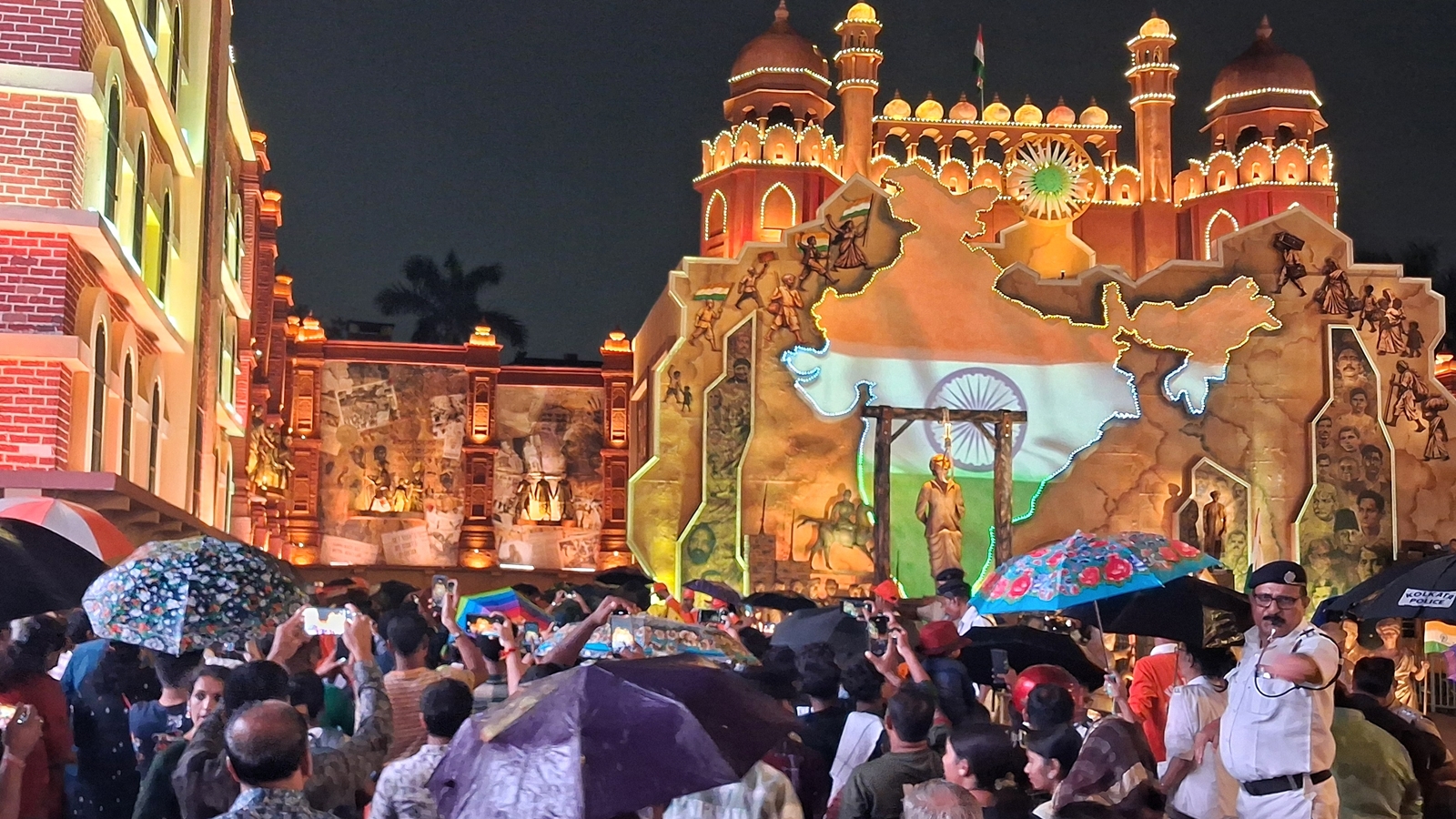
At Lake Town, in the northern suburbs of Kolkata, the lights are on and festive anticipation fills the air. On the eve of Mahalaya last weekend, which marked the beginning of the countdown to Durga Puja, workers rushed to put the final touches on this year’s pandal: an 80-foot-tall replica of Jaipur’s Hawa Mahal, rendered in shades of pink.
Prabir Dhar, the working president of the Sreebhumi Sporting Club Durga Puja Committee, expects this year’s celebrations to be grander than ever, attracting more visitors than the 1.5 crore estimated to have visited the pandal last year.
Yet, beneath the spectacle, the neighbourhood is anticipating a different kind of change. Until last year, Sreebhumi was closely associated with Trinamool Congress (TMC) leader Sujit Bose, who was the public face and chief patron of the puja. Under his supervision, it became a two-week carnival, disrupting traffic and everyday life for residents.
With Bose embroiled in the municipal jobs scam case, a new committee is managing the puja. Its stated aim is to regularise the celebrations and restore their local, residential character without sacrificing grandeur.
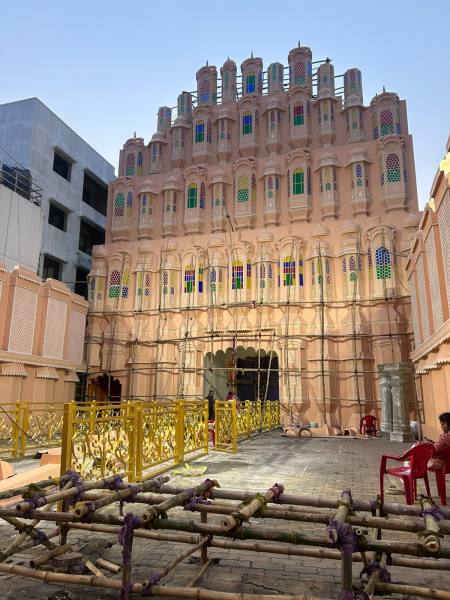 The Durga Puja in Sreebhumi in Kolkata’s northern suburbs under construction last week. The Puja Committee has gone from Trinamool control to BJP. (Express photo by Adrija Roychowdhury)
“Till last year, the puja would be inaugurated on Mahalaya itself, that is during Pitri Paksha (the fortnight dedicated to ancestor worship),” says Dhar. “It is an insult to the Sanatan tradition. Maa (Goddess Durga) must be worshipped during Devi Paksha (the fortnight dedicated to goddess worship),” he argues.
This year, the puja was opened to visitors a day after Mahalaya by West Bengal Chief Minister Suvendu Adhikari. Sreebhumi presents a larger question facing Durga Puja following the change of government in West Bengal in May: has the festival’s political economy changed, or have its patrons simply changed?
Months before the celebrations, Durga Puja was already at the centre of controversy over calls to restrict the sale and consumption of non-vegetarian food near pandals, as well as government directives concerning liquor sales on Maha Ashtami and DJ music during festivities and immersion processions.
“Durga Puja, in a way, remains as it was, but some structural changes will be apparent this year. Earlier, there used to be a contest between different Puja committees led by TMC heavyweights who acted as patrons,” says an organiser of a prominent city Puja, who did not wish to be named.
New faces at the helm
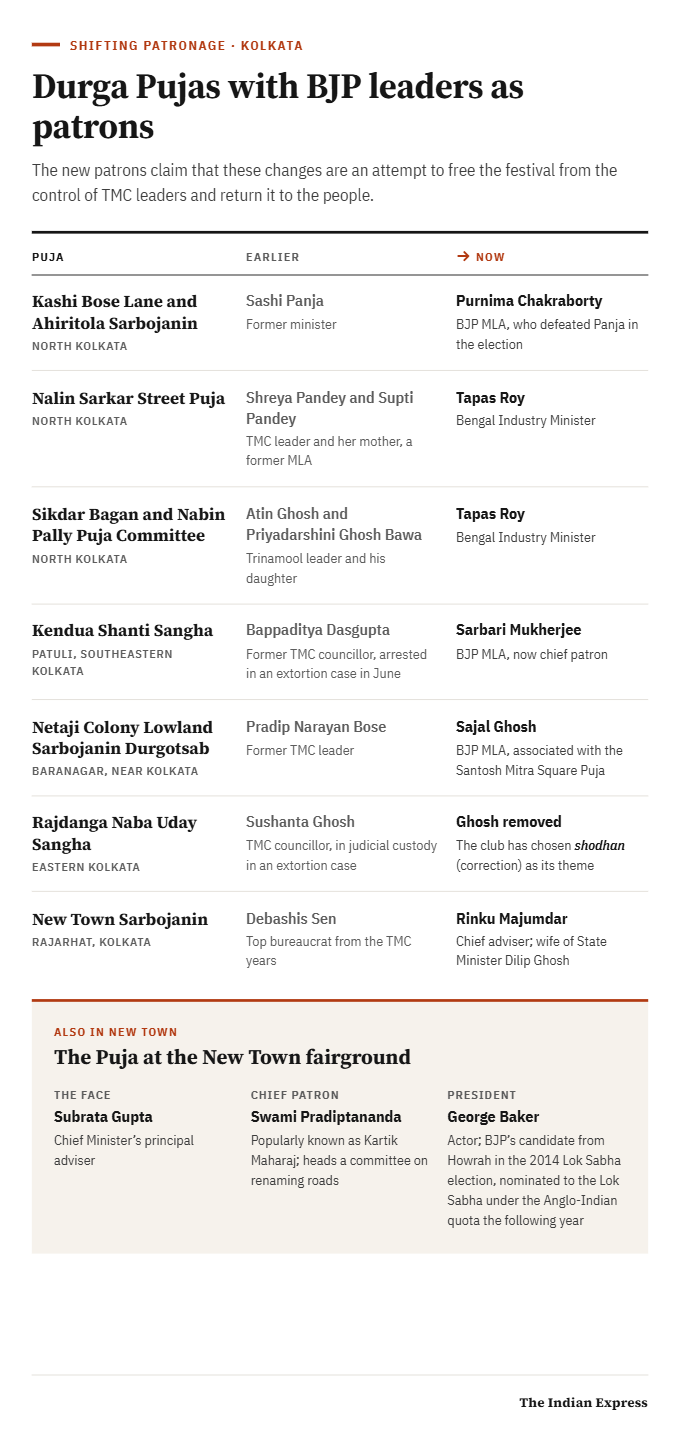
One of the most visible changes this year is the emergence of new political faces at prominent pujas across Kolkata.
At Sreebhumi, Bose has been replaced by Health Minister Sharadwat Mukherjee, who defeated him in the Assembly elections. At Suruchi Sangha in New Alipore, BJP MLA Sourav Sikdar has assumed a key role, replacing Aroop Biswas and his brother Swaroop, who was associated with the Bengali film industry. At Hathibagan Sarbojonin in north Kolkata, BJP leader and state Industry Minister Tapas Roy has replaced TMC leader Atin Ghosh and his associate Saswata Bose. BJP MLA Ritesh Tiwary has also replaced former tourism minister Indranil Sen as patron of Tala Prottoy.
The new patrons claim that these changes are an attempt to free the festival from the control of TMC leaders and return it to the people. “What used to be the Biswas brothers’ puja is now a puja for the residents of New Alipore. The puja will be conducted strictly according to the scriptures. The theme and grandeur will remain the same,” says Sikdar of Suruchi Sangha.
“Different Puja committees approached me to be their patron. I selected a few. The main organisers remain the same,” says Tapas Roy.
But whether the changes amount to a redistribution of control, rather than a transfer of political patronage, remains an open question.
Politics and the Goddess
The close association between politics and Durga Puja is not new. “Durga Puja has always been political,” says Sandipan Mitra, who was part of the research team that prepared the dossier for the inscription of “Durga Puja in Kolkata” on UNESCO’s Representative List of the Intangible Cultural Heritage of Humanity.
From grand zamindari celebrations during colonial rule to the use of the festival in the nationalist movement, Durga Puja has long provided a space for political expression. Mitra points to Hathibagan Sarbojonin, which displayed a map of India behind the goddess during the freedom struggle. At Simla Byayam Samiti, founded by revolutionary leader Atindranath Bose in 1926, the idol was dressed in khadi and came to be known as the “Swadeshi Thakur”.
After Independence, several pujas became associated with Congress politicians. Ekdalia Evergreen Puja in south Kolkata’s Gariahat, for instance, became closely identified with the late Subrata Mukherjee from the 1970s.
The CPI(M), which came to power in 1977, largely kept its distance from direct participation in religious festivities on ideological grounds. This left space for Congress politicians, and later the TMC, to cultivate relationships with puja committees.
“TMC leaders’ involvement in Durga Puja was not sudden,” says Mitra. They participated in the festival long before the party came to power in 2011, with leaders such as former Kolkata mayor Firhad Hakim and former ministers Partha Chatterjee, Aroop Biswas, and Sovan Chatterjee becoming known faces through the pujas they hosted.
Under the TMC, this involvement expanded into what came to be described as a “festival mode of governance”. Art historian Tapati Guha Thakurta, who has extensively studied the cultural and social significance of Durga Puja, says the party increasingly used the festival as a platform for politics and governance.
“Didi and Durga almost had a political pact. She became Durga’s greatest champion, but her face also competed with Durga everywhere,” she says.
The change of government marks a shift in the political actors associated with the festival, but not necessarily in the relationship between political power and public celebration.
A public art festival
The new government’s emphasis on tradition has also raised questions about the artistic freedom that has become central to contemporary Durga Puja.
BJP’s Baranagar MLA and Santosh Mitra Square Puja organiser Sajal Ghosh — whose father Pradip Ghosh was a Congress leader and a patron of the Puja — has argued that idols should follow traditional conventions and should not be distorted through artistic experimentation.
Pashupati Rudra Paul, an artist from Kumartuli, says several committees have insisted that Durga idols should not exceed 11 feet in height. “This rule existed previously as well, but no one followed it. This year there is strict adherence to it,” he says.
Another artist, speaking on condition of anonymity, says many idol makers are avoiding experimentation with the idol’s form this year.
Anirban Das, the main artist at Nandanik Club in Kanthi in Purba Medinipur, which is CM Adhikari’s home turf, insists there is no political pressure. “We will worship Mahishasura Mardini as we do every year. We believe in her presence everywhere and in every object,” he says.
“We are organising Durga Puja the same way we have been doing for years. Nobody has told us to change anything,” says Somen Dutta, an organiser at the Kashi Bose Lane puja.
Others emphasise that creative freedom is integral to the festival. “Goddess Durga does not reside in temples. She is celebrated by common people in the streets and neighbourhoods. Who can dictate how she should look?” asks Bhabatosh Sutar, who has designed Durga Puja pandals and idols in Kolkata for 27 years.
This year, Sutar has designed the Dum Dum Telipukur Nagerbazar Puja around the theme “Ek Pukur Bhalobasha” (a pond of love). Using a neighbourhood pond as his canvas, he seeks to address environmental concerns through the pandal. The idol depicts the goddess emerging from water, covered in water lilies and other aquatic vegetation.
“There is a huge creative crafts economy that is centred around Durga Puja,” says Guha Thakurta. Young artists, she says, have used the festival as a platform to showcase their work, opening up a democratic space for art production in the city.
The festival’s significance as a public art event was recognised when Durga Puja in Kolkata was inscribed on UNESCO’s Representative List of the Intangible Cultural Heritage of Humanity in 2021.
Pandal themes frequently make social and political arguments, sometimes provoking public outrage. In 2021, the Bharat Chakra Puja committee in north Kolkata based its theme on the farmers’ protests, featuring tractors, barricades and footwear at the entrance. The footwear installation sparked a controversy.
“It is not uncommon for art to be controversial. But in the case of Durga Puja, it becomes more so due to its public accessibility,” says Mitra.
Who owns the festival?
The expansion of Durga Puja has also raised concerns that commercialisation and political patronage have weakened its neighbourhood character.
At Sreebhumi, Dhar says the corporatisation of the festival over the past 15 years made it difficult for residents to participate. The idol was adorned with gold, while heavy security restricted access to the goddess, including for those wishing to offer pushpanjali, or flowers during worship. This year, the committee intends to encourage local participation and keep the idol simpler.
Guha Thakurta acknowledges that commercialisation and politicisation have distanced some pujas from their local communities. A celebration once heavily controlled by the TMC as Sreebhumi, she argues, exemplified this trend.
Yet, she questions whether the change of government will fundamentally alter the model. The faces may have changed, but the script of a relationship between political power and the festival may remain much the same.
At Sreebhumi, the promise is to restore the Puja to its neighbourhood. Whether that translates into a meaningful change in ownership remains uncertain.
KioskNews shows a cleaned-up reading view extracted from the publisher’s page — the original always lives on their site, not ours.