NASA 'troubleshooting' transporter for space station's robotic arm [Updated]
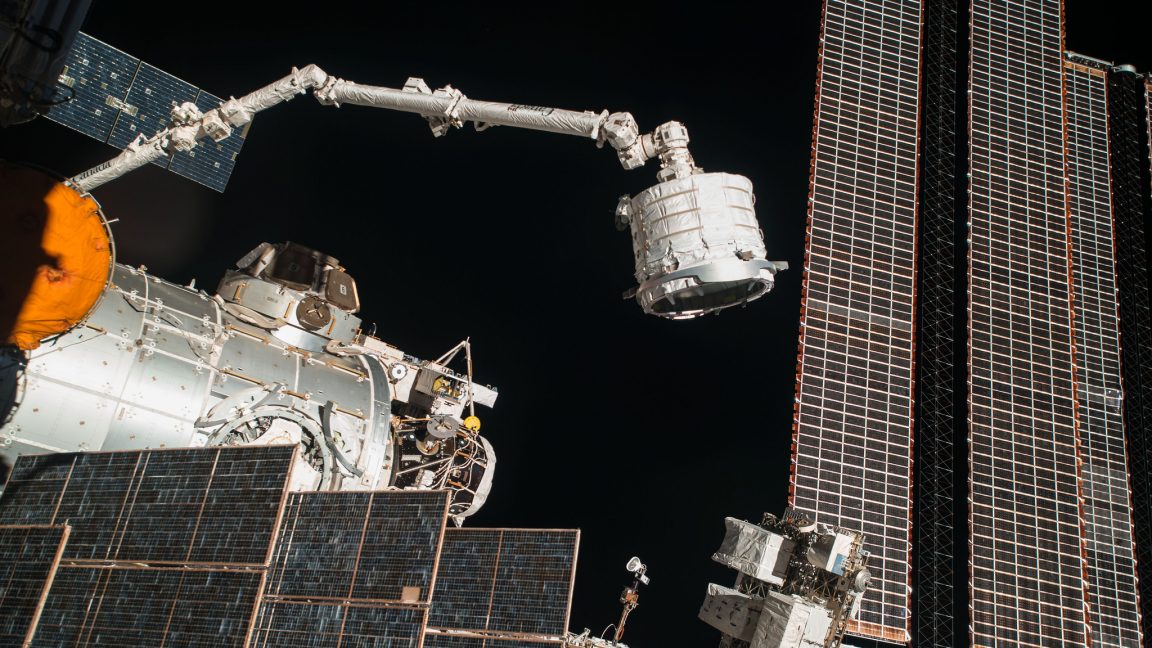
Recently, the astronauts on board the International Space Station performed a routine “walk-off” maneuver with the large, 58-foot-long robotic arm attached to the orbiting laboratory.
The robotic arm, known as Canadarm2 because it was supplied by the Canadian Space Agency, is something of a modern engineering miracle—it can effectively move around the exterior of the large space station like an inchworm because both ends are essentially identical.
However, after this particular walk-off maneuver, the robotic arm, along with the mobile transporter that guides it along the main truss of the space station, could no longer be moved.
As of Sunday evening, according to two sources, work was underway to determine whether this problem was due to a data or software issue or the robotic arm or mobile transporter hardware itself. Asked for more information, a NASA spokesperson did not offer a comment by late Monday morning.
Working past its design lifetime
Designed and developed by the Canadian space corporation MDA, the Canadarm2 launched to the International Space Station in April 2001 on Space Shuttle Endeavour, and it has since served as a critical component of the orbiting laboratory. Its nominal design lifetime was 15 years, so it has been operating for more than a decade beyond this point.
The arm has a mass of nearly two metric tons and can handle payloads of up to 116 tons.
For much of its lifetime, the arm was essential in getting supplies to the International Space Station. The first version of SpaceX’s cargo vehicle, as well as Northrop’s Cygnus and Japan’s HTV-X transfer vehicles, was designed to be grabbed by the arm when it got close to the station and then be moved into a berth at the facility.
KioskNews shows a cleaned-up reading view extracted from the publisher’s page — the original always lives on their site, not ours.