India's Hunger Score Improves, But Child 'Wasting' Remains High
The world is preparing to celebrate World Food Day on Thursday, but India continues to face serious hunger challenges despite long-term improvements in nutrition indicators.
India has made progress in reducing hunger over the past two decades, but its progress remains uneven.
The Global Hunger Index (GHI) 2026, released on October 14, ranked India 100th among 122 countries. With a score of 24.1, India remains in the "serious" hunger category.
The index measures hunger using four indicators: undernourishment, child stunting, child wasting and under-five mortality.
Together, these capture different aspects of food insecurity and malnutrition, rather than simply measuring how much food a country produces. A higher GHI score indicates a more severe hunger situation.
India's Hunger Score Has Improved
India's GHI score declined from 37 in 2006 to 24.1 in 2026. It stood at 28.8 in 2012 and 25.8 in 2018.
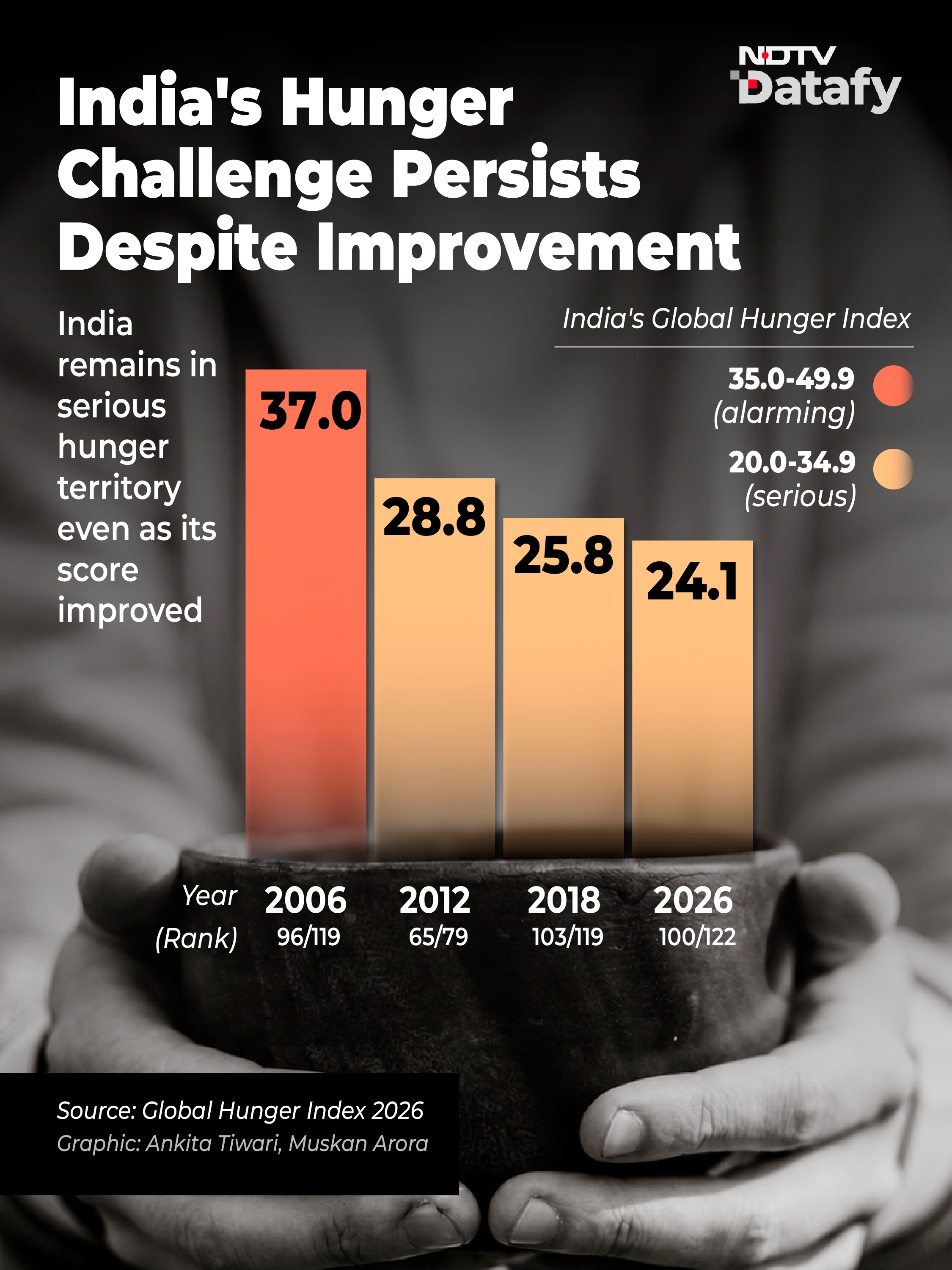
The fall shows a long-term improvement in India's hunger indicators. However, the country remains in the serious category, meaning the problem has not gone away.
Child Stunting Remains A Concern
The share of children under five affected by stunting fell from 50 per cent in 2000 to 29.3 per cent in 2026. Stunting affects a child's growth and is often linked to prolonged undernutrition and repeated illness.
The latest figure means that nearly three in every ten children under five are still affected.
Child wasting has followed a different path. It occurs when a child is too thin for their height and can indicate acute undernutrition. The share of children affected stood at 18 per cent in 2000, rose to 20 per cent in 2006 and fell to 15 per cent in 2012. By 2026, it had climbed to 19 per cent.
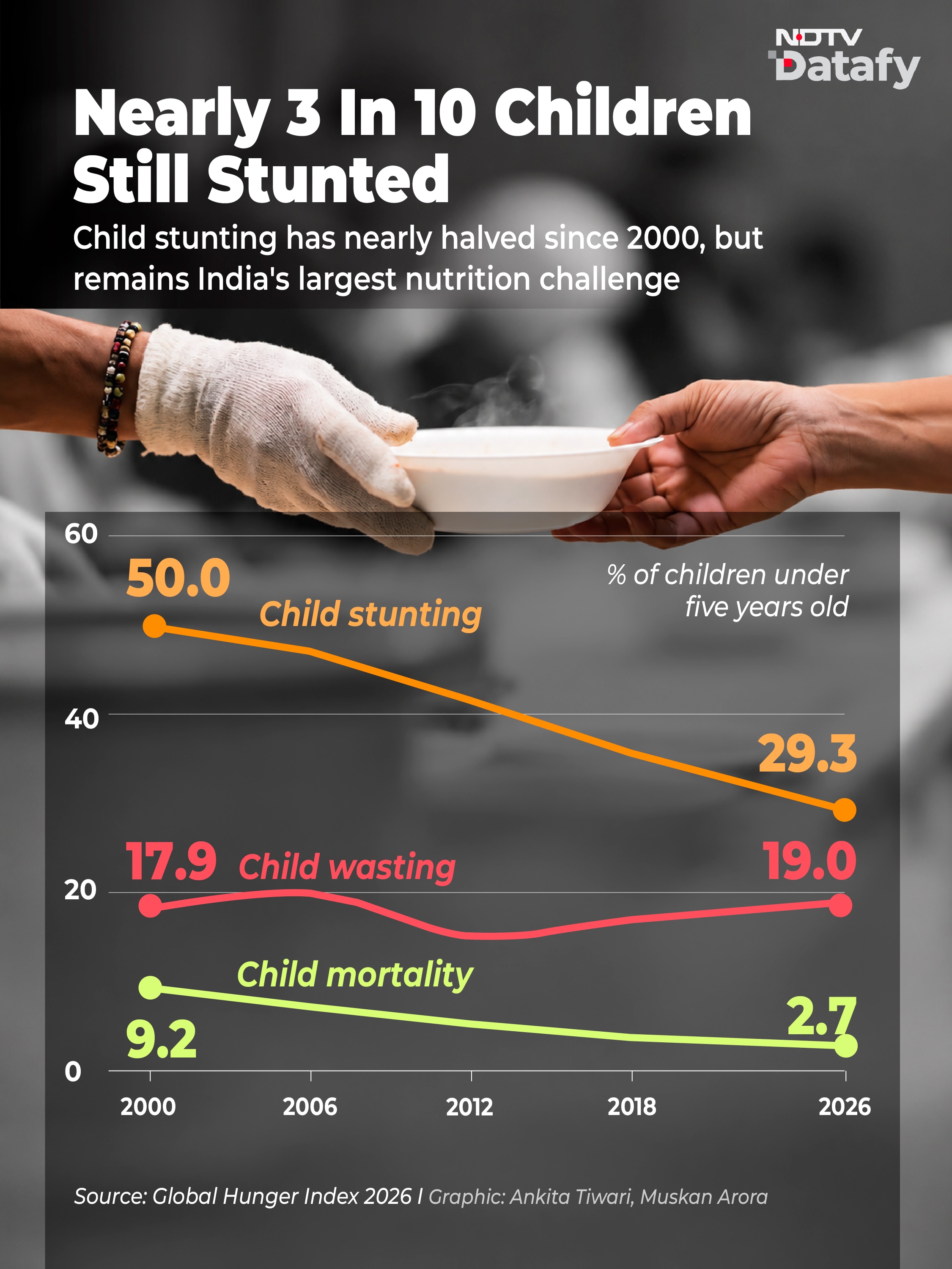
This means child wasting remains close to its level at the start of the period. Unlike stunting, it has not shown a consistent long-term decline.
Other indicators have improved. The share of India's population that is undernourished fell from 18.4 per cent in 2000 to 9.8 per cent in 2026. Under-five mortality also declined, from 9.2 per cent to 2.7 per cent.
India Remains Behind Several Neighbours
India's GHI score of 24.1 is higher than the global average of 18.1 and South Asia's average of 23.5. A higher score indicates a more severe hunger situation.
Among neighbouring countries in the 2026 comparison, India scored better than Afghanistan, at 28.6, and Pakistan, at 25.5. Bangladesh scored 19.2, while Nepal scored 14.5.
KioskNews shows a cleaned-up reading view extracted from the publisher’s page — the original always lives on their site, not ours.