Bookstores: This is how India’s silicon city protects its analogue soul
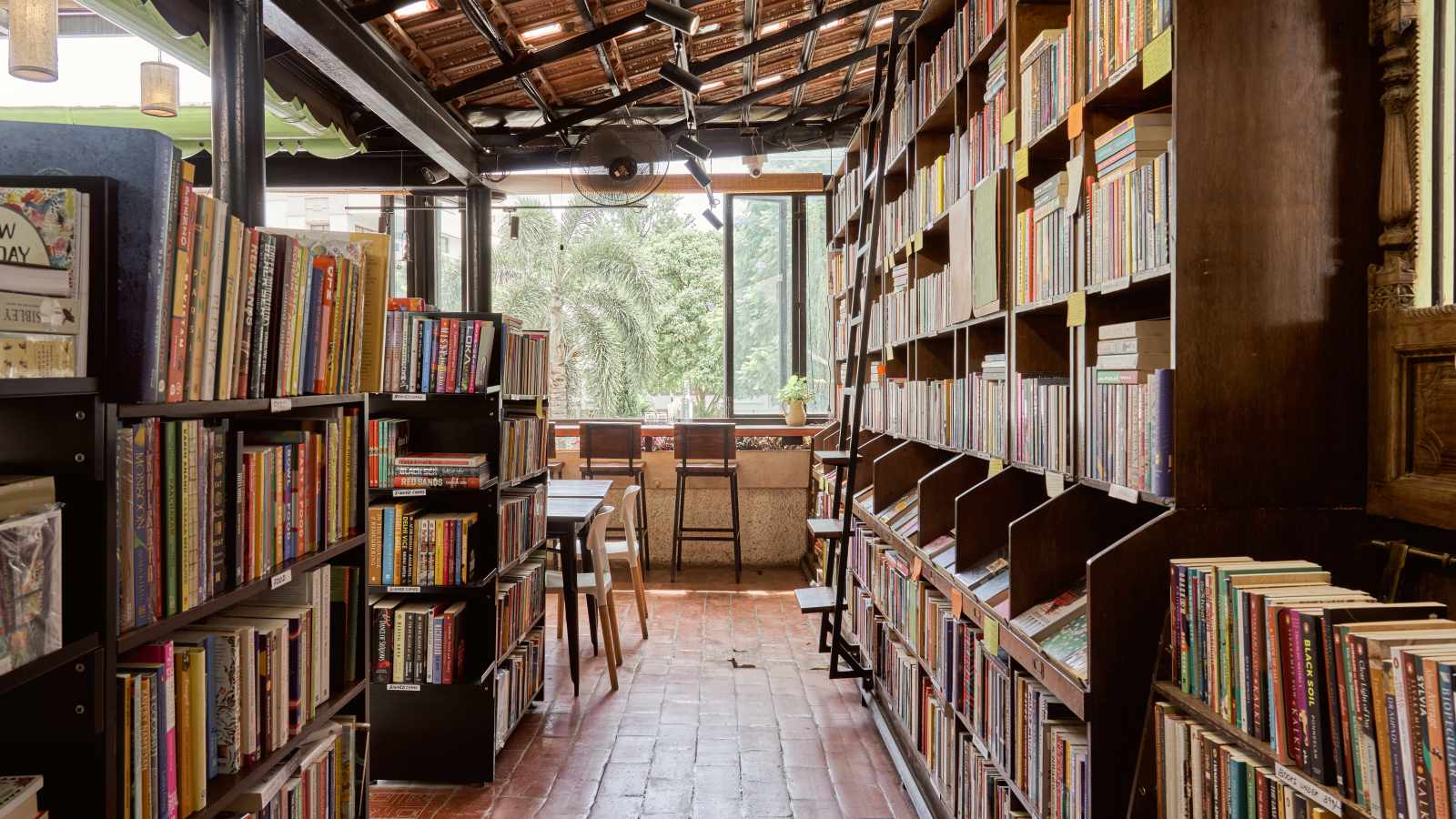
In Bengaluru, as you walk into a lane off Brigade Road, the sound of traffic dims. Walk past a restaurant from which the smell of kebabs rises and fades, and you soon hit a dead end. Tucked there is a little bookstore, and inside is the smell of brown, second-hand books. This is Select Bookshop, now run by third-generation proprietor K Sanjay.
For 81 years, Select has survived waves of gentrification in Bengaluru, which has transitioned from the quieter city of pensioners to the country’s technology capital. Select’s story is the story of Bengaluru’s independent bookstores and how they have adapted to the city’s changing workforce and their reading habits, without losing what made people walk in through their doors in the first place.
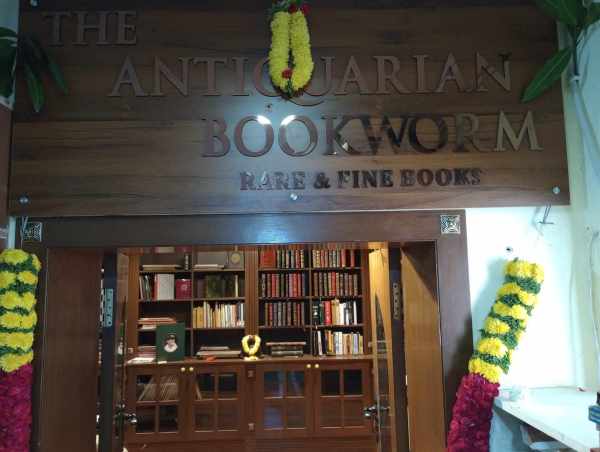 The Antiquarian Bookworm – A section opened by Krishna Gowda devoted to old and rare books, in collaboration with other collectors and lovers of old books.
Select has not always been at the same spot. It was on Museum Road and a couple of other places before it found a home off Brigade Road in 1984. Its main space is a small room, packed with every imaginable second-hand book, but the rarest offerings end up in a larger room above: a history of the Frankish kings of Europe, or an 1890 edition of Edward Gibbon’s The History of the Decline and Fall of the Roman Empire.
“There used to be a lot of serious readers. Apart from college students, people would come to get out-of-print books for their research. Some of them turned out to be writers,” says Sanjay, who personally helps customers navigate the stacks and find rare volumes. “In the last few years, people have been coming to buy popular fiction books. Some youngsters buy philosophy books — Nietzsche and Kant.”
That change has been accompanied by a change in how Select reaches readers. Sanjay says that social media influencers and visitors to the shop are now driving customers to the bookstore through photographs, reels and book recommendations they share online.
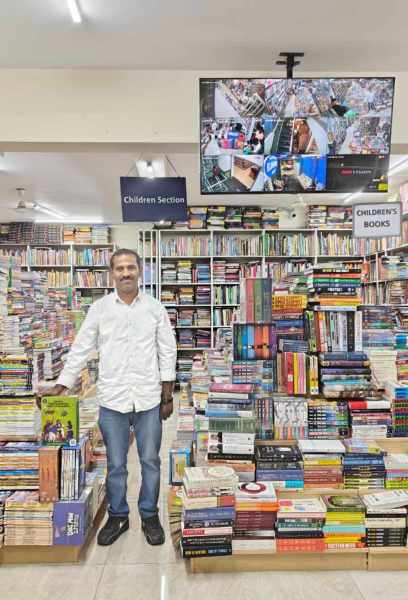 Mayi Gowda, the quiet, dedicated proprietor of Blossom Book House.
Select has also joined the trend of bookstores hosting literary events and discussions on subjects, ranging “from vaccines to Japanese poetry”. Some come to participate in these talks; others leave mid-event with a book or two.
The shop enjoys a third kind of customers: those who grew up buying books from Select now bring their children. “Parents bring kids so they develop a reading habit. Otherwise, they will be glued to their phones,” Sanjay says.
Story continues below this ad
One such visitor is Tejasvi, who steps into Select with her 10-year-old son. She says he is fascinated with books. “He loves books. He went upstairs because he is enthusiastic about the old novels and the antiques. It was here that, for the first time, he saw an old tape recorder cassette.”
The cassette is one of the many objects that make Select feel more like a time machine. Old-style clocks and furniture sit among the books, connecting the past and the present.
It was a little over two decades ago that a king walked into Select. K Sanjay remembers being thrilled at the prospect: it is not every day that Srikantadatta Narasimharaja Wodeyar, the Maharaja of Mysore, walks into your establishment.
 Spread across three different locations in Bengaluru’s Church Street, Blossom houses every genre of book one might think of.
His father and second-generation proprietor, KKS Murthy, as always, prepared ahead and filled a cabinet with books he thought the Maharaja would like. “He (Wodeyar) bought mostly non-fiction and historical books. He did not talk much but looked at the books seriously,” Sanjay now recalls.
Story continues below this ad
Writer Meera Iyer remembers visiting Select 10-12 years ago. “I remember the feeling of entering a wonderland — the smell of books, books piled high, the sheer joy of discovering something. You go in looking for one book and come out with something else because you chanced upon it,” she says.
Another regular is Swedish author and decades-long Bengaluru resident Zac O’Yeah, who says that K Sanjay keeps an eye out for the books that he likes and sets them aside. Corresponding with the Indian Express, he said, “…I’ve been going to Select for over twenty years now. Or longer. So have met Murthy on several occasions while he was still there. Lovely fellow. He used to go to the bookshop even though he must have been nearly 100 years old!…..The particular thing that I enjoy most about Select is how tucked away it is, so often when one goes there, one is the only customer in the shop and can browse leisurely……the shop is like a goldmine where books are more like relics than products. The description “hidden gem” would be extremely accurate in this case. It is also one of the bookshops in the world that has the most of what one might call “personality”. And I’m happy that Bengaluru is home to such an anomaly in these times when everything is moving so fast, click this, click that…none of which applies to Select that continues to exist in its own time zone. ”
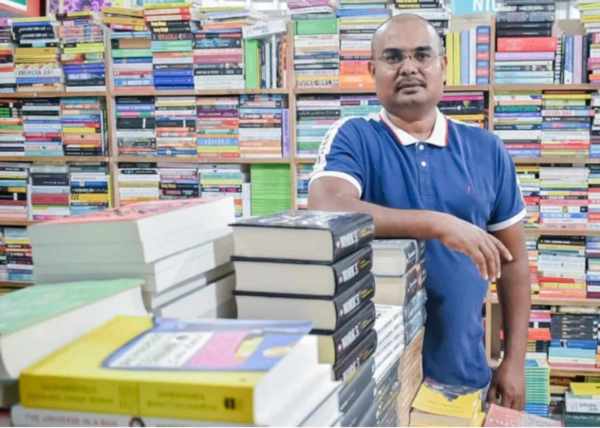 Bookworm’s Krishna Gowda can usually be found behind his desk, ready to lend a helping hand to visitors looking through his vast collection. Credit: Jitendra Kumar
Carving out a niche
Some distance away from Select, off Queens Road, stands a much younger bookshop that popped up just before the pandemic. This is Champaca, run by Radhika Timbadia.
Timbadia says she decided to fill a smaller niche, considering that the city already had an array of excellent bookstores. As she put it, “What I felt was missing was a more curated space, where you could put together authors for people to discover from collections, keeping them as diverse as possible.”
Story continues below this ad
A year before opening the store, Timbadia was working for the Bengaluru-based Nature Conservation Foundation as an ecologist. But, even without a background in publishing, she decided to take a risk with Champaca. “Maybe that helped because otherwise I would have been too daunted,” she says.
For Timbadia, a woman who grew up reading everything from John Grisham novels as a teenager to Ursula Le Guin as an older student, owning a bookstore seemed like a convenient pretext to keep up with the latest books. And the city also seemed ready when she opened the doors to Champaca in 2019.
Despite the pandemic years, the business has not only survived, but thrived. “My husband is from here, my aunt is from here, and I used to visit the city when I was younger. There used to be small libraries then, in what felt like every neighbourhood. But several of them no longer exist. I think that gap has been filled by bookstores,” Timbadia says.
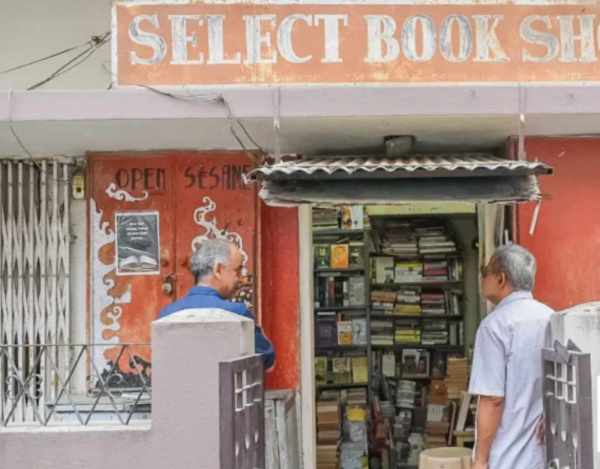 K Sanjay (right) is the third-generation proprietor of Select Book Shop, one of the oldest fixtures for Bengaluru bibliophiles.
But how are newer bookstores faring in Bengaluru? “I can’t compete with the big bookstores, and I can’t compete with Amazon. But I think what we’re doing is completely different in many ways,’’ Timbadia says. “Each of our titles is very carefully selected. There are things we care about that I think are showcased in the store. We have anti-caste and feminist literature, we have several translated works, and we pay attention to books on nature and science”.
Story continues below this ad
From BR Ambedkar’s ‘Annihilation of Caste’ to Namdeo Dhasal’s ‘A Current of Blood’ and MN Srinivas’s ‘Caste: Its Twentieth-Century Avatar’, readers will find a collection of books on caste in Champaca. In ‘feminist reading’, there is Kate Lister’s ‘A Curious History of Sex’ and Annie Ernaux’s ‘A Girl’s Story’, sitting alongside Nitasha Kaul’s ‘Can you hear Kashmiri Women Speak?’ and Sumanta Banerjee’s ‘Dangerous Outcast’.
While Timbadia organises author book discussions at Champaca to increase reader interaction, she also encourages guests to leave handwritten notes on books they read. In Adam Nicolson’s book, Bird School, is stuck a note that goes, “Nicolson approaches the birds in his backyard in Suffolk with intense curiosity”. Another note on a Zubaan Books publication (The many that I am) reads, “a delightful collection of personal essays, short stories, poetry & artwork from Nagaland”.
A book lovers’ community
“Any books which people promote on Instagram are popular these days. Classics like Tolstoy sell a lot. Many teenagers are promoting these titles,” says Mayi Gowda, who runs the Blossom Book House on Church Street.
On Church Street, Blossom Book House and Bookworm came up around the same time in the early 2000s. They are treasure troves of second-hand books and bestsellers, and haunts of writers and readers alike. Drop in on any day, and you might run into crime novelist Zac O’Yeah, historian Ramachandra Guha, or any number of regular readers. Their proprietors, Mayi Gowda and Krishna Gowda, arrived in Bengaluru from the same village near Mysuru — Rangasamudra. Both had grown up on a steady stream of Kannada literature.
Story continues below this ad
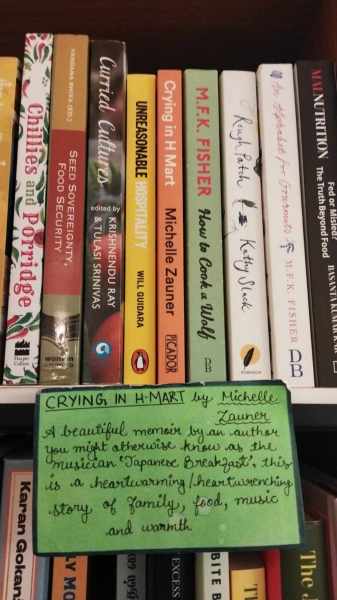 Handwritten notes on the shelves of Champaca provide a human touch in an era of technology.
The city was a different place then, still retaining much of what older Bangaloreans remember as the ‘pensioner’s paradise’. An engineer by profession, Mayi Gowda began selling books from a stall after becoming dissatisfied with jobs. He brought Krishna Gowda in to help him expand. Mayi’s Blossom soon became a proper bookstore in the Brigade Gardens building. Krishna established Bookworm as his own independent store on Church Street.
Today, Blossom’s vast collection is spread across three premises, while Bookworm occupies an old British-era house.
Walk into Bookworm, and it feels like many shops in one. Each room is devoted to something different — Kannada literature, science fiction, antique books and more. But it is old, second-hand books that have brought Bookworm where it is. “I came to Bangalore more than 29 years ago. Those days, good books were not easy to source. There was a huge demand for second-hand books, especially rare and out-of-print ones,” Krishna Gowda says, recalling the early days. “It was our passion for rare books which made our work lighter and encouraged us to work harder. When our customers say they finally found a book after decades, it’s a wonderful moment. Those moments motivate us.”
Till now, Bookworm has no online cataloguing system, and instead, its staff use their knowledge of the store and its stock to guide customers. Krishna Gowda himself goes to considerable lengths when customers ask for books that are difficult to find and also provides space for book clubs and meetings.
Story continues below this ad
That has helped him build a community among Bengaluru’s book lovers. When disaster struck this May, and a flood destroyed many books at Bookworm, it was the same community that came forward. Volunteers, including bookstore owner Ravi Menezes, helped with the clean-up. People bought books and volumes that had survived.
It is the same, manual system at Blossom, where employees reach into stacks some 12 feet high to retrieve a volume. “Most of the bookstores used to stock Kindles, but not anymore… it means people are buying more physical books now,” Mayi Gowda says.
Interactions among readers across ages, he says, keep up his spirits. “People come here and suggest books to each other. You might see seventeen-year-olds suggesting books to older people. And seeing that, there is satisfaction.”
In a city where daily life has become more digital and increasingly mediated by screens, independent bookstores like his offer something rare: a chance to wander, to stumble upon a book that is interesting, to find a book you could not find for years, and sometimes, a friend to share in that joy.
KioskNews shows a cleaned-up reading view extracted from the publisher’s page — the original always lives on their site, not ours.