Singapore government worried AI may break 'bottom rung' of career ladder for young workers: PM Wong
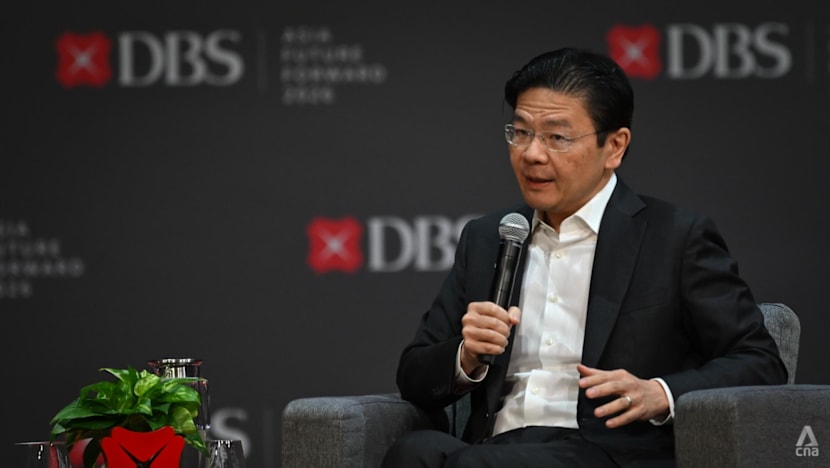
SINGAPORE: The government is concerned that artificial intelligence may be breaking the “bottom rung” of the career ladder, leaving young workers with too little training, Prime Minister Lawrence Wong said on Monday (Oct 12).
Speaking in a dialogue with DBS Group chief executive Tan Su Shan at the bank’s Asia Future Forward conference, Mr Wong said the government is studying the training and mentoring of young workers across sectors.
Mr Wong recalled taking notes, drafting speeches and preparing slides for his superiors as a young civil servant, and said that there is value in this learning process.
“AI will replace all of that routine work, but we should be careful not to automate away the learning that comes from it,” he said, calling on employers to be more deliberate about training and mentoring young workers.
“We are concerned that there may be that bottom rung of the career ladder that’s broken and young people may not get sufficient training.”
The government is exploring whether new schemes are needed to get companies to pay attention to this, said Mr Wong, who is also finance minister.
A Ministry of Manpower report in April found that among Singapore companies that had adopted AI, 6.2 per cent reported reduced headcount and another 8.5 per cent reported lower hiring activity.
Most of the other companies said they had redesigned jobs, created new AI-related jobs or redeployed workers to new roles, among other moves.
The government wants employers to harness AI fully to enjoy the productivity benefits, said Mr Wong. “But we also want to make sure that employers pay attention to training and continue to nurture the next generation.”
WHAT SINGAPORE WILL NOT COMPROMISE ON
Asked about Singapore’s "non-negotiables" as it embraces technology, Mr Wong said AI and technology should benefit all Singaporeans.
“We are not doing technology at all costs,” he added. “We are not trying to be an AI-driven society. We are trying to be a better society enabled by AI.”
Singapore will also not compromise critical systems, sensitive information or human responsibility, said the prime minister, stressing that humans should ultimately make the critical decisions.
INTERNATIONAL STANDARDS FOR AI
Mr Wong also spoke about Singapore’s decision to back the international call for stronger safeguards for frontier AI amid greater scrutiny of the technology’s risks. He said such moves reflect a growing recognition that while AI can bring tremendous benefits for humanity, people are also more worried about losing control of these powerful systems.
On Sep 12, Anthropic’s Dario Amodei called on AI firms to slow down development, warning that building it too fast was "reckless". Top AI companies' executives, including OpenAI chief Sam Altman and xAI's Elon Musk, backed his push for a slowdown.
After meeting with top tech executives at the White House, US President Donald Trump said on Sep 29 that they had agreed to establish voluntary standards for AI.
Mr Wong welcomed the move on Monday, even though the leading AI labs do not all agree on what form the standards should take.
“Even if it’s voluntary at first, I think it’s a good start,” he said.
The standards could be built up progressively, he added, raising ideas such as an independently appointed international governing board and an independent audit process.
“If investors, customers and the marketplace also recognise these standards, then it will give even more incentive for the frontier labs to participate,” said Mr Wong.
Ideally, international rules on developing AI safely should be put in place, he said, noting that similar standards apply in other industries like aviation, finance and nuclear power.
“Can this happen with AI? Possibly, in theory, yes. Realistically in the near term? Not likely to happen.”
NEW REGIONAL FRAMEWORK
The two also discussed global market uncertainty, energy supply amid advances in the technology, and Singapore’s relevance to businesses and other countries.
Mr Wong and Ms Tan also discussed the Digital Economy Framework Agreement (DEFA), which is set to be signed at the 49th Association of Southeast Asian Nations (ASEAN) Summit in November.
As the first such regional agreement, it sets out rules for data, payments, digital trade and AI across the 11 ASEAN member states.
Describing the agreement as “an attempt to make ASEAN’s digital economy work better”, Mr Wong pointed out that many businesses in the region know that it is currently fragmented, with different rules, systems and requirements across countries.
“It can be very frustrating,” he added. “Hopefully with DEFA, we can reduce the barriers, facilitate more data flows and allow more cross-border digital trade,” he said, noting that more will need to be done to translate the agreement into practical benefits for companies.
KioskNews shows a cleaned-up reading view extracted from the publisher’s page — the original always lives on their site, not ours.