Quel head trip! Failed postcards, scrapping poets and germ-ridden film rock Paris Photo – review
No one at the three-day Paris Photo fair seemed worried about being a target for protesters – the fate of fellow art fair Art Basel Paris, which closed two days early. “Photography isn’t expensive enough,” joked one gallerist.
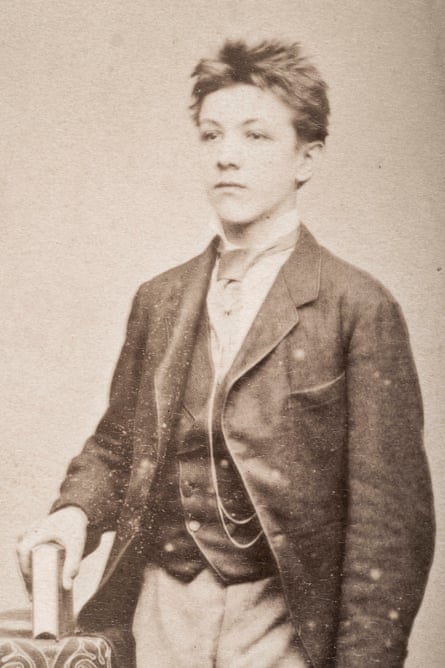
This 29th edition coincided with celebrations across France of the bicentenary of photography, and as such looked back at photography’s origins and the questions that have preoccupied photographers from the beginning. One example was a 19th-century portrait that is thought to be an extremely rare depiction of Rimbaud with a black eye – the poet was a known ruffian who often got physical over literary squabbles. Whether the photograph is really Rimbaud or not begs the question: what matters more, the truth, or what we believe the truth to be? After 200 years, photography hasn’t resolved the issue. The strongest thread running through Paris Photo is the uncertainty and instability of photography: as evidence that collapses into fiction and performance.
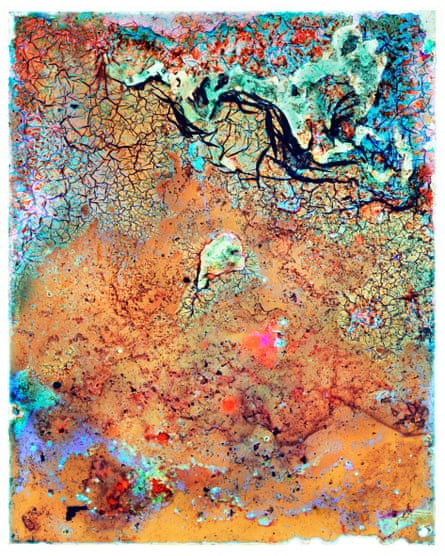
Lara Tabet’s Vitreous Body, developed with curator Yasmine Chemali, was among the fair’s most conceptually adventurous projects. Tabet, who trained as a medical biologist, collected water samples from canals, natural sources and waterways around Marseille, then mixed them with photographic film. The bacteria in the samples eat away at the film and transform it into brightly coloured abstract compositions, portraits of the city of sorts, a way of representing the landscape through microorganisms invisible to the naked eye. The works on agar bioplastics are the most interesting – the bacteria continue actively to transform the material, so that the work will continue to be alive, and changing. They are both beautiful and disquieting. Nature is not just depicted, but a collaborator in the image.
A different but equally intriguing interrogation of representation came from the young Colombian artist Felipe Romero Beltrán, who has frequently collaborated with African migrants in Europe, especially dancers. In his carefully constructed black-and-white photographs, his collaborators re-enact the positions used by police to subdue someone they’re arresting; yet without the uniforms or weapons, the aggression and hostility, the hierarchy and power, the choreographed movements become surprisingly tender and soft, institutional control becomes intimacy. The bodies carry the narrative without directly showing the violence those same bodies are regularly subjected to by the state.
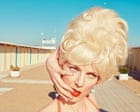
Kourtney Roy showed works from her Failed Postcards series, taking another kind of vernacular visual language, travel photography, and turning it into something more ambiguous, strange and at times hilarious – saturated colours, theatrical poses and awkward fails, as she constructs scenarios in front of the kind of picturesque views tourists are prone to photograph. Beneath these polished shiny pictures, there’s also a darker rumination on the way experience is commodified.
Silina Syan brings a different understanding of the relationship between image and place. Her Made in Bangladesh series is rooted in Bidyakut, her father’s village in Bangladesh, and the architectural transformations that result from migration. The elaborate mansions financed by family members living abroad stand in striking contrast to the surrounding vernacular architecture; these buildings become visual markers of economic aspiration, family obligation and belonging. Some of her photographs are encased in their own architecture, carved wooden frames or sculptural elements framing the image. The architecture becomes a portrait of people who are absent.
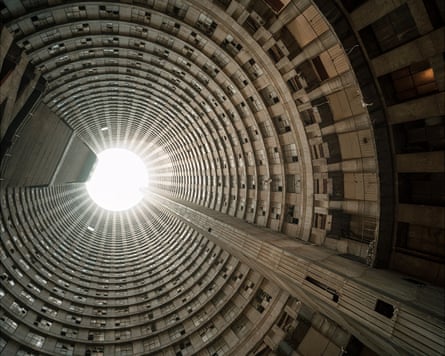
One of the fair’s big draws was the chance to see Ponte City by Patrick Waterhouse and Mikhael Subotzky. Developed over 15 years, the project examines Johannesburg’s famous 54-storey residential tower through an extraordinary accumulation of photographs, documents, objects and residents’ stories. A new addition is their Ponte City book box presentation, which turned this archive into a modular installation of mobile towers, books, images and archival material. Photographs of doors, windows and television screens become fragments of a collective portrait of the tower, revealing the complexity of a building that embodies South Africa’s contested social and architectural history. It raises questions about the ethics of documenting a community, about how to preserve residents and honour their lives without reducing them to an art object. It’s a richly layered and absorbing story – enough to make you forget you’re at a fair.
Ultimately, Paris Photo 2026 was at its most convincing when it moved beyond the familiar. The bicentennial resulted in a load of nostalgic booths, not only at the fair but at institutions across the city, but does anyone really care about the anniversary? The best bits were about photography’s future – its capacity to be porous, to absorb other references and disciplines, to challenge reality as we know it. Two hundred years after its invention, photography’s most interesting question may no longer be what it can show us, but what it can make visible that we have previously been unable, or unwilling, to see.
KioskNews shows a cleaned-up reading view extracted from the publisher’s page — the original always lives on their site, not ours.