‘I’ve never been more terrified!’ Carly Rae Jepsen on motherhood, stardom and her horniest album ever

Carly Rae Jepsen is as bubbly as ever as she comes down for breakfast at Manhattan’s Hotel Chelsea. She’s one of those pop princesses, like Kylie Minogue, whose voice and demeanour remain unchanged whatever the situation. And she feels at home at this New York landmark where, last year, she married the musician and producer Cole MGN. That a wedding at the Chelsea would need to be kept to about 100 people was an immediate selling point. “I loved that it was smaller,” she says. “It felt big to me! I didn’t even get time with all the people that were there.”
We’re here to talk about her new album, though, which comes out 14 years after the song that made her world-famous. Born and raised in the city of Mission in British Columbia, Jepsen had come third on Canadian Idol in 2007, and then released a low-key folk album called Tug of War in 2008, before dropping Call Me Maybe four years later. It became the bestselling global single of 2012; her second album, Kiss, came out in the same year. Now, at the age of 40, she has six more studio albums under her belt. The latest, Day and Night, is her take on marriage and motherhood. And, in its own way – which is to say, a bit coy, a bit breathy – it might also be Jepsen’s horniest album to date.
“I’m gonna spit my tea out,” she says when I suggest this, laughing while steadying the cup in her hand. It turns out I’m not the first to broach the subject. During a session with King Princess, Jepsen’s fellow singer-songwriter called her a “very horny writer”.
Jepsen thought she’d been subtle about it. “I don’t love it to be aggressively there,” she says. “However, I think that longing is really sexy – knowing what you want and being not afraid to say it out loud. I’ve always found a real thrill in being the person who’s advancing the thing; who’s a couple steps ahead of the person they’re chasing.”
As far back as Call Me Maybe, she points out, her music has contained a thread of exhilaration about being the pursuer. If lust is so prominent in Day and Night, it’s because Jepsen and her husband fell in love during the album’s creation. “‘Don’t kiss the producer’ was a rule of mine,” she says – and yet she did.
And it’s not the only time she’s broken rules or confounded expectations. Say what you will about Call Me Maybe – and it’s easier to appreciate the track when it’s not blaring out from every storefront – but it demonstrated Jepsen’s mastery of pure pop: melodic, catchy, with fiendishly clever lyrics Abba would be proud of: “I get lovingly told that I’m part Canadian, part Swedish,” she says, delightedly.
It sold more than 18m copies, reached No 1 in 19 countries, and won Jepsen a worldwide recording contract. It also helped Kiss, the album on which it appeared, reach the Top 10 in Australia, the UK, Canada and the US. Its follow-up, 2015’s Emotion, was ecstatically reviewed.
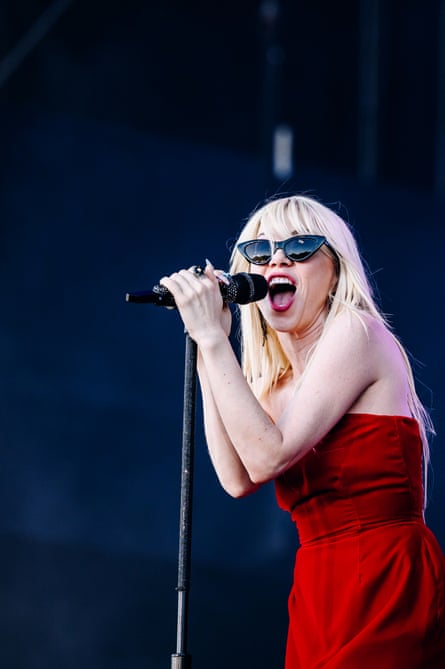
In virtually any other era, Jepsen might be filling stadiums. But changing tastes aside, the music scene has fragmented thanks to streaming and social media, and the charts can be topped by a song that many have never heard. The one-time “megastar” is now more likely to be described as an “indie darling”. How does she feel about her industry?
“There’s a little bit that I don’t totally know or understand, or stay checked into,” she says, “and I don’t know if that aloofness just comes from the fact that it’s not super interesting to me.” Maybe it’s a survival tactic, she adds, “but the reality is, long ago I became aware of what my strategy would be, and I’ve stuck to it. I knew around the time that I made Emotion that I was more excited about having a strong, small-but-mighty group, than I was about trying to be confused and feed the masses.”
Now she knows who she is and who her fans are, but that knowledge didn’t come overnight. “I needed to take a second to figure out what it was that I liked about pop music to begin with, and what it was that I thought I had to contribute to it,” she says. “That’s why I went and did Cinderella, which was a really weird left turn.”
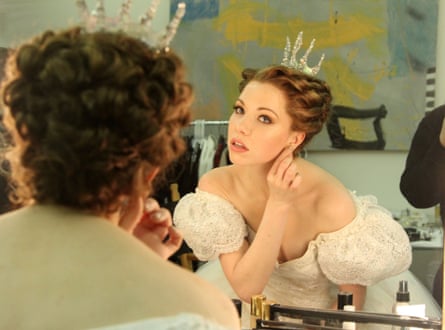
In 2014, less than a year after winning three Canadian Juno awards for Call Me Maybe and Kiss, Jepsen made her Broadway debut in a production of the Rodgers and Hammerstein musical. “I think everyone in the industry around me at the time was like: ‘What is she doing?’,” she says. But ticket sales were good, her stint on Cinderella was extended (“I love theatre, so it was like getting my cake and eating it”), and the experience reconnected her to her craft: “It was more of an artistic choice than a strategy, I guess.”
“I think what I feel about pop music is not that I love all of it, but I have a really strong opinion about it,” Jepsen says. “I don’t know that I can define it, but I was excited about trying to figure out the thing that makes me feel like I did with Rufus, where you know a stranger.” “Rufus” is Rufus Wainwright, whose moody 2001 song Poses first inspired her to “take a run at this music thing”. That unknowability is what still excites her about pop: “The idea that comes across, hopefully, in this album, is that you can play with so many different genres as ingredients and it can still be the thing.”
It was Jepsen’s former A&R representative, John Ehmann, who fostered that playfulness when he encouraged her to release a “B-side” follow-up to Emotion, knowing she had written far more songs than she had released. Initially hesitant, and worried that the songs weren’t up to par, Jepsen was convinced by the lower-stakes connotation of the B-side concept, and the fact that the record would only be an EP. She particularly liked the idea “that it was a bit more like showing the inside process”. Fans loved it and, from there, these projects became increasingly official. After 2016’s Emotion: Side B came 2020’s Dedicated Side B – a full album – and then 2023’s The Loveliest Time, a companion to the previous year’s The Loneliest Time, salvaged from the “100 or so” tracks she’d written for the album but then culled.
“It ended up being such a weird door that opened for my life,” this notorious overwriter says. “I’ve so enjoyed this permission to not only get more experimental but, because I write so much, have this other place for things to live. So even when I was creating Dedicated [in 2019], I was already allotting things to this other idea of: ‘Maybe not everyone will get it, but I’ll have some fun.’”
From Dedicated onwards, Jepsen felt she was “expanding and exploring, excited about the vastness of what a pop song could be”. But for Day and Night, her goal was cohesion: “something that felt like it lived in a home; a pure world.”
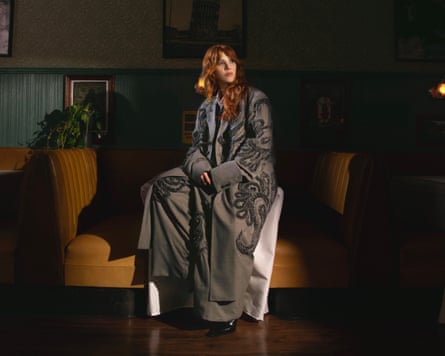
Sonically, she’d found herself drawn to sunshine through the soul singer Minnie Riperton and jazz vocalist Blossom Dearie, and then the “darker scents” of house music and chillwave producer Bullion, with whom she collaborated on the 2024 single Rare (which appeared on his album Affection, released on Ghostly International). A visit to the Abba Voyage hologram concert, meanwhile, reinvigorated her appreciation for “a tight melody, with updated production”.
Then her longtime guitarist, Tavish Crowe, suggested a thought experiment: a musical walk through a house party that included stops by the stoners, the ravers, the couple fighting in a locked room. They landed on the idea of a double album that could sustain all of these ideas. “The challenge became making sure that each of those albums was expansive enough,” she says. “I wanted cohesiveness, but I also didn’t want 12 songs that felt like you were listening to the same song on repeat.” There’s more delving into her thought process, then she stops herself: “Sorry, I sound so nerdy when I talk about this.”
Nerdiness is not what comes across on Day and Night, though. There’s that aforementioned sexiness, in lyrics that are less about getting someone into bed than about the difficulty of making it out the next morning. And there’s domestic bliss. Jepsen became a mother in March, which she “didn’t always think was on the cards”.
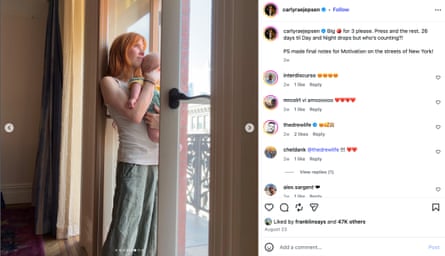
She remembers working in a Vancouver coffee shop 20-odd years ago, seeing young kids and thinking: “I would love to hold that cute baby.” But, she says, “I always had this very clear vision for my life; that I was on a mission to make music, and that was, for a very long time, my priority. Similar with getting married.” There was never a bridal Pinterest board for Jepsen, hardly even the thought of a husband. “All of these things were nice, hypothetical ideas that belonged to other people. Maybe I almost romanticise this idea that, as an artist, it was more my job to be an observer of life than to wildly participate.”
Now she’s left being a bystander behind. “At this stage in my life, I feel much more comfortable with the parts that I don’t have full control over,” she says. “There is nothing more vulnerable than having a child. It’s this whole heartbeat that breathes outside you. I’ve never been happier and more terrified – but I feel very, very alive.”
After Day and Night, Jepsen’s focus will be on the result of a phone call with the theatrical producer Mike Bosner, five years ago. Having heard that she was interested in writing for Broadway, Bosner rang Jepsen and said: “Lena Dunham, 10 Things I Hate About You.” She slaps her palms on the table and mimes an awestruck face.
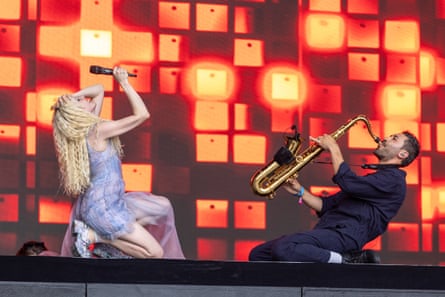
Jepsen had wanted to work with Dunham for years, having met her through their shared friend and collaborator Jack Antonoff. “She’s been a support from the beginning, always so sweet about certain songs,” Jepsen says, recalling the Girls creator’s love of Guitar String/Wedding Ring, from Kiss. (Dunham used a key line from the song – “If you cut a piece of guitar string / I would wear it like it’s a wedding ring” – as an epigraph for the “Falling in Love” chapter of her 2014 autobiography, Not That Kind of Girl.) “I’ve always thought – and I think everyone feels this way – that the way she puts words together is hilarious and brilliant,” says Jepsen.
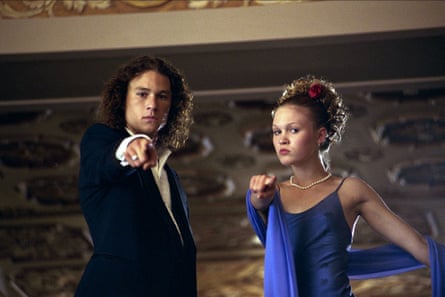
Their adaptation of Gil Junger’s 1999 teen comedy 10 Things I Hate About You – a collaboration with co-composer Ethan Gruska and playwright Jessica Huang – is due to open next August. The task of scoring an existing story, let alone one that’s a spin on Shakespeare’s The Taming of the Shrew, with a lead character to whose “anger and passion” Jepsen thinks every woman relates, “is a completely different energy of approaching music. You want to honour the 90s and really do it justice.”
Having caught a workshop presentation of the production earlier this year, I tell Jepsen how I heard her voice throughout the cast’s. “That is the best part,” she beams, adding that she has enjoyed the challenge of writing for different characters, particularly men. But, she adds: “I do believe if you haven’t felt it you can’t write it – you have to really feel them in order to have anything for them to say.
“When you’re singing on Broadway, when you think about the reason one would need to sing in real life, the emotion has to be so potent that words are no longer doing it,” Jepsen says. “There’s only a song when the feeling erupts.”
KioskNews shows a cleaned-up reading view extracted from the publisher’s page — the original always lives on their site, not ours.