Still wielding a chainsaw at 85: the Australians restoring nature in retirement
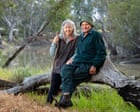
When Susan Downes stepped into the hallway of an old farmhouse for sale in York, Western Australia, she felt an oddly certain sense of knowing. “Oh, this is my house,” the retired GP remembers thinking. There was just one problem: it came with 200 hectares.
Widowed and with her children grown, Downes, then in her 60s, was finally able to act on a long-held wish to move to the countryside. She had imagined something modest: an old house with “a little bit of garden and stuff”. Two hundred hectares was rather more than she had in mind, no matter how charming she found the high ceilings. “I thought, the house is lovely, but I can’t possibly do that.”
But the property had gotten under her skin. Returning for another look two weeks later, she discovered Mount Mackie, a 295-metre hill at the back of the farm where ancient York gums and wandoos had survived about 150 years of grazing. Almost all of the understorey had disappeared. “These magnificent old trees” were all that remained. “I felt a great connection to the land,” she says.
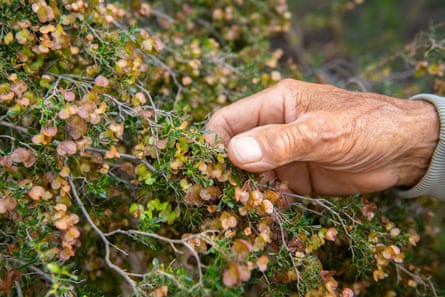
Downes, now 76, bought the property and slowly began restoring it. She started with a small local grant to control foxes and feral cats. Then she applied for another, and was awarded 24,000 trees over three years. “I thought, OK, I can start doing this,” says Downes, who began her career as a botanist. “This is what I really want to do.”
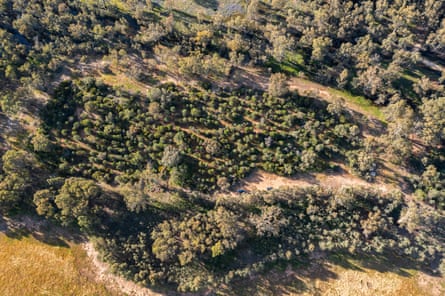
Today, about 45,000 native seedlings have been planted, while a further 45 plant species have reappeared naturally from the seed bank. The restoration now spans 120 hectares of Downes’ working farm, which she is placing under a conservation covenant so it can never again be cleared. The work is supported by Friends of Mt Mackie, a volunteer group with a core crew of about eight alongside more than 80 volunteers who join organised planting and seed-collecting days.
Downes’ days are spent rebaiting live traps, weeding and planting, and dealing with what she jokingly calls “all this bloody admin”. But the payoff is considerable. “Some of the trees are now taller than I am,” she says proudly. “You can see them from two or three kilometres away.”
‘I was hooked’
Downes is part of a large cohort of Australians spending their spare time repairing the natural world. The latest Australian Bureau of Statistics data suggests roughly 290,000 Australians volunteer through environmental protection or animal welfare organisations.
Older Australians are particularly prominent: in Landcare Australia’s 2026 national survey, 80% of respondents were aged 55 or over.
Peter Garrett, Landcare Australia’s chair, calls older Australians “the backbone” of the movement. Retirement brings more time, he says, but also a chance to reassess priorities and think about what will be left for children and grandchildren. “The sort of stirring song of the Australian bush calls to them,” he says.
In a world of crises that can feel beyond individual control, conservation offers something tangible. People may not be able to change everything, Garrett says, but they can look after “our back yard, our bit of bush down in the gully, our creeks and streams”. This can bring “a lot of purpose” in later life.
For 70-year-old Lyn Sharp of the Gold Coast, conservation volunteering began with sea slugs. Five years ago she joined a project to count and monitor them at Burleigh Heads. Immediately she felt she had found her place. “That was it,” she says. “I was hooked.”
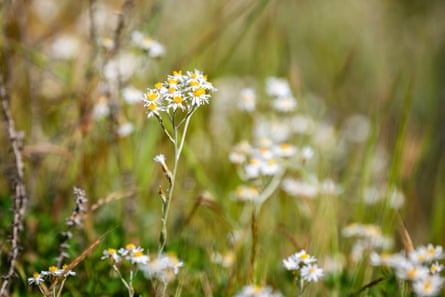
Sharp spent most of her career in the cheese industry and, for 23 years, lived on a steep bush block on Tamborine Mountain that absorbed much of her spare time. After retiring and downsizing to a townhouse in Nerang, she redirected that energy into national parks, council reserves, waterways and beaches.
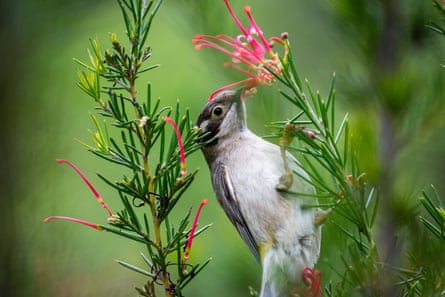
Sea slugs were just the beginning. Sharp soon added water bug, turtle and platypus surveys, seagrass monitoring and bush regeneration. Cane toad season brought nocturnal hunts and calls from people needing somewhere to drop them off. She now volunteers up to 15 hours a week.
Some of the work is becoming harder. Bursitis in her hip makes the repeated squatting involved in surveys painful, while a troublesome shoulder has flared up too. Sharp remains determined. “What am I going to do? Sit around like a veggie?” she says. “No one’s gonna stop me.”
‘We need another two lifetimes’
On the Edward River in New South Wales, 30km outside Deniliquin in the Riverina, 85-year-old Ken Hooper and his wife, Jill, 82, have spent decades restoring damaged country. “It’s a bit addictive,” Ken says.
In 1992 the Hoopers bought Wirra-Lo, a 180-hectare property in northern Victoria, as part of their dairy farming operation. When they retired, they kept it, placed it under a conservation covenant and began the painstaking work of restoring its bush and wetlands. Even that was not enough.
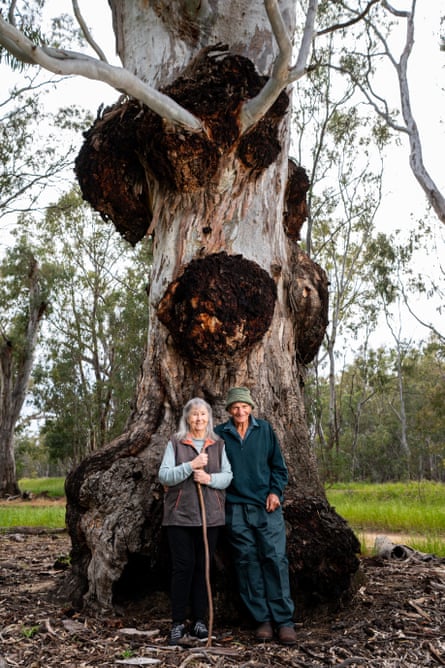
Looking for somewhere to spend their retirement, they found Moona-Bingel in NSW, where a conservation agreement now covers 970 hectares of country they have spent more than 20 years restoring. For a time, they ran both projects, with Ken frequently driving 100km back to Wirra-Lo – and sometimes camping there. In 2023 the pair sold it to the Wetland Revival Trust.
Ken is still nowhere near done. “No retirement involved,” he says. At Moona-Bingel, the work is relentless: weeds, feral animals, revegetation and flood management. Despite osteoarthritis and two replacement knees, he still uses a chainsaw. Red deer are a particular irritation, capable of smashing a carefully nurtured 2-metre tree below knee height. “The rotten bugger,” he says.
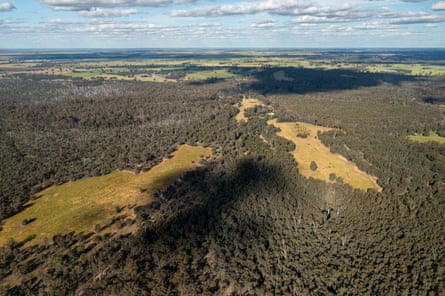
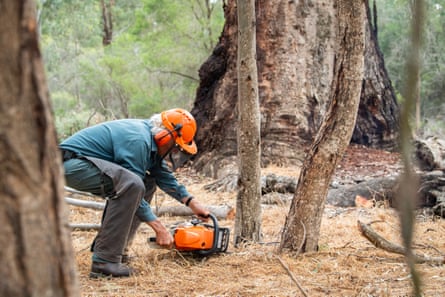
But there are rewards almost daily: new birds, breeding carpet pythons and native vegetation spreading by itself. “You’ve got to have something, because that’s what keeps you going,” Ken says.
Jill jokes that “there needs to be three of us … There’s just not enough time in the day.” Ken reckons even three might not be enough. “We need another two lifetimes to do what we’d like to do.”
Back at Mount Mackie, Downes contemplates what will remain when she is gone. The deaths and dementia diagnoses of friends have changed the way she thinks about the time she has left. “I suddenly realised I might not even have a day,” she says.
What remains unresolved is who will ultimately take responsibility for it, her grandchildren or some kind of society or organisation: “I need to have it set in stone.”
She hopes her children and grandchildren, seeing what she has done, will be inspired to care for the natural world in their own way. She also wants Mount Mackie to remain a place the wider community can use and share.
Several times a year, Ballardong women from York come to the hill for cultural healing sessions. Downes is working with Ballardong elders to find an Aboriginal name for Mount Mackie, with planning also under way for a 2030 reconciliation event marking 200 years since European arrival in the region.
“It’s no use to me being there by myself,” Downes says. What brings her the most joy is “seeing people love the place … having people share it with me”.
KioskNews shows a cleaned-up reading view extracted from the publisher’s page — the original always lives on their site, not ours.