China corruption watchdog investigates senior science ministry official Liu Min
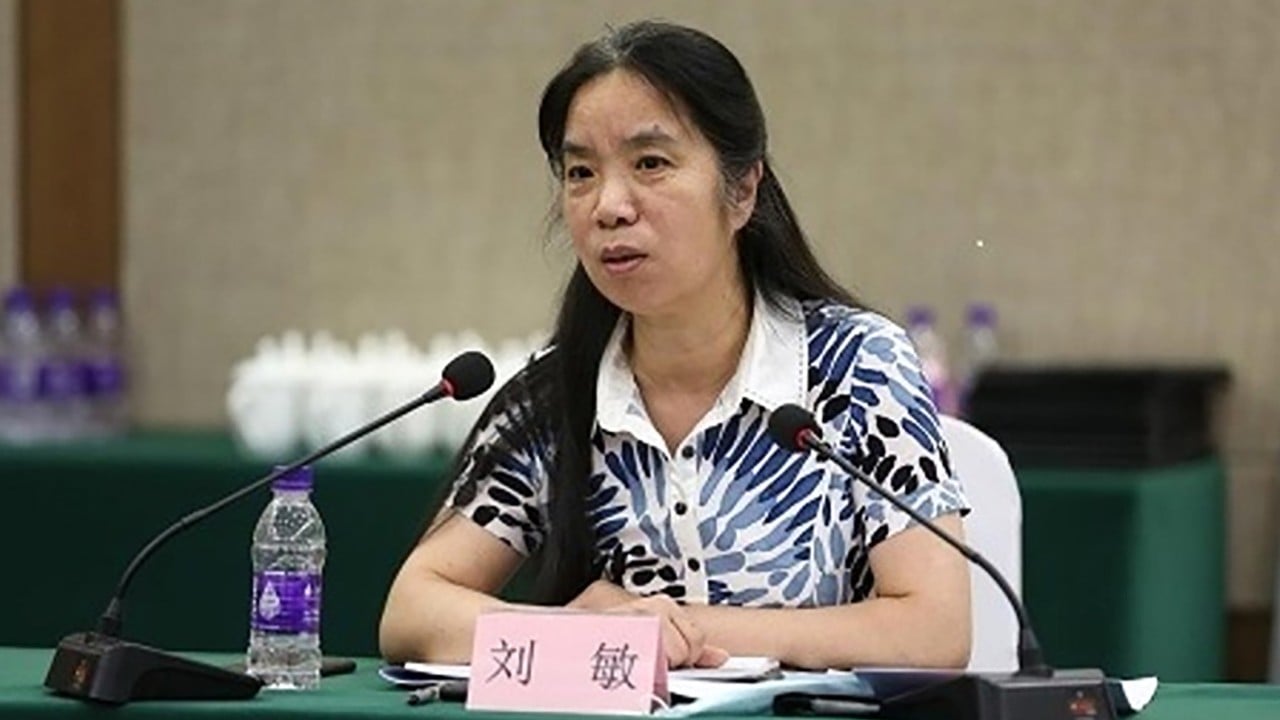
Liu Min, a senior official at the Ministry of Science and Technology, is under investigation, according to China’s top anti-corruption watchdog, the Central Commission for Discipline Inspection (CCDI).
Liu is “suspected of serious violations of party discipline and national laws” – a euphemism for corruption – and is currently subject to disciplinary review by the CCDI team at the ministry.
She is also being investigated by the supervisory commission in Yichang, Hubei province, in central China, the CCDI said in a statement issued on Monday.
Liu, who has served at the science ministry for more than a decade, was named deputy director of its Department of Innovation and Development in 2014.
A year later she became director of the ministry’s Intellectual Property Affairs Centre and in 2020 was appointed director of the Department of Major Science and Technology Projects.
Public records show that this department was in charge of developing proposals and planning major national projects, as well as monitoring and overseeing project implementation, issuing supporting policies and organising evaluations.
In 2023, after institutional reform, the ministry removed the department and integrated its core functions into other divisions.
The reform was part of a plan to assert more party control over crucial domains such as science and technology, finance and grass-roots governance, at a time of fierce technological competition with the United States.
The authorities were concerned with the need to achieve important breakthroughs and move the country faster towards self-reliance while striving against the US for leading position in the technology race.
China’s investment in science and technology has continued to rise in recent years, with national research and development expenditure reaching 3.93 trillion yuan (US$58.89 trillion) in 2025, up 8.2 per cent from the previous year, official data showed.
The science ministry holds significant authority over the overall layout, coordination, supervision, evaluation and resource allocation of major national science and technology programmes.
Liu’s case comes amid a broader anti-corruption campaign that continues to target officials in key industries.
The science ministry has seen several senior officials fall from grace in the past few years. In July 2020, the CCDI investigated Zhang Zhaofeng, who was in charge of overseeing biotechnology and pharmaceuticals.
In 2024, Li Yong, deputy director of the ministry’s department for talent and science popularisation, was sentenced to 11½ years’ imprisonment for taking bribes. And in July last year, Wang Chunyang, who works at the centre of new technologies, was placed under investigation.
China’s anti-corruption crackdown
At a meeting in April on comprehensive and rigorous party self-governance, Gao Bo, the head of the ministry’s discipline inspection and supervision team, cautioned that “lessons must be drawn from handled cases”.
“We need to pay attention to the loss of ideals, weak awareness of rules, inadequate implementation of institutions and absent management and oversight reflected by these serious violations,” he said.
The Chinese leadership has stressed repeatedly the pursuit of “full and rigorous party self-governance”. President Xi Jinping declared it again last month, as the party’s 20th Central Committee closed its fifth plenum.
“If full and rigorous self-governance has had an impact on economic and social development, it has been positive, not negative,” he said.
Xi vowed that the party’s stance would not soften, declaring that regardless of future headwinds or uncertainties, the leadership would remain steadfast with “not the slightest hesitation or retreat”.
Also on Monday, the CCDI announced that Ma Jin, an official at the National Natural Science Foundation – China’s primary funding mechanism for basic research – was under investigation.
KioskNews shows a cleaned-up reading view extracted from the publisher’s page — the original always lives on their site, not ours.