Notes from Central Taiwan: How the AI industry is reshaping Taiwan’s landscape
The AI boom is transforming land, industry and resource use from Miaoli to Pingtung
By Michael Turton / Comtributing reporter


Focus Taiwan reported on the Kuai Kuai land sale, with a narrative centered on the famed snack factory’s workers. But buried in it was a glimpse of the way Taiwan’s land markets are being relentlessly reshaped by the multiple pressures of sagging traditional industry fortunes and surging AI and related electronics industries.
Kuai Kuai’s owner, the San-ti Group, sold the factory and the land it sits on in Taoyuan’s Zhongli District (中壢). According to Taoyuan Confederation of Trade Unions Secretary-General Tracy Sun (孫語謙), who was quoted in the piece, rising land prices, especially for industrial land, tempt factory owners to sell off their land to AI and semiconductor firms. Sun suggested San-ti had probably purchased the land intending to sell it in the hot industrial land market.
Industrial land prices are indeed rising, driven by demand from AI. A June report from Sinyi Realty Inc (信義房屋) noted that the hottest industrial land market was in Miaoli County. Several years ago I wrote on attempts to join Miaoli and Hsinchu to form a single municipality in response to the desire of tech firms to reduce the administrative costs of having factories in two separate counties and multiple industrial park managements (“Municipal Independence”, Jan. 3, 2022). This demand will only grow as Miaoli becomes an even more important site of industrial land expansion. Hsinchu City and County now have a combined population exceeding one million, close to the 1.25 million statutory threshold for a special municipality.
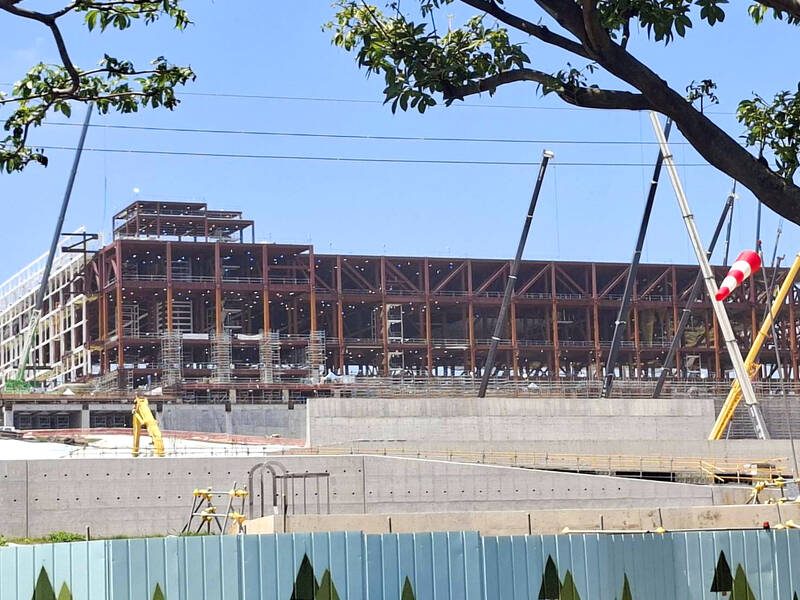
Construction of Taiwan Semiconductor Manufacturing Co’s P1 fab, located in Phase II of the Taichung Science Park.
Photo: Su Chin-Feng, Taipei Times
The Miaoli experience is being repeated across central Taiwan. Demand for industrial land and commercial office space is booming. An April 2025 report by Colliers International noted rising industrial land prices driven partly by semiconductor and AI-related demand, with industrial expansion increasingly moving south. Demand for industrial land was expanding southward even then.
Recent Democratic Progressive Party (DPP) administrations have been careful to spread the wealth, pushing semiconductors and their associated industries further south. Redistribution from the north to the south has long been a DPP policy goal. Southern expansion also relieves pressure on northern water and electricity systems.
Construction commenced in June on a dedicated semiconductor supply chain park in the southernmost section of the Southern Taiwan Science Park (STSP) in Pingtung County. The STSP stretches across Chiayi, Tainan, Kaohsiung and Pingtung. Taiwan Semiconductor Manufacturing Co (TSMC, 台積電) is building advanced packaging fabs in the Chiayi Science Park. National Science and Technology Council (NSTC) Minister Wu Cheng-wen (吳誠文) said the government envisions a vast corridor of semiconductor and associated technology firms in parks extending from Pingtung to Hsinchu, the greatest such collection in the world. Unsurprisingly, the Pingtung portion of the STSP sits within the High Speed Rail (HSR) land allocation for the Pingtung HSR station, on Taiwan Sugar Land, next to the Liukuaicuo Taiwan Rail Station.
Meanwhile, as CommonWealth Magazine noted in another excellent piece last year (“Taiwan’s Machine Tool Makers Struggle to Survive”, Nov. 5, 2025), traditional industry factories are shutting down as competition from the People’s Republic of China (PRC) and the new tariffs of the administration of US President Donald Trump hit them.
“All along the ‘Golden Valley,’ which once supported tens of thousands of families, one roll-up metal door after another is shut tight,” it reported, referring to the dense accumulation of small machinery, metal and sporting goods factories that once spread from Taichung down into Changhua.
This is happening across Taiwan, as the article observed: “older industrial zones in northern Taiwan are also in structural decline.”
Smart young people are studying for jobs in the shiny new semiconductor industry, instead of traditional industries.
Continuing too is agricultural land loss. Taiwan has lost a substantial amount of cultivated land since 1990. Anyone paying attention to the steady conversion of farmland to industrial use, and the large quantities of agricultural land occupied by illegal factories, which always hunger for more land, can understand the objections by local factions and large industrial firms to renewable energy: it drives up agricultural land prices.
A 2023 study in the Journal of Environmental Management (“Solar farm policy and farmland price — A land zoning perspective”, October, 2023) by Chang Hung-hao (張宏浩) and Lin Tzu-chin (林子欽) showed that after the government tightened zoning regulations to prohibit solar panels on farmland under 660 square meters, farmland prices fell by 21.8 percent. They also found that this reduction grew as time passed, and “farmland with higher prices per hectare are most severely affected.”
Land speculators, especially local faction-linked developers and land brokers, probably noticed that land is cheaper when there is no solar power around. Hence, political parties with strong links to local factions attempt to quietly suppress the development of solar power on agricultural land. The domestic economy depends on land and real estate, and a supply of cheap agricultural land is necessary to keep it running. It is also critical to the semiconductor boom.
Researcher Justin Kollar interviewed officials and found that “local governments, enticed by land conversion revenues and industrial prestige, have rezoned agricultural areas at unprecedented speed,” he wrote last year in a must-read paper on semiconductors and land (“Fallowing the fields, feeding the fabs: Territorial restructuring and the political-industrial ecology of high-tech Taiwan”, Environment and Planning E: Nature and Space.
As the semiconductor industry expanded, so did local government rezoning of agricultural land.
Kollar’s work shows how the government quietly prioritizes water development for semiconductors even where it piously says enhanced water facilities are constructed to serve farmers and residents. It is likely that Taiwan is heading towards the same quiet redistribution of electricity as well. The erosion of traditional industries, which are more electricity-intensive per unit of GDP created than semiconductors, has helped ameliorate a possible looming power crisis.
Minister of Economic Affairs Kung Ming-hsin (龔明鑫) last month said the government would consider raising its average annual electricity demand growth forecast, originally projected at 2.5 percent annually through 2035 in June, to reflect the high demand scenario.
The world of the future is already being realized as is shown in a case study of farmers experiencing farmland loss in Yunlin County’s Huwei Township (虎尾), which identifies several issues with farmland loss and conversion (“Agricultural Land-Use Transition and Procedural Justice: Evidence from a Systematic Literature Review and a Case Study in Taiwan,” Sustainability, 2026, Vol 18) by Liu Wei-kuang (劉為光) and Shen Yi-wei. The Huwei case takes place in the HSR development corridor (the Yunlin HSR station is nearby).
The farmers and local agricultural experts and officials reported that many farmers did not realize the true value of their land when they sold it to developers. As home prices rose farmers sold their land to pay for houses elsewhere, since they could no longer afford to live in the local community. Sons did not carry on farming, since crop prices were low, water difficult to access and less land was available.
Moreover, some farmers leased land to farm, but the government subsidies for dryland crops, intended to reduce groundwater use, went to land owners rather than farmers. The farmers themselves blamed urban expansion and construction for groundwater overuse, rejecting the narrative that criticizes farmers’ groundwater overuse for subsidence.
This transition is going to take place across the south as the semiconductor industry reorganizes demand for land, power and water. What will the region’s politics look like in a decade?
Notes from Central Taiwan is a column written by long-term resident Michael Turton, who provides incisive commentary informed by three decades of living in and writing about his adoptive country. The views expressed here are his own.
KioskNews shows a cleaned-up reading view extracted from the publisher’s page — the original always lives on their site, not ours.