The BoM’s temperature record keeping is under attack – again. What’s going on? | Temperature Check

Australia’s climate has warmed by more than 1.5C since 1910, according to the Bureau of Meteorology’s main long-term temperature data.
If you were so motivated, you might think if you could discredit this data, then you would undermine the whole climate change story and even – perhaps – the rationale for cutting Australia’s greenhouse gas emissions.
Over the past week, The Australian newspaper has launched a major reporting campaign based on a “forensic audit” that attempts to discredit the data, claiming it has found “widespread errors” that raise “questions about the integrity of records used for climate analysis”.
These are big claims indeed, that would require remarkable evidence.
Former prime minister and climate science denier Tony Abbott called for an independent review, while News24 (formerly Sky News Australia) and 2GB also promoted the story, which sent climate science denial blogs into a flutter.
On Thursday night, the bureau released a statement saying the claims were based on “several misunderstandings” and accusations of human intervention in the data were “false and unsubstantiated.”
The bureau’s temperature records have been a constant target for climate science sceptics for more than 15 years. So what is going on?
First, a primer.
When it comes to temperature records, the bureau makes the raw temperature data from its weather stations available to the public.
But the bureau’s main temperature dataset for measuring climate change – known as ACORN-SAT (Australian Climate Observations Reference Network – Surface Air Temperature) takes observations from 112 weather stations and performs a quality control process to remove the effects of local changes (like a station moving) that could artificially alter the readings.
There are of course multiple other datasets that show Australia’s climate, just like the rest of the planet, has warmed and how this heating presents a troubling laundry list of risks that leave almost no aspect of life in the country untouched.
The Australian’s reporting – that includes at least eight pieces of coverage from stories, follow-ups and cartoons to editorials – centres on an “audit” of the raw data, which it said was carried out by a retired scientist and a former computer engineer.
There are too many claims to list here, but they range from accusations that sequences were detected showing “obvious patterns of human intervention” to missing or duplicated data.
How was this audit done? The audit report does not outline its methodology, saying only it had used statistical software and computer coding. This lack of a methodology might cause some to pause, but not The Australian.
The most striking example from the report, wrote The Australian’s environment editor, Graham Lloyd, came from the minimum temperature readings for August 1907 for Sydney’s Observatory Hill that were found to have been duplicated in the record for August 1867.
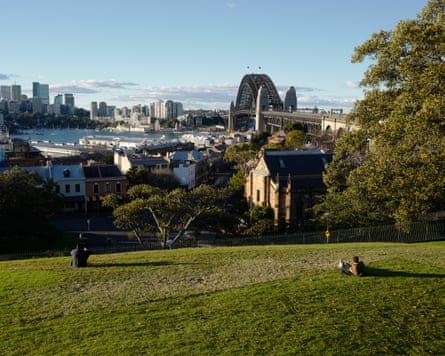
This deserves an explanation from the bureau.
But it is also true that data before 1910 is not used in ACORN-SAT and so, in the context of what the bureau’s data says about Australia’s changing climate, it is irrelevant.
A bureau spokesperson said it had examined the claims made in the report and less than 200 observations from the 7m in ACORN-SAT data had been affected by duplication.
The spokesperson said 10 months of observations had shown duplicate data for minimum temperatures at Observatory Hill, but only three of those months were after 1910. A fourth month of duplicate temperatures had been identified at Charleville in Queensland.
They are all from handwritten records of pre-1946 data that have been manually digitised.
The “resultant impact on Australia’s long-term temperature record is so small as to be statistically irrelevant,” the bureau said.
No further duplicate months had been found in the entire network of weather station readings.
But how could these duplications have happened? A spokesperson said a “working hypothesis” was that the errors likely occurred in the 1950s or 1960s.
“This is when the original handwritten records (field books) were transferred to a punch card system,” they said.
“It is plausible that the manual handling introduced the duplication. Discussions with former bureau employees indicate the digitisation in question occurred prior to the 1980s.”
after newsletter promotion
Data failure?
What about the claimed “patterns of human intervention” in temperature data?
Another claim of the audit was that a run of 17 consecutive days of 31C maximum temperatures at Palmerville on Queensland’s Cape York in 2004 was evidence of “data failure”. “The probability of this occurring naturally is effectively zero”, the audit report claimed, and “less likely than winning the lottery every week for a year.”
The bureau rejected this and said the audit had appeared not to have taken into account how some historical raw observations were recorded to the nearest degree, as was the case with the Palmerville site at the time.
“In combination with lower temperature variability in the tropics, this makes repeated patterns in the raw data more likely.”
‘Secret climate business’
In one follow-up piece, David Evans, a climate sceptic, made the odd declaration that “secret climate business” at the bureau had to end and repeated it in an editorial he wrote for the newspaper.
I say odd, because the so-called audit could not have been done had all the data not already been made public. The ACORN-SAT has already been the subject of two independent reviews and the methods it uses have been published in peer reviewed journals.
The recent audit report had two authors. Lloyd described one, Tom Berger, as an investigator and “former computer engineer and specialist in data-based deception analysis”.
According to Berger’s own website, he has also been a corporate entertainer for more than 30 years and had “mesmerized corporate audiences worldwide” blending “mind-bending entertainment with neuroscience-backed insights – revealing thoughts, predicting actions, and cracking the code of persuasion”.
A second author, Geoff Sherrington, was described only as a “retired scientist”.
Sherrington described himself as a retired geochemist at a mining company when he signed a declaration in 2022 rejecting the role CO2 plays in the climate.
‘Red meat to its audience’
Lloyd wrote that the audit report had been sent to the bureau “on behalf of Mr Berger” by the independent Tasmanian MP Andrew Wilkie, who received a letter back from the bureau explaining its investigations, and saying accusations of fraudulent or deliberate data manipulation had “no basis in fact”.
Wilkie told Temperature Check he wasn’t asked by The Australian to comment and “felt uncomfortable” the article might have been interpreted as him having doubts about the bureau’s integrity or its climate data.
“I found The Australian’s coverage of the matter to be quite feverish, and red meat to its audience, which flooded one article with about 1,000 comments,” he said.
He had “no reason to reconsider my trust in the bureau,” he said.
Attacks on the bureau’s temperature records have been orchestrated by climate science deniers for more than 15 years. Previous episodes have been described by scientists as “harassment”. One former bureau boss described the source of previous attacks as a “fever swamp” of climate science denial that had wasted scientists’ time.
On each occasion, The Australian newspaper, rather than the scientific literature, was the journal of choice for sceptics to make claims of a conspiracy within the bureau.
In the meantime, the climate isn’t paying attention.
Guardian Australia approached The Australian for comment.
-
Graham Readfearn is Guardian Australia’s environment and climate correspondent
KioskNews shows a cleaned-up reading view extracted from the publisher’s page — the original always lives on their site, not ours.