More Singapore parents value non-academic development but stress over children’s future: IPS study
SINGAPORE - More parents of primary school children in Singapore feel stressed and anxious about their children’s future, and whether they will fall behind in the long run.
Though most increasingly value holistic or broader development and see Singapore’s education system as among the best in the world, more than two-thirds of parents say it still causes their children unnecessary stress.
Compared to 2016, the proportion of parents who reported arguing with their spouses over their children’s education rose from 42.8 per cent to 59.7 per cent in 2026. Those who reported feeling stressed rose from 73.1 per cent to 87.9 per cent.
These were findings from a 2026 Institute of Policy Studies (IPS) study on parents’ attitudes and perceptions of Singapore’s education system from May to August. The results build on insights from its last study on the same topic in 2016.
The latest edition surveyed 1,500 parents - Singaporeans and permanent residents - between the ages of 21 and 65, who have at least one child attending a local primary school during the study period.
Mathew Mathews, the principal research fellow at IPS, said the latest study was conducted following major reforms over the past decade. These include using broader achievement bands instead of numeric T-scores for the PSLE, phasing out mid-year examinations and implementing full subject-based banding.
Yet he said these changes have not translated into significantly less pressure for families.
“This is a concern... despite the fact that we do have shifts within the education system… you still see that the stress has broadened into newer areas,” said Mathews, one of three researchers involved in the study.
He was speaking on Sept 25 at a media briefing held at the IPS building at Cluny Road. The other two researchers were IPS research fellow Melvin Tay and IPS senior research fellow Teo Kay Key.
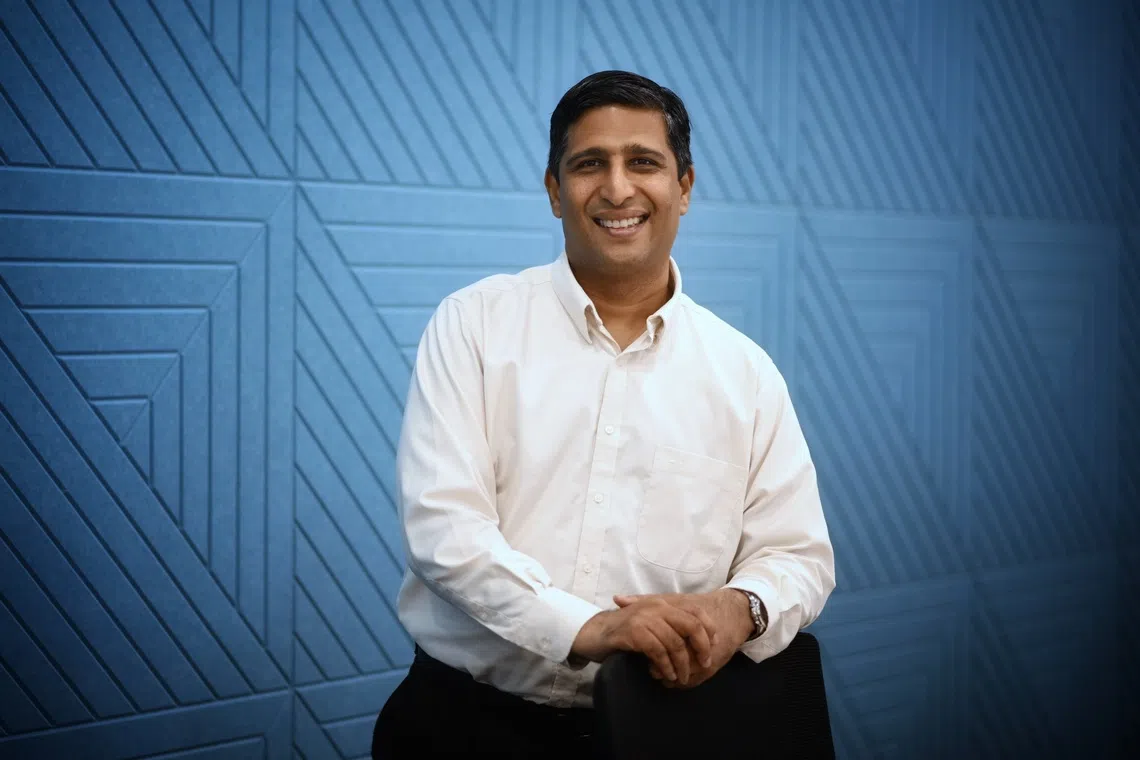
Mathew Mathews, the principal research fellow at IPS, said the latest study was conducted following major reforms over the past decade.
ST PHOTO: CHONG JUN LIANG
“We do notice that parents are reporting less anxiety or less stress about homework, and being there to prepare the child for examinations,” said Mathews, adding that these were the top concerns for parents surveyed back in 2016.
Parents now are concerned that their children are not obtaining the grades they are capable of, may lose out in the education system in the long run, and not keeping up with what is taught in school.
Though children spend less time on homework compared to ten years ago - 4.3 hours in 2026 down from 6.46 hours in 2016 - findings show that they now spend more time on tuition and enrichment outside of school.
This corresponds with higher spending in these areas. Parents in 2026 spent a median monthly sum of $500 on private tuition, compared to $242 in 2016. Similarly, spending for enrichment has risen from $48 to $260. The 2016 figures have been adjusted for inflation.
Parents say PSLE essential, but more reforms needed
While parents wanted lower-stakes assessments and broader recognition of strengths, findings show that they remain attached to familiar markers of merit and certainty.
For example, more than half of the parents said the new PSLE scoring system still contributes to significant stress for their children. It also makes it harder for them to get into the school of their choice and gauge how well they are doing against their peers, they say.
The study found that more than eight in 10 of parents view the PSLE as an important milestone for children to learn how to set goals and work hard, and consider the national examination necessary to assess students fairly.
Those living in one to three-room HDB flats felt the most positive about the PSLE, with only 4.6 per cent in favour of postponing it. On the other hand, private property owners were the least supportive of the PSLE, with 20.4 per cent wanting it postponed.
Tay said this could be because smaller households with less financial resources may feel that they are not as able to cope with change and adjusting to preparing their children for a later PSLE sitting.
The researchers said the findings reflect a wider uncertainty about the future.
Mathews said the study indicates that parental stress has shifted from immediate examination pressure to broader uncertainty about children’s longer-term educational prospects, especially in the ever-increasing global competition for jobs.
He added that many parents increasingly want both academic success and holistic development, and tensions arise when they perceive trade-offs between the two.
“Holistic development must not become an additional arena for competition,” said Mathews, adding that access to developmental opportunities should not depend disproportionately on family resources.
Elisha Tushara is a correspondent at The Straits Times, specialising in Singapore’s education landscape.
KioskNews shows a cleaned-up reading view extracted from the publisher’s page — the original always lives on their site, not ours.