ASEAN leaders sign new power grid deal. What’s next for Philippines?
Already have Rappler+?
to listen to groundbreaking journalism.
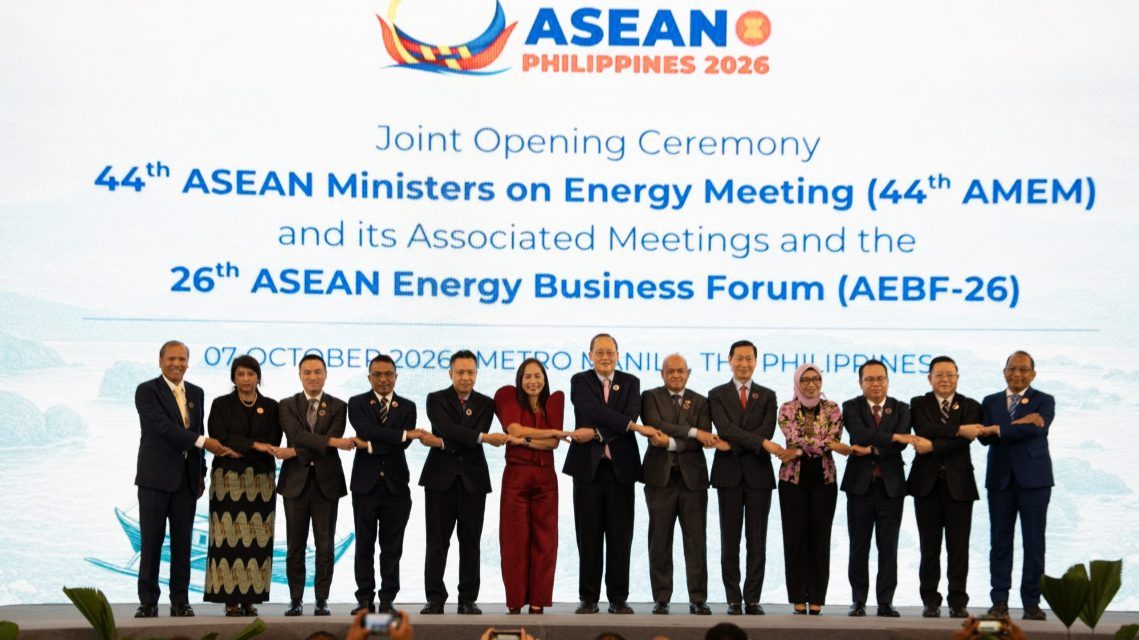
ASEAN. Energy ministers from different ASEAN member-states pose ahead of discussions on regional energy issues, on October 7, 2026.
ASEAN
Philippine Energy Secretary Sharon Garin says the ADB and World Bank have 'indicated their interest in financing' regional power grid connections, which could require hundreds of billions of dollars in investment
AT A GLANCE
- All 11 ASEAN countries have signed an Enhanced Memorandum of Understanding (MOU) on the ASEAN Power Grid, aiming for an interconnected electricity network to facilitate cross-border electricity trade.
- The agreement focuses on infrastructure planning, policy development, and financing, with significant potential benefits for the Philippines, including improved electricity reliability and reduced reliance on fossil fuels.
- Challenges include the need for substantial investments in infrastructure and the integration of power markets, with ASEAN targeting fully integrated operations by 2045, although no firm construction timetable has been established.
This is AI-generated. Read the article for full context. Report any errors.
MANILA, Philippines – Southeast Asian nations have long dreamed of an interconnected electricity network. Now, they are one step closer after all 11 ASEAN countries completed the signing of a power grid agreement that could eventually allow them to buy and sell electricity across borders.
The Enhanced Memorandum of Understanding (MOU) on the ASEAN Power Grid officially entered into force upon completion of its signing on Sunday, November 15, during the 49th ASEAN Summit in Manila.
According to ASEAN, the agreement “covers cooperation on infrastructure planning, institutional arrangements, policy and regulatory development, and access to financing, including for overland transmission lines and subsea power cables.” (Watch ADB’s brief explainer video below:
The agreement builds on discussions during the 48th ASEAN Summit in Cebu last May, when leaders pushed for greater regional energy connectivity, particularly through submarine power cables connecting the region’s island economies. This continued during the ASEAN energy ministers’ meeting in Manila last October, when all member countries at the time reached a consensus on the agreement.
With all ASEAN countries now manifesting their support for an interconnected grid, the proposal now moves down to the more detailed technical, legal, and financial levels of discussion.

What’s in it for the Philippines?
For the Philippines, the benefits could be significant. Connecting to neighboring countries could allow the country to import electricity when domestic supplies are tight. Beyond improving reliability, it could also help move the Philippines’ away from expensive and dirty fossil fuel generation. (READ: Solar for whom? What Philippines can learn from Pakistan’s rooftop boom)
But connecting the grids will be neither cheap nor easy.
The Philippines itself operates three major electricity grids, Luzon, Visayas, and Mindanao, which are now interconnected but still face transmission constraints. It was only in 2023 that the P52-billion Mindanao-Visayas Interconnection Project was energized, allowing electricity to flow between the two regions.
Even this year, the Visayas and Mindanao grids have repeatedly been placed under yellow and red alerts, with parts of the Visayas experiencing rotational power outages. These shortages were caused mainly by power plant outages, compounded by transmission constraints that capped the amount of electricity the Visayas could import from Luzon.
Connecting the Philippines to the rest of ASEAN would no doubt require another major investment in submarine cables, alongside improvements to domestic transmission infrastructure.
The costs could be substantial. According to the International Energy Agency, ASEAN would need around $27 billion in investment in cross-border power interconnections from 2025 to 2040, on top of more than $300 billion needed to expand and modernize domestic electricity grids. ASEAN’s own estimate is even higher, at $764 billion covering both power generation and transmission through 2045, assuming high adoption of renewable energy.
The regional bloc knows this well, which is why its enhanced MOU encourages pooling resources among governments, the private sector, and financial institutions to finance power grid projects. This is complemented by the ASEAN Power Grid Financing Initiative, which brings together ASEAN, the Asian Development Bank, and the World Bank to help prepare projects and mobilize funding.
Energy Undersecretary Felix William Fuentebella said that investors will view the signing of all ASEAN members in the enhanced MOU as a strong positive sign, which could unlock “big amounts of investments” and pave the way for more detailed feasibility studies on interconnections. Energy Secretary Garin also said that the ADB, World Bank, and other development-focused financial institutions have “indicated their interest in financing this” depending on the project proposal.
Another major challenge could be power market integration, which ASEAN said would follow a “voluntary, stepwise approach” that takes into account policies, laws, and regulations of the participating countries.
“It will be by steps, voluntary – because we won’t be forcing any country that will not participate,” Garin told Rappler in a press conference on Tuesday, November 17. “But with the signature of everyone in the enhanced MOU, that’s a clear indication already of their participation.”
ASEAN is targeting fully integrated regional electricity grid operations by 2045, although individual connections could be developed earlier.
However, for now, no firm construction timetable has been set, with ASEAN acknowledging that “further development of technical, regulatory and commercial frameworks will be essential to translate this foundation into bankable investments.”
On November 15, the Philippines’ Department of Energy also separately signed a two-year research agreement with the Economic Research Institute for ASEAN and East Asia, which includes technical studies supporting the Philippines’ participation in the regional grid. – Rappler.com
KioskNews shows a cleaned-up reading view extracted from the publisher’s page — the original always lives on their site, not ours.