Mathematician creates new shape with 8 sides, 26 edges, and 3 holes
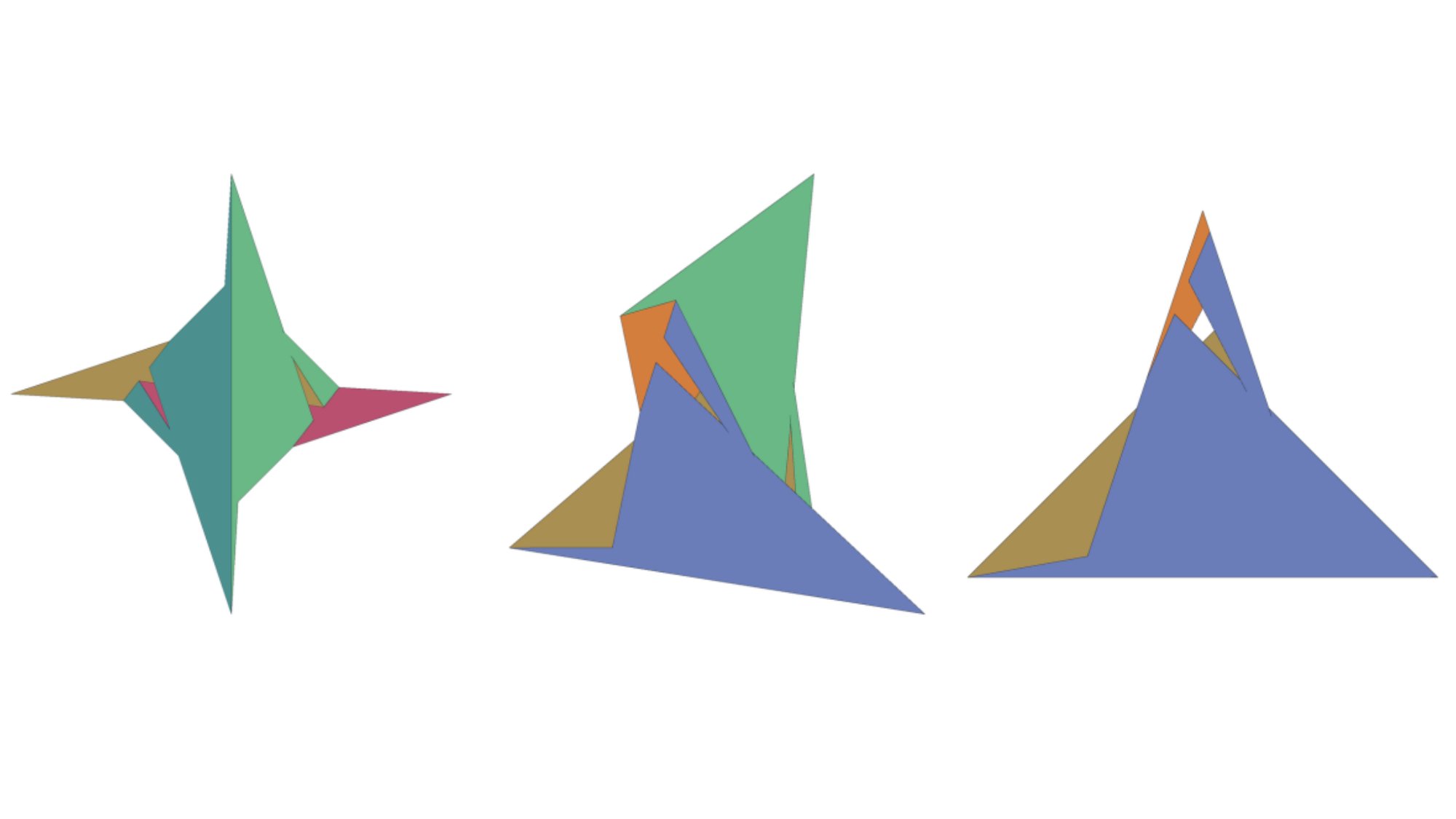
It may be hard to believe, but mathematicians are still discovering shapes. The latest three-dimensional example is far stranger than your standard cube or pyramid. Dubbed the genus-3 polyhedron by Ruslan Mizhaev, the independent researcher’s newly identified shape features eight faces arranged so that every pair shares at least one edge. The end result is an oddity with 26 edges and 24 vertices, with 20 face pairs sharing a single edge while eight others share two faces. And as if the concept wasn’t headspinning enough, three faces meet at every vertex.
While Mizhaev explains the genus-3 polyhedron’s geometry in a pre-print study detailed by New Scientist, it’s probably easiest to look at an example yourself. Pre-prints like these are research papers that have not been formally peer reviewed or published in a scientific journal.
In geometry, the polyhedron is a foundational concept that follows a few basic rules. A three-dimensional shape simply needs to feature straight edges and angled vertices connected along flat faces. The dodecahedron (12 faces shaped as a five-pointed pentagram) is likely the most complex anyone regularly sees in daily life. Even then, dodecahedrons usually show up once a year as the geometric star atop a Christmas tree.
The subject matter gets even more complex when toroidal polytopes enter the mix. These are polyhedrons that are also toruses—figures with holes in their center. The Császár and Szilassi polyhedrons illustrate this concept, although you’d be forgiven for not instantly recognizing them. While they are important concepts, Mizhaev explained they are mostly useful in studying relationships between “combinatorial topology, graph theory, and three-dimensional geometry.”
Regardless, the genus-3 polyhedron is easily replicated (by other mathematicians) using simple integer coordinates, and forms a shape with three separate holes. It’s unclear if such a shape ever occurs in nature,but if Mizhaev’s study checks out, then it’s certainly possible.
KioskNews shows a cleaned-up reading view extracted from the publisher’s page — the original always lives on their site, not ours.