SKH, NUH save over $1.1m in annual energy costs with innovations in operating theatres
SINGAPORE – Sengkang General Hospital (SKH) and National University Hospital (NUH) have introduced energy-saving innovations in their operating theatres that reduced their power bills by more than $1.1 million every year.
The two projects each received the Sustainability Star Award at a competition held in conjunction with the Singapore Healthcare Sustainability Symposium on Oct 27.
Singapore’s three public health clusters submitted 150 entries to the competition on the theme Low Carbon Healthcare. Projects were evaluated on criteria such as environmental impact and potential for scalability across healthcare settings.
Operating theatres are among the most energy-intensive areas in acute care, using up to six times more energy than standard hospital wards due to needs such as ventilation and air-conditioning.
Working with infection control specialists, a team from SKH introduced a recirculated air-conditioning system between 8pm and 6am across 28 operating rooms at the hospital in 2025.
Unlike conventional air-conditioning, where air is drawn from outside a room, a recirculated air-conditioning filters and cools air that is already inside the room, thus requiring less energy.
SKH’s enhancement has reduced its annual energy consumption by 3.38 gigawatt-hours (GWh) – equivalent to the monthly electricity use of 12,000 four-room HDB flats – without compromising patient safety. Power bill is cut by $818,000.
At NUH, a team implemented operational changes that reduced energy required for ventilation systems during lull periods across 26 operating theatres at NUH, while maintaining continuous control of temperature, humidity and room pressure.
This has helped the hospital save 1,123,200 kilowatt-hours and $300,000 in recurring costs annually, as well as reduce CO2 emissions by 456 tonnes a year. The reduction in energy consumption is equivalent to the annual electricity use of 270 four-room HDB flats.
The competition’s Big Impact award went to a team from Woodlands Hospital, where clinicians developed a risk stratification framework to reduce tuberculosis (TB) patients’ usage of isolation rooms, while maintaining infection control standards.
This has freed up isolation rooms by an estimated 652 bed-days annually, resulting in $620,400 in combined recurring savings and cost avoidance.
Held at Woodlands Hospital, the symposium also saw Singapore’s three public healthcare clusters – NHG Health, the National University Health System and SingHealth – commit to accelerating greener clinical care.
This includes exploring the use of lower-carbon alternatives while maintaining patient care standards, as well as reducing the use of tests and treatments which do not improve patient outcomes, said Senior Minister of State for Sustainability and the Environment Janil Puthucheary, who attended the event.
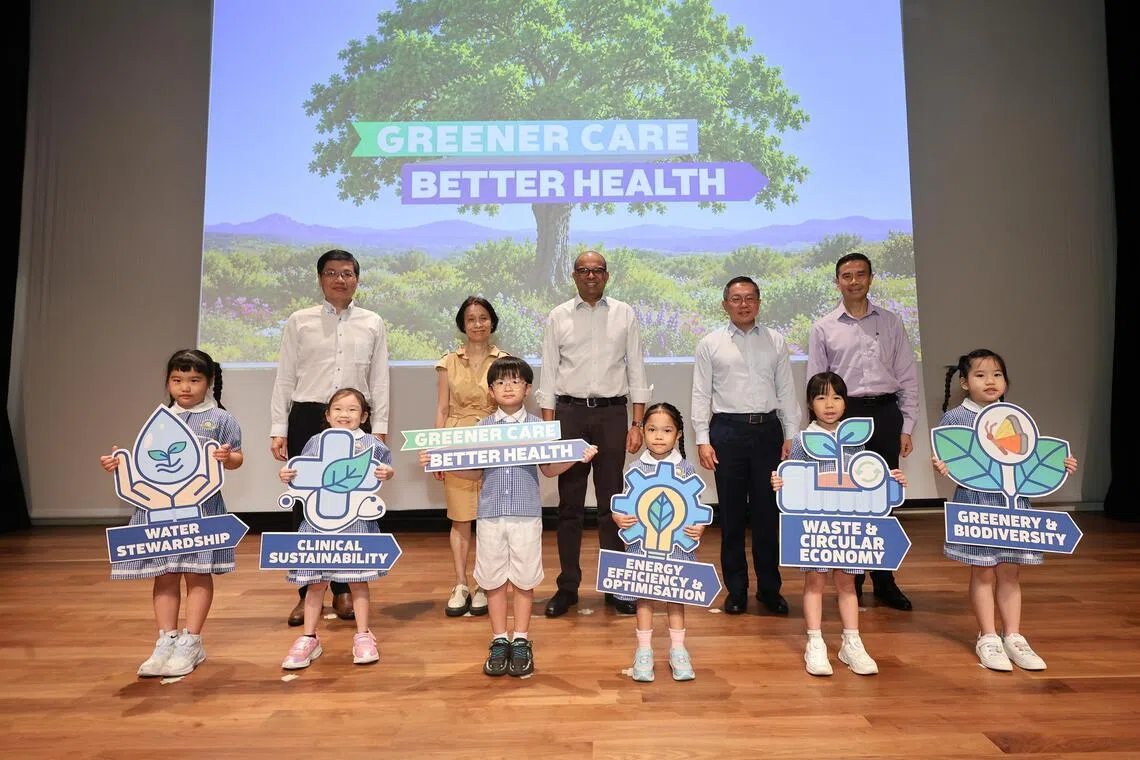
(Back row, from left) National University Health System group chief operating officer Jeffrey Chun, SingHealth group director for sustainability Chow Wan Cheng, Senior Minister of State for Sustainability and the Environment Janil Puthucheary, NHG Health group chief executive officer Joe Sim, and Kwong Wai Hsiu Hospital chief executive officer Mok Ying Jang with children from Learning Vision pre-school on Oct 27.
PHOTO: NHG HEALTH
He noted that since 2019, hospitals here have reduced the use of desflurane and nitrous oxide – greenhouse gases used as anaesthetics – by 45% and 35% respectively without affecting patient outcomes.
In July, Changi General Hospital became the first hospital in Singapore to eliminate the use of desflurane in all surgical procedures.
Local hospitals and clinics emit 4.1 million tonnes of greenhouse gases each year, or about 7% per cent of the country’s emissions, according to a study by the NUS Yong Loo Lin School of Medicine and the Ministry of Health which was published in 2025.
Globally, the healthcare industry is responsible for about 5% of greenhouse gas emissions per year, Janil noted. While the carbon intensity of Singapore’s healthcare system is about 20% lower than those in other advanced economies, there is still more that can be done, he said.
The clusters have also committed to strengthen circular economy in healthcare, referring to a model that aims to reduce waste and keep materials in use for as long as possible.
“The three clusters will increase the use of reusable products, improve waste separation at source, and expand the recycling of materials such as stainless steel, linen and plastics,” said Janil, who is also Senior Minister of State for Education.
He added that this circularity should extend beyond hospitals to the healthcare supply chain.
In line with this, the first green procurement course designed specifically for healthcare will be launched by the Centre for Healthcare Innovation’s Sustainability Academy, along with the Agency for Logistics and Procurement Services and consulting and investment advisory firm NanRise.
The one-day course, which will begin in April 2027, will help healthcare professionals consider sustainability “more systematically in purchasing decisions, alongside cost, quality and clinical needs”, said Janil.
NHG Health group chief executive Joe Sim said the progression of sustainability in healthcare requires more than individual efforts.
“Such collective commitment helps us set new benchmarks for sustainable healthcare, and safeguard both health and the environment for future generations,” he said.
KioskNews shows a cleaned-up reading view extracted from the publisher’s page — the original always lives on their site, not ours.