Opinion: Opinion | Louis Vuitton Loot, Torched Cars: France Protests Have An Unlikely Beneficiary
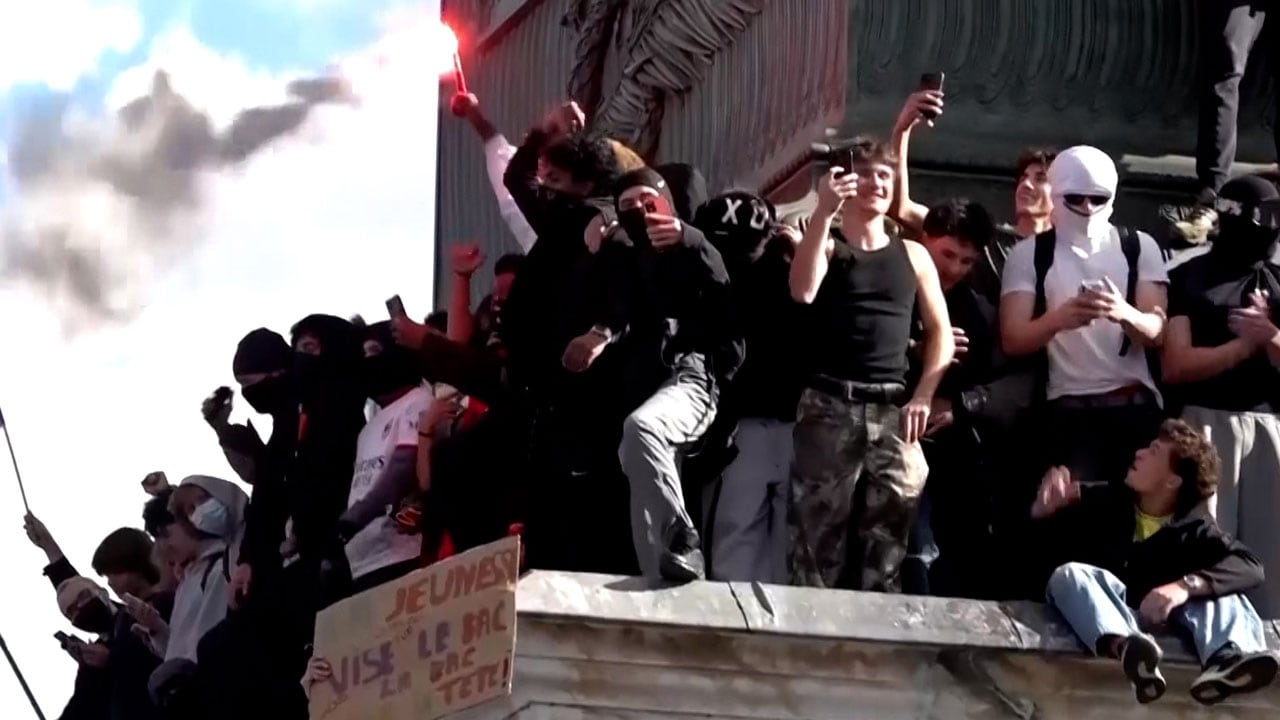
It's an unbelievable moment. Crowds looting the most exclusive stores in Paris, including the famed Luis Vuitton, and stores most of us wouldn't even think of entering, given their almost unreachable costs. Yet, video footage shows precisely that. Apparently, all this is part of 'student' protests, though the masked hoodlums appear to be anything but. It is almost an action replay of what Delhi witnessed just recently, though thankfully here, the scale of the protests was kept firmly in check by an alert administration. Student protests seem to have become the norm rather than the exception, with 31 in the Eurozone alone, and India, Nepal, and Bangladesh being notable cases outside. In at least two of those cases, the protests led to government change. Some curious aspects are worth noting, since this is by no means the end of the game. For a game it is, and a dangerous one.
Why The French Are On The Streets
So far, this is the story in France. The protests started in early September, oddly enough, over almost the same type of issues as in India. Causes included teacher shortages, overcrowded classrooms, dilapidated school buildings, overloaded schedules, and complaints about the Parcoursup university admission web system, which was likened to a 'black box' non-transparent system, with long waiting-list cycles leading students to spend months in limbo over the summer, creating high psychological stress and mistrust in the education system. Bureaucracies are not that different across the world.
Advertisement - Scroll to continue
Anyway, that particular grouse spiralled quickly to include other issues, so that by mid-October, the students had converged with labour unions, trade unions, and groups echoing the "Yellow Vest" movement - which had been a grassroots movement in 2018 and has now been revived - all of which meant that the demonstrations would turn into a wider agitation against the government on rising living costs, fuel prices, and broader economic hardship.
This is certainly the reality. Public debt has spiralled to 119% of GDP, what with Macron's 'war budget', which aimed at doubling defence expenditure, and the massive aid to Ukraine, which may have reached 26 billion euros. Then there are rising energy costs, which the government has had to underwrite, to the tune of some 70 billion euros in just two years, to prevent social unrest. All that comes with costs, but the point is that the causes of the protests are real enough, just as they were in other countries. What's interesting is how they coalesced and then went out of control suddenly. Over the last few weeks, social media has grown more influential, in a move that is reminiscent of the sudden climb of the Delhi Exam protests, which peaked in days. Snapchat messaging was central, with rapidly changing digital slang and youth codes. One example - again typical of the 'cockroach' nomenclature - was the viral protest slogan "Bismillah, c'est les tén~CHECK~bres" ("In the name of God, darkness") - which trended across student networks after it was revealed that an undercover police officer allegedly used the phrase while trying to blend into a student Snapchat group. President Macron, in his speech to the nation, stressed that a clear line must be drawn between peaceful demonstrators with "legitimate demands" and "those who destroyed, smashed, and looted". He accused "insurrectionist elements from radical far-left groups, joined by numerous criminals", of attempting to foment chaos and bring down the Republic. Again, not unlike the Delhi riots. But the violence was far, far worse. That needs explanation.
Advertisement - Scroll to continue
Macron - Between A Rock And A Hard Place
At present, footage shows thousands upon thousands on the streets, with police vainly battling the onslaught. A record 850-plus people have been detained, and around 1,500 shops and retailers were damaged or looted, with the cost to the establishments being quoted at "several hundreds of millions of euros", according to the head of the Retail and Trade Federation. Total numbers seem to be around 8 lakh, which means any police action was useless. French police unions warned the government that they cannot take the pressure; all in all, a useful lesson to imbibe, that the key to managing protests is not to allow a crowd to go beyond a certain level.
But there are some interesting specifics. President Macron is no longer going to run for office, being constitutionally barred from doing so. As The Guardian wryly observes, with some 35 contenders in the race for the Presidency, what could possibly go wrong? There are at least two former Prime Ministers aligned with Macron in the ring, a third is likely to join, and another is likely to throw his hat in the ring.
The Left is a welter of competing interests, with some 17 potential or declared candidates, also joined by a former president Francois Hollande. The Left is also divided on whether to support Jean-Luc Mélenchon, the veteran radical leftist who is known to have extreme views against Jews, among others. What emerges from this chaos is that the only party that has coalesced on the ground is the far Right led by the once-fringe elements of the National Rally, under Marine Le Pen, who incidentally had a case against her for embezzlement of European Parliament funds in a fake jobs scandal. She has now been cleared by a Paris court, but her party president and 'standby' is Jordan Bardella, who campaigns on a hardline anti-immigration platform centred on strict border controls, national sovereignty, curbs on migrant flows, and stopping birthright citizenship. Marine Le Pen's father was far worse, but today, the party has the largest numbers in the Opposition. Under her, it has managed to steer a less radical course, at least in public. But the truth out there is this: the far Right is going to be a strong factor in the coming elections, with the Far Left also playing a role. Both loathe each other, but both will cut into the centrist vote of Macron's party base.
A Very American Problem
And here comes the coup de grace. US Vice President JD Vance has, yet again, come down heavily on France and Europe at large for its open-door and generous immigration policy. President Trump also called upon France to close its borders and warned of a tide of hatred coming from outside. Neither had the slightest proof that the protests and violence were due to 'immigrants', but this is hardly the first time such sentiments have been aired in Europe. In 2025, it was Vance who decided that Europe's most pressing problem was its lack of democracy - by which he meant the sidelining of extreme right-wing elements, like the neo-Nazis - comparing it with a 'vibrant' US system. That left the audience gasping. Later in 2026, at the same Munich Security Dialogue, it was Secretary of State Marco Rubio who expressed regret about the end of the Empire and invited Europeans to join American efforts to restore a glorious world of Western dominance that vanished decades ago. Coming from the apparently more reasonable and soft-spoken Rubio, it was a shock for much of the world. And now, it has come full circle.
The right wing has surged in much of Europe, the underlying conviction being that the 'corrupt elite' doesn't allow the people a voice. That's almost identical to the messaging that led, for example, to Sheikh Hasina's downfall. Or that of the Oli government in Nepal. Coincidence? Probably not.
An Unstable France Is Bad News
Here is the crux of the matter. An unstable France means a weakened Europe and a less powerful opposition against the US. Trump's insults to Macron are well known, as is the fact that France has always stood for European centrality over US domination. President Macron's lashing out at the US in his address to the nation is significant, noting that France is paying for the US's war in Iran. That is borne out by facts. Wars have raised the cost of living and nearly broken the back of state budgets. Meanwhile, the US has taken over 60-68% of total LNG supplies for Europe and is the largest single supplier to France. In short, US companies are making a huge profit as the streets bleed.
Indian agencies have probably already studied the pattern of protests here and in Asia. As seen above, the parallels are many. True, there is more of a political content in France given the upcoming elections. But multiple forces are at work here as well. The present global situation is unprecedented, not just in terms of social unrest due to interminable wars, but also a collapse of moral values in politics and international politicking. The on-off tariffs on Russian fuel are only one example. The key is to stand together with countries like France and Italy, including the 'Missing in Action' Global South. That last term has been much used in speeches and declamations. Time to make this a force to reckon with. Meanwhile, address the very real issue of corruption, lack of governance, and bureaucratic apathy. No inimical force in the world can create a protest. It can only work with very strong sentiments on the ground. Meanwhile, the government has to be visible on the ground and seen to be publicly making amends. That's the key to it all.
(Tara Kartha is a former Director, National Security Council Secretariat)
KioskNews shows a cleaned-up reading view extracted from the publisher’s page — the original always lives on their site, not ours.