Largan reports gross margin slide to 42.21 percent
By Meryl Kao / Staff reporter


Largan Precision Co (大立光), a key iPhone lens supplier, yesterday reported that gross margin slid to 42.21 percent in the third quarter — the lowest in 13 years — from 49.41 percent in the previous quarter and 47.24 percent a year earlier.
The decline was mainly due to lower yields for new smartphone camera lens products and higher green energy costs, Largan chairman Adam Lin (林恩平) told an earnings conference.
As green energy costs are structural and unlikely to ease in the near term, this quarter’s margin outlook would depend largely on improving yields for new lens products, Lin said.
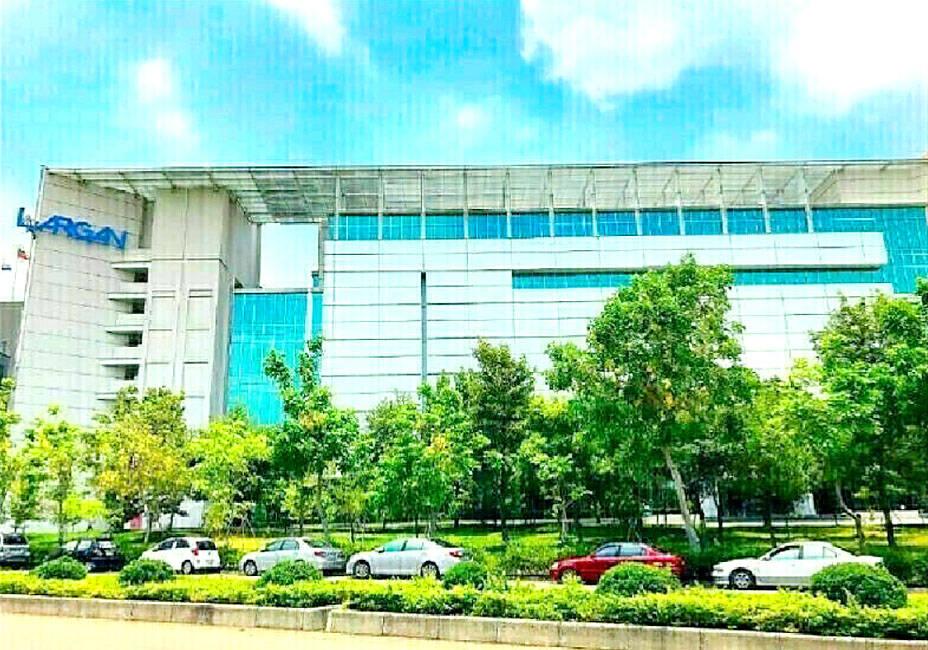
A Largan Precision Co building is pictured in Taichung on June 12, 2018.
Photo: Chen Mei-ying, Taipei Times
During the July-to-September period, Largan’s revenue fell 11.47 percent year-on-year to NT$15.65 billion (US$490.98 million), while net profit declined 27.65 percent to NT$5.18 billion.
Earnings per share were NT$39.62, down from NT$53.05 a year earlier, company data showed.
This month’s revenue is expected to remain flat from last month’s NT$5.78 billion before declining next month after smartphone customers began cutting orders last month, he said.
Apple Inc last quarter launched the iPhone 18 series with variable aperture lenses, for which Largan has an exclusive supply share.
Yields for variable aperture lenses are currently “rather OK,” Lin said.
However, shipment momentum is weakening as the peak season has passed, he said.
Factory utilization for smartphone lenses is expected to remain at full capacity this quarter, Lin said.
Customers are testing samples of upgraded camera lens modules for next year’s models, he said, adding that new periscope lenses are entering trial production.
As the company pushes into the copackaged optics business to supply fiber arrays (FAs), Largan has completed a trial automated production line for FAs after gaining customer certification last month, Lin said.
The company also plans to complete its first fiber array unit (FAU) production line by the middle of next year and begin volume shipment in the second half of next year, he said.
Largan aims to begin mass production of FAU products for one customer in the second half of next year, with sample deliveries slated for this month, he said.
The company integrates FAs with prism microlens arrays it sources externally to make FAUs, Lin said.
The FAU solution next year is expected to use grating couplers, while Largan is also working with customers on edge-coupling technology, he said.
Largan is also discussing next-generation FAU products with other customers, with timelines broadly pointing to 2028, he said.
Capital expenditure totaled NT$8.18 billion last quarter, mainly for land and factory purchases in Taichung, he said.
The purchases are to support the expansion of its FAU-related business, Lin said.
Construction is expected to begin next year and be completed by 2030, he added.
KioskNews shows a cleaned-up reading view extracted from the publisher’s page — the original always lives on their site, not ours.