Cabinet approves changes to sibling inheritance rules
By Chung Li-hua and Jake Chung / Staff reporter, with staff writer


The Executive Yuan yesterday approved draft amendments to the Civil Code that would increase a surviving spouse’s statutory inheritance share to two-thirds when inheriting alongside the deceased’s siblings, whose combined share would be reduced to one-third.
The proposed changes would also allow financially disadvantaged siblings who had been continuously supported by the deceased to seek a discretionary award from the estate, recognize heirs’ special contributions to the deceased’s assets and shorten the maximum period during which a will may prohibit an estate from being divided to five years from 10.
The Legislative Yuan in July passed an amendment to remove a provision in the Civil Code guaranteeing reserved inheritance shares for siblings.
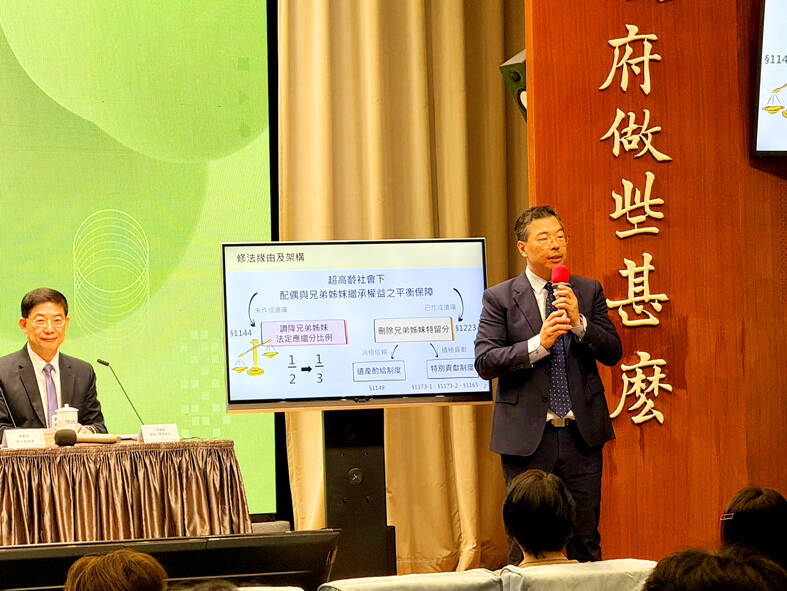
A Cabinet official introduces proposed changes to the inheritance law at a news conference in Taipei yesterday.
Photo: Chung Li-hua, Taipei Times
The changes reflect shifts in family structures and Taiwan’s transition into a super-aged society, the Ministry of Justice said.
Under the current law, when a person dies without leaving a will and is survived by a spouse and siblings, but no descendants or parents, each side would receive half of the estate, a division the ministry said no longer aligns with modern social expectations.
Under the draft, siblings who had been continuously supported by the deceased could seek a discretionary award if the death leaves them in financial hardship and they receive nothing or a markedly inadequate amount under the will, the ministry said.
The amendments specify the eligibility requirements, procedures, factors for courts to consider and time limits.
They would also recognize heirs who made special contributions to the deceased’s assets, such as by providing labor or financial support to the deceased’s business, caring for the deceased or otherwise helping maintain or increase the value of the estate.
The value of the contributions would be reflected in the heir’s share when the estate is divided.
To avoid evidentiary difficulties caused by delays in dividing estates, the draft would generally limit the application of rules on qualifying lifetime gifts and special contributions to estate divisions within five years of the start of inheritance, subject to exceptions.
Under transitional provisions, wills that took effect before the new law and prohibit division of an estate for a remaining period exceeding five years when the amendments take effect would have that remaining period shortened to five years.
For inheritances that began before the new law takes effect and involve estates that have not yet been divided, the five-year period for applying the rules on qualifying lifetime gifts during estate division would run from the law’s effective date.
If the amendments are enacted, the changes to spouses’ and siblings’ statutory shares and the discretionary award provision would take effect on Feb. 17 next year.
The provisions on estate division, special contributions and the five-year claims deadline would take effect on Feb. 17, 2028, the ministry said.
The changes are to be sent to the Legislative Yuan for review.
KioskNews shows a cleaned-up reading view extracted from the publisher’s page — the original always lives on their site, not ours.