‘Children are naturally drawn to beauty’: the head of the ‘fake’ Issey Miyake preschool on their pleated uniforms

“Does anyone know what the deal is Ms Lam Montessori … and why all their employees wear Issey Miyake … every day … I’m confused and a bit jealous,” asked one commenter on the Williamsburg subreddit last week, sparking a unexpected viral moment for a chain of Brooklyn Montessori preschools.
The poster was responding to photos on the Montessori’s website of the teachers’ uniforms: raspberry, cobalt and apple green dresses in plissé fabric. They appeared to be from the Pleats Please line by Japanese designer Issey Miyake. It seemed an avant-gard choice for staff posing in front of the abachi and blond wood toys of their preschool classroom.
On X, those pictures were screen grabbed and viewed 3.5m times, with most comments reading along the lines of “only in Brooklyn”.
So was it Issey Miyake?
Over email from Taiwan, Ms Lam Montessori head of school, Stephanie Woo – a vision in chartreuse pleated fabric and matching hexagonal-framed glasses on the nursery’s website – explains that the dresses are actually by a more affordable Japanese designer, Yamasaki Takashi (they are priced around a 10th of the $700 one might pay for a Pleats Please frock), and are worn at all of the company’s locations. Ms Lam is a Mandarin immersion school and was originally founded in Tapai, Taiwan, where it has 14 branches, as well as its five in Brooklyn.
Woo is herself a “huge fan” of Issey Miyake, and owns “a couple of pieces that I bring out for special events at the school”. She adds: “Issey Miyake clothing is of course stunning, but we chose Yamasaki for its understated designs, comfort, durability and price. Those qualities made it a particularly good fit for everyday life in our classrooms,” she writes, adding that the clothes wash well and “hold their color and shape beautifully. Even after we’ve washed it 100 times, they still come out of the dryer looking much the same.”
She adds that the outfits were originally her mother’s idea – the original Ms Lam – who, according to the company’s website, was the first person to bring Montessori to Taiwan. Staff in Taiwan have been wearing them for 12 years and in Brooklyn for eight. Uniforms are important, she says, working with children from the age of one to six: “They help a young child recognize, even on a busy campus, this adult can help me.”
One of the reasons the Issey Miyake-esque outfits so delighted the internet is that the Pleats Please line, which launched in 1993, is having a fashion resurgence.
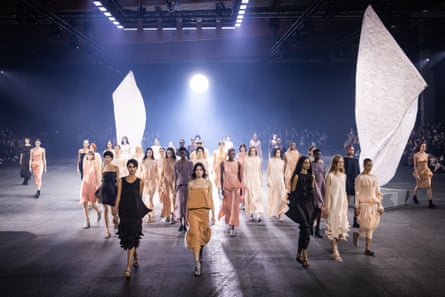
One particular garment – the Madame T stole, a large piece of plissé fabric with a diamond-shaped neck hole, which comes with an instruction booklet for the many ways it can be folded around the body – has recently become a social media fascination. In August, shopping platform Lyst ranked it among the hottest products of the summer, and reported a 100% rise in demand for Issey Miyake quarter-on-quarter.
That said, Issey Miyake – which was launched in 1970 in Tokyo – and its more affordable Pleats Please line has never really been uncool. Miyake was the first of the wave of Japanese designers – followed by Yohji Yamamoto and Rei Kawakubo’s Comme des Garçons – to break through into European fashion.
Miyake developed his then revolutionary near-permanent pleats in the late 1980s, by constructing garments first, flat, at a much larger size than they would eventually fold down to, then heat-pleating afterwards. Most Pleats Please garments are 100% polyester, and their popularity comes despite a larger polyester backlash. Unlike fast-fashion polyester, Pleats Please are high quality, the designs timeless – and the construction of the garments makes specific use of polyester’s thermoplastic properties to hold shape, rather than using cheap polyester to make throwaway knockoffs of natural fibers.
Pleats Please’s practical, technical and arty associations – the focus is on the garment, and its own silhouette, rather than the body beneath – has made it popular with accomplished creative women for decades. Zaha Hadid, Solange Knowles, Meryl Streep, Tessa Thompson and Joni Mitchell are among its longtime fans, while Lorde, who wore a neon pink Pleats Please crop top at Lollapalooza Doja Cat have been spotted wearing the designer more recently.
In the west, says Dr Sasha Raspopina, the course leader for the fashion marketing and journalism BA at London Metropolitan University, Pleats Please has a kind of “if you know you know” appeal. She has noticed its adoption in east London among young people, who are perhaps “trying to signal that they are creative”. Given that context, Raspopina thought the Montessori image was a meme at first because the garment seemed to speak of an “alternate universe” to that of the kindergarten teacher.

The use of a Pleats Please-inspired garment may land differently for an east Asian audience, says Prof Wessie Ling, a visiting professor of transcultural arts and design at the University of Bologna (who, as a fashion scholar, knew the dresses weren’t genuine Miyake the moment she saw the photo: “the materials, and how it drapes on the body isn’t quite there,” she says).
She says that the link between Japanese design and Taiwan is very deep, given the colonial history (Taiwan was under Japanese colonial rule from 1895 until 1945). In east Asia more broadly, she says, there is a profound “admiration for Japanese designers, specifically the first generation of Japanese designers”. Miyake was the first to open a boutique in Paris, in the 1970s, nearly 10 years before Comme des Garçons and Yohji Yamamoto. This was at a time when “absolutely no other non-white designers made it into the fashion capital. So he represents something.” In east Asia, she says. Miyake is “the signature Japanese designer” and the first designer brand a woman would turn to if they reached executive level.
Ling had not heard of the brand Yamasaki Takashi, but she has noticed many younger, independent east Asian designers, including those based in South Korea and Vietnam, recently using pleats similar to Miyake’s. She doesn’t necessarily consider them to be copycats. “Obviously it is a kind of Miyake because it’s pleats – but they also create different patterns, colors and silhouettes, and they are putting some thought into the pleats they are trying to create.”
As Woo adds over email, the aesthetic of the garments certainly matters, even at school: “The truth is, we believe young children should be surrounded by beauty. From birth to age six, children have what Montessori calls the ‘Absorbent Mind’ – they effortlessly absorb so much from their surroundings,” she says. “They are naturally drawn to beauty, and by making it part of their daily lives, we hope to nurture their appreciation for it and their desire to care for the spaces and things around them.”
KioskNews shows a cleaned-up reading view extracted from the publisher’s page — the original always lives on their site, not ours.