Authorities issue NT$12.53m in fines for ads
By Esme Yeh / Staff reporter


The government last year issued NT$12.53 million (US$381,315) in fines in 246 cases involving illegal advertisements for environmental agents, the Chemicals Administration said on Thursday last week.
As of August this year, it had issued NT$4.2 million in fines for 76 online advertising violations, it said.
According to the Ministry of Environment’s Web site, environmental agents include pesticides and similar products used for environmental sanitation.
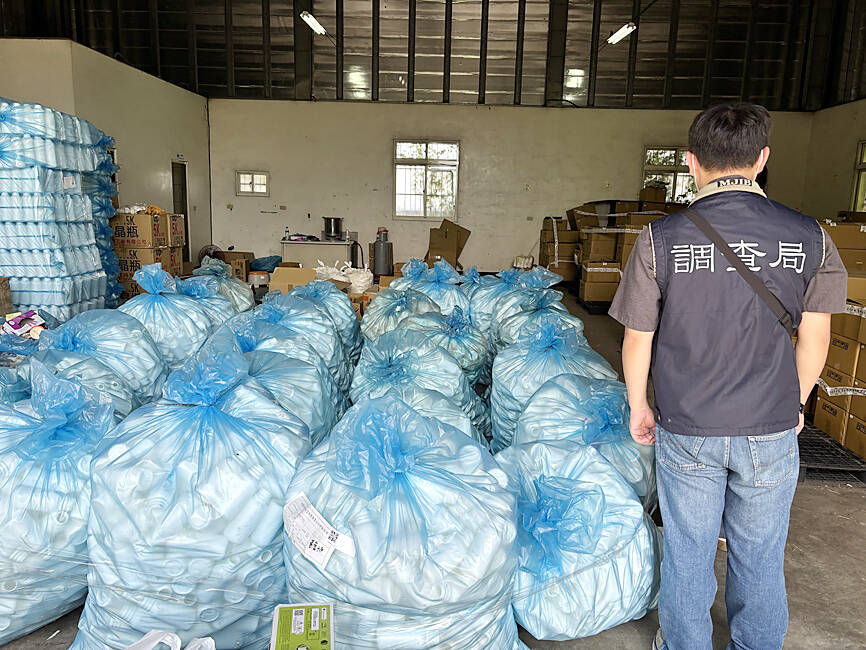
Bags of environmental agents seized by the Yunlin Prosecutors’ Office and the Ministry of Justice Investigation Bureau’s Yunlin County Station are pictured a storage facility in Yunlin County in January.
Photo courtesy of the Yunlin Prosecutors’ Office
Violations included false advertising, noncompliant labeling or sales of expired environmental agents, the administration said.
The overall compliance rate for 43,274 environmental-agent products inspected nationwide from January last year through August was 98 percent, it said.
Seventy-six percent of last year’s 246 advertising-enforcement cases involved counterfeit environmental agents, it said.
Another reported violation involved unauthorized advertising of otherwise legitimate environmental agents, it said.
The administration inspected 50,673 environmental-agent product listings on e-commerce platforms last year and ordered the removal of 525 counterfeit-product listings, it said.
It screened 17,107 online environmental-agent listings as of September this year, with 240 counterfeit-products listings removed, it said.
It has also helped customs authorities intercept 53 counterfeit environmental-agent products last year and 57 as of September, it said.
It thanked online shopping platforms for cooperating with inspections, including Coupang Taiwan Co, Shopee Taiwan Co and PChome Online Inc.
The administration listed five signs that an environmental-agent product being sold online could be counterfeit: It does not have a permit number or uses a fake permit number; the manufacturer’s or the supplier’s address is not listed, with only a Line account or an e-mail address listed for customer inquiries; simplified Chinese characters or phrases commonly used in China appear on the product labeling; promotional slogans include phrases such as “limited time only” or “buy one, get one free,” or the listing makes exaggerated claims such as “eradicates all”; the listing only has five-star ratings without any negative reviews.
While e-commerce platforms screen listings using keyword searches and removes suspect product listings, such products are also sold on social media platforms, particularly Facebook and Line, the administration said.
People should report suspicious listings or advertisements for environmental agents using the “report button” on e-commerce and social media platforms, it said.
People can report cases through the ministry or report suspected fraudulent Web sites through the Ministry of Digital Affairs’ “Fraudbuster Web” platform, it added.
KioskNews shows a cleaned-up reading view extracted from the publisher’s page — the original always lives on their site, not ours.