HUGH HEWITT: Three big legal fights are looming, and Trump needs answers before January

United States Assistant Attorney General T. Elliott Gaiser is going to be a very busy man in 2027. Before the new Congress arrives in January, President Donald Trump should require Gaiser and his team to provide detailed answers to a few very important questions of law.
On Friday, November 6, at 3:29 p.m., Rep. Robert Garcia, D-Calif., the incoming chairman of the House Oversight Committee, posted a threat barely disguised as advice directed at new White House Chief of Staff Stephen Miller: "Steven Miller should lawyer up."
At 6:10 p.m. that same day, United States Attorney General Todd Blanche posted a response: "The Chief of Staff already has a lawyer. The Attorney General of the United States and the Department of Justice."
‘LAWYER UP’: DEMS IMMEDIATELY PUT TRUMP ON NOTICE AMID REPUBLICANS' MIDTERM BLOODBATH
Welcome to the next two years. There is an epic clash coming between the powers of Congress under Article I of the Constitution and the powers of President Trump under Article II. The Supreme Court will referee the clash, but it will start soon, and one of the key participants will be Mr. Gaiser, the assistant attorney general for the Office of Legal Counsel (OLC).
OLC is the division of the U.S. Department of Justice that serves as the principal legal adviser to the president and the executive branch. AAG Gaiser was confirmed by the Senate on July 30, 2025. By all accounts, he is a brilliant lawyer. Gaiser helms an office of about two dozen lawyers who are collectively widely regarded as among the top legal minds in the country. The office is a mix of career and political appointees, but all are serious legal scholars.
OLC tackles questions President Trump or Attorney General Blanche require it to answer, and it can also supply answers to questions from Cabinet officers and military leaders, as time allows and the president and the AG permit. The Supreme Court does not issue advisory opinions on possible controversies that have not reached it at all or that are premature (cases that are not yet "ripe" for decision), but OLC does.
Everyone should expect President Trump to follow the examples of Presidents Clinton, Obama and Biden and play full-court defense against what have already been announced as sweeping inquiries into executive branch conduct.
One recent example: On August 10 of this year, OLC opined that "executive privilege can apply to presidential communications with private advisers so long as the communications (1) relate to official presidential decision making, (2) involve or reflect communications with the President or his direct advisers, and (3) are confidential."
AG BLANCHE CLASHES WITH ANCHOR ASKING WHETHER IT'S HIS 'JOB' TO DEFEND THE TRUMP ADMINISTRATION
There is going to be a raft of additional executive privilege questions incoming, as the new Democratic majorities cannot immediately compel testimony about matters over which President Trump has asserted "executive privilege." But there are other pressing questions about "court packing," statehood for the District of Columbia and the constitutionality of the National Popular Vote Interstate Compact that can be asked and answered by OLC before the executive privilege debates begin.
Both Republican and Democratic presidents have asserted their privilege in situations that have angered Congress. Sometimes the Supreme Court or the United States Court of Appeals for the D.C. Circuit has sided with the president, and sometimes it has sided with Congress.
TRUMP'S MOVE FROM WILES TO MILLER SIGNALS MAJOR TACTICAL SHIFT FOR GOVERNING WITHOUT CONGRESS
President Biden, facing a demand for the audio recordings of his and his ghostwriter’s interviews with Special Counsel Robert Hur, sought and received an OLC opinion on May 15, 2024, on whether he could assert executive privilege over those recordings. OLC opined that Biden could. Lawsuits were filed challenging that opinion and President Biden’s decision not to release the recordings, and the Trump administration decided to release the recordings.
President Clinton asserted a novel Secret Service protective-function privilege as well as a White House attorney-client privilege, both of which were rejected in whole or in material part by the United States Court of Appeals for the D.C. Circuit. President Obama made claims of executive privilege over materials in the "Fast and Furious" investigation, and when litigation followed, a settlement was reached before a court decision was made.
MORNING GLORY: DSA DEMOCRATS' RADICAL PLAN TO RESHAPE AMERICA STARTS WITH THE SUPREME COURT
Everyone should expect President Trump to follow the examples of Presidents Clinton, Obama and Biden and play full-court defense against what have already been announced as sweeping inquiries into executive branch conduct by such members as Garcia and Congressman Jamie Raskin, D-Md., who will chair the House Judiciary Committee. Both committees have subpoena powers.
President Trump may require a legal opinion from the attorney general under 28 U.S.C. § 511, and when such a demand is made, the AG turns to OLC. Before OLC is deluged with requests from President Trump and A.G. Blanche in 2027 on the scope of executive privilege across the executive branch, the president could secure some important OLC opinions between now and January 3, when the new Congress is sworn in.
Three such questions come to mind in light of last week's sweeping Democratic wins across the country and the often very extreme positions put forward by Democrats campaigning for House or Senate seats.
JONATHAN TURLEY: MIDTERMS EMPOWER DEMOCRATS TO TARGET THE ELECTORAL COLLEGE
First and perhaps most important: Is it in fact constitutional for Congress to expand the Supreme Court to more than the current nine justices? There is a strong argument that, in the wake of the ratification of the Fourteenth Amendment and the almost immediate passage of the Judiciary Act of 1869 the following April, "court packing" is simply unconstitutional.
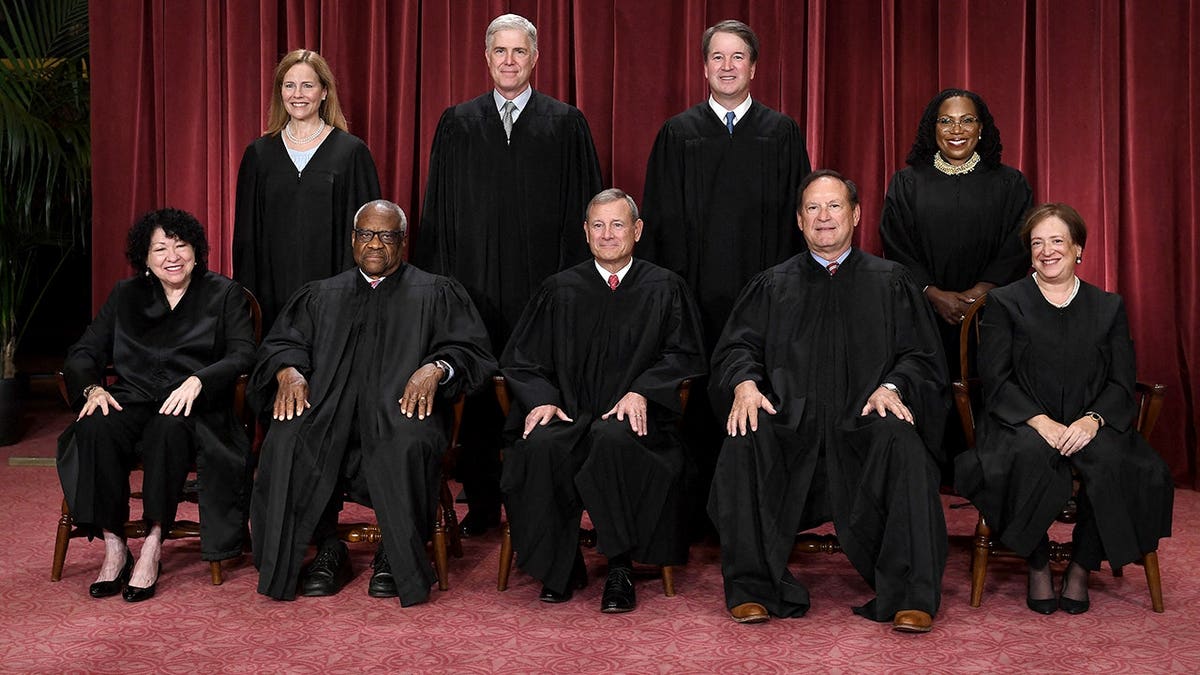
Justices of the U.S. Supreme Court pose for their official photo at the Supreme Court in Washington, D.C. on Oct. 7, 2022. (OLIVIER DOULIERY/AFP via Getty Images)
When Congress set the number of justices at nine in 1869 after expanding it to 10 justices in 1863, and then temporarily reducing it to seven in 1866, Congress and President Grant did so in the shadow of the new Fourteenth Amendment’s guarantee of "due process of law." OLC ought to be tasked by President Trump with weighing in on whether "court packing" violates that guarantee of due process and/or whether packing the court is an unconstitutional attempt to seize control of judicial review, which has always been implicitly vested in the federal courts by the Constitution but which was only made explicit by the Supreme Court in 1803 in the case of Marbury v. Madison, almost a decade and a half after the Constitution was ratified.
Democrats also want to make the District of Columbia and Puerto Rico states. The Twenty-Third Amendment to the U.S. Constitution deals with the District of Columbia, and OLC ought to opine on whether statehood for D.C. would require another amendment.
CLICK HERE FOR MORE FOX NEWS OPINION
George Washington University law professor and Fox News contributor Jonathan Turley has already raised another important issue: "With one-party control in states like Michigan, Nevada, Pennsylvania, and Wisconsin, the [Democratic] party is ready to get states to join the National Popular Vote Interstate Compact," Turley wrote recently in an op-ed for Fox News.
"Under the Compact," Turley explained, "states agree to give all their electoral votes to the presidential ticket that wins the national popular vote."
"The constitutionality of the Compact has obviously not been tested," Turley wrote.
CLICK HERE TO DOWNLOAD THE FOX NEWS APP
As with "court packing," OLC has never weighed in on either statehood for D.C. or the Compact. AAG Gaiser and his team of big legal brains can study these issues and provide the first comprehensive analysis for the executive branch, including who would have "standing" to bring constitutional challenges to all three schemes and when such challenges would be ripe. Of course, OLC opinions would not bind federal courts, but they would be instrumental in shaping the debate before the courts.
Hugh Hewitt is a Fox News contributor and host of "The Hugh Hewitt Show" heard weekday afternoons from 3 PM to 6 PM ET on the Salem Radio Network, and simulcast on Salem News Channel (SNC). Hugh drives Americans home on the East Coast and to lunch on the West Coast on over 400 affiliates nationwide, and on all the streaming platforms where SNC can be seen. He is a frequent guest on the Fox News Channel’s news roundtable, hosted by Bret Baier weekdays at 6pm ET. A son of Ohio and a graduate of Harvard College and the University of Michigan Law School, Hewitt has been a Professor of Law at Chapman University’s Fowler School of Law since 1996 where he teaches Constitutional Law. Hewitt launched his eponymous radio show from Los Angeles in 1990. Hewitt has frequently appeared on every major national news television network, hosted television shows for PBS and MSNBC, written for every major American paper, has authored a dozen books and moderated a score of Republican candidate debates, most recently the November 2023 Republican presidential debate in Miami and four Republican presidential debates in the 2015-16 cycle. Hewitt focuses his radio show and his column on the Constitution, national security, American politics and the Cleveland Browns and Guardians. Hewitt has interviewed tens of thousands of guests, from Democrats Hillary Clinton and John Kerry to Republican Presidents George W. Bush and Donald Trump over his 40 years in broadcasting. This column previews the lead story that will drive his radio/ TV show today.
KioskNews shows a cleaned-up reading view extracted from the publisher’s page — the original always lives on their site, not ours.