Africa’s biodiversity goals face data, funding and capacity gaps, experts warn
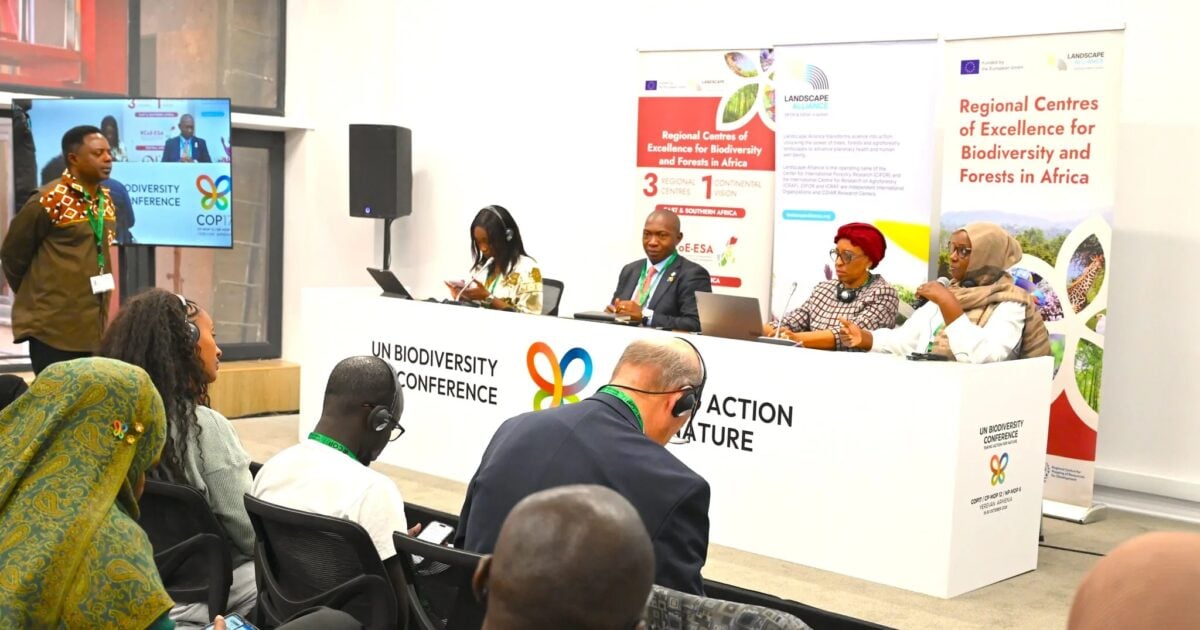
NAIROBI,Kenya, Oct 29 — African countries need stronger biodiversity data systems, technical expertise and sustainable financing to translate global conservation commitments into measurable action, regional institutions have warned.
The warning emerged at the UN Biodiversity Conference (COP17), where African regional institutions highlighted gaps in biodiversity monitoring, data sharing and institutional capacity that could hinder implementation of the Global Biodiversity Framework.
The discussions, convened by Landscape Alliance (CIFOR-ICRAF) through an EU-funded initiative supporting Regional Centres of Excellence for Biodiversity and Forests in Africa, focused on strengthening the technical systems countries need to implement and report on their biodiversity commitments.
“The question is no longer whether Africa has biodiversity commitments. The question is whether we have the systems, institutions, expertise and resources to implement them at scale,” said Dr Peter Minang, Africa Director at Landscape Alliance.
He said regional institutions were critical in connecting global conservation commitments with the technical realities facing individual countries.
The discussions brought together three regional centres designated to support technical and scientific cooperation under the Convention on Biological Diversity: the Regional Centre for Mapping of Resources for Development (RCMRD), serving Eastern and Southern Africa; the Centre de Suivi Écologique (CSE), serving West Africa; and the Central African Forest Commission (COMIFAC), serving Central Africa.
The institutions provide support ranging from geospatial data and biodiversity monitoring to regional assessments and technical guidance for national implementation.
Data gaps hinder conservation planning
One of the challenges identified was the limited usability of biodiversity information, with data often scattered across institutions, collected using different methods or requiring validation before it can inform policy decisions and national reporting.
Jackline Karimi, a Policy Engagement Specialist at RCMRD, said geospatial tools could help countries identify errors and inconsistencies, compare new datasets with existing records and validate information for reporting.
“Better data leads to better decisions. We need to ensure that the information countries collect is accurate, validated and accessible, so that it can actually be used to guide biodiversity action and reporting,” Karimi said.
However, the availability of technology alone will not resolve the problem, with countries also needing trained personnel and institutions capable of maintaining data systems and applying the information to conservation planning.
RCMRD is supporting government agencies, universities and other stakeholders to strengthen these technical skills.
Marième Diallo, Technical Director at CSE, said countries needed reliable information, the expertise to use it and adequate funding to move from commitments to implementation.
She also called for stronger systems to harmonise, validate and share biodiversity information across institutions and national borders.
“The objective is to strengthen the sharing and use of biodiversity information so that countries can have reliable information to support decision making and implementation,” Diallo said.
Sustained funding
Valérie Tchuante, a Monitoring and Evaluation Specialist at COMIFAC, said regional institutions needed stronger links with universities and research organisations to provide sustained technical support to countries.
“We need to strengthen regional institutions and Technical Support Centres so that they can respond to the technical needs of countries,” she said, adding that this required stronger partnerships and sustainable institutional and financial arrangements.
Participants said long-term investment was necessary to maintain data platforms, update biodiversity information and retain technical expertise beyond individual projects.
Minang said addressing the financing challenge would require governments, civil society, the private sector and other stakeholders to work together to support the institutions and technical capacity needed to deliver conservation commitments.
“We need to bring all actors together, including governments, civil society, the private sector and others, to look at the financing challenge and find ways of ensuring sustainable financing for the institutions and capacities needed to deliver biodiversity action,” he said.
The engagements were organised under an EU-funded initiative led by Landscape Alliance to strengthen regional technical support for biodiversity and forest management across Africa.
KioskNews shows a cleaned-up reading view extracted from the publisher’s page — the original always lives on their site, not ours.