‘A launch every day our goal’: What lies ahead for firm that sent India’s first private rocket into space
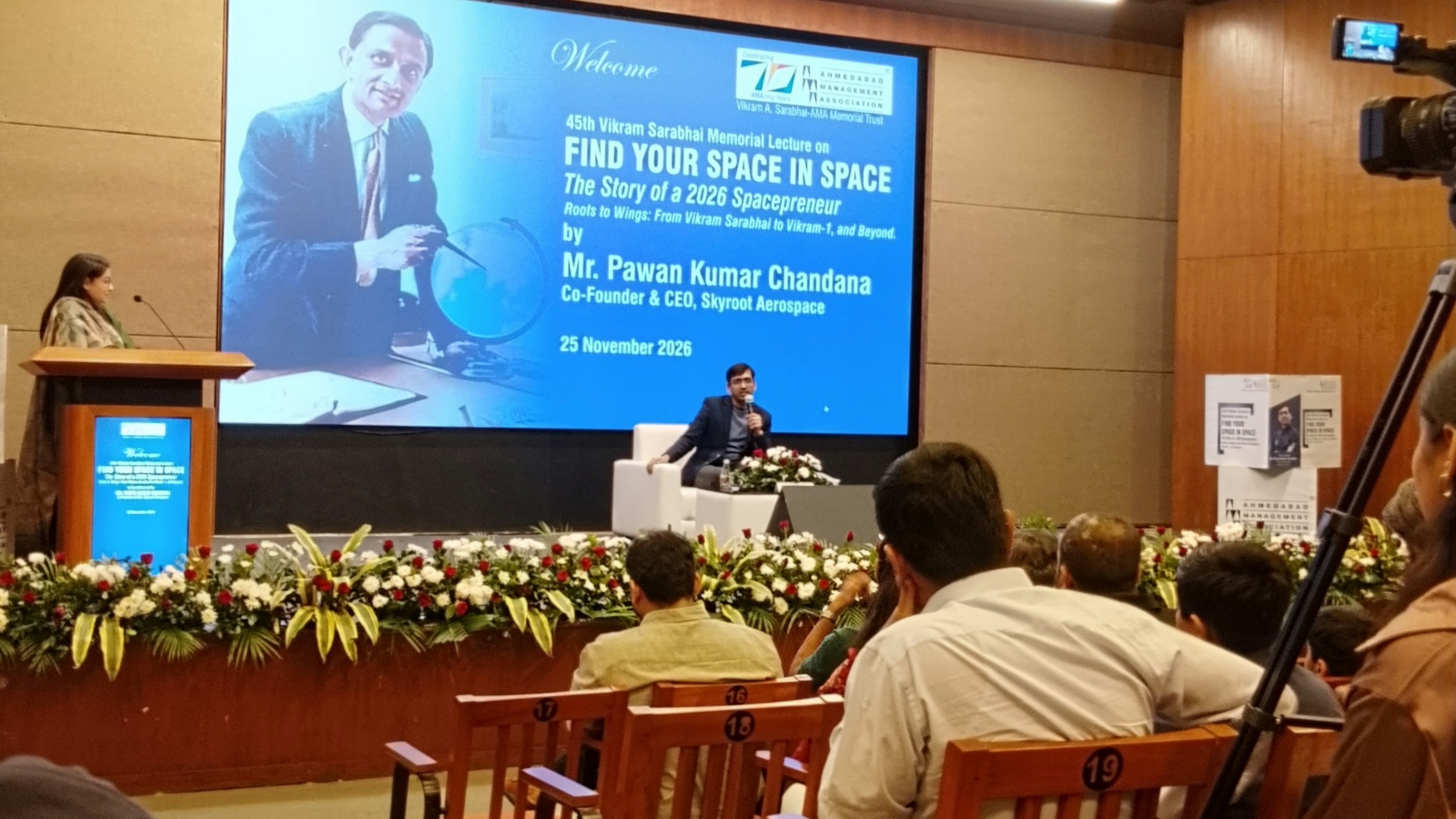
“The space programme that Dr Vikram Sarabhai sowed the seeds of gradually grew into ISRO. But what he built was not just an institution or infrastructure; he created a culture that inspired generations of scientists and engineers to take India's space journey forward,” Chandana said.
BY ILMA SHAIKH
When Pawan Kumar Chandana “cold-texted” Myntra co-founder Mukesh Bansal seeking funds for his rocket project in 2018, he had little idea about how to raise capital.
“I thought that startups just took loans. I didn’t even know what equity was,” the co-founder of Skyroot Aerospace said at the 45th Vikram Sarabhai Memorial Lecture in Sarabhai’s city of birth, Ahmedabad, on Wednesday (November 25).
Skyroot’s second rocket named after Sarabhai, Vikram-1, shot into space in July from Sriharikota. This was India’s first privately developed orbital launch vehicle.
Chandana recalled “how he searched online for terms, such as term sheets, and ways to raise investment”.
Titled “Find Your Space in Space: The Story of a 2026 Spacepreneur – Roots to Wings: From Vikram Sarabhai to Vikram-1, and Beyond”, the lecture explored India’s journey from the early days of its space programme to the emergence of private companies in the sector. It was held at the Sarabhai-founded Ahmedabad Management Association (AMA).
Chandana’s vision now is to take Skyroot, the private space launch company headquartered in Hyderabad, “from one rocket launch every month to one every week and, eventually, to one every day”.
“When Skyroot Aerospace began its journey in 2018, the idea of an Indian private company building and launching its own rocket was met with scepticism. The question was not simply when the company would launch [a rocket], but how a young team, in a sector dominated by institutions, could make it happen,” he said.
“Only because of the foundation Dr Vikram Sarabhai has set can entrepreneurs like us even imagine building a rocket in India,” he said.
For him, Sarabhai’s work was also an example of what it meant to begin something when “almost nothing existed”. He recalled how the scientist had to convince the government, secure resources, bring people together across fields and create the foundations of a space programme in the 1960s.
“That willingness to take a risk became an inspiration for Skyroot,” he said.
Recounting his struggles, he says, “I created a LinkedIn account and started reaching out to angel investors. Almost everybody rejected us. Then one person said, “Okay, let’s catch up.” That person was Mukesh Bansal.”
“Building a rocket and launching a rocket, of course, is so complicated. But authorising a rocket launch is also rocket science,” he said.
He explained that a launch involved several layers of coordination, including safety clearances and ensuring that the rocket’s stages fell in designated areas. For a young private company, navigating these requirements was another test of persistence.
The development of Vikram-1 involved more than 1,000 engineers and nearly 400 domestic suppliers, reflecting the scale of the ecosystem needed to build a launch vehicle.
KioskNews shows a cleaned-up reading view extracted from the publisher’s page — the original always lives on their site, not ours.