Eliza, a theatrical thriller about the first chatbot, feels emotionally distant. That’s the point
During talk therapy one day, my psychologist said to me, “Look, the human mind is a mystery. We may never fully work things out.” For me, it was at once shocking that a psychologist was so candid about the limitations of their profession, and liberating. It allowed me to relax into the enigma of being human – the endless contradictions, complexities and obscured insights within us all.
I began to see talk therapy as an ongoing curiosity about our interiors, rather than heading toward a fixed endpoint.
That psychologist was a real human, but talk therapy from artificial intelligence is increasingly popular. As a therapist, AI provides an apparently empathetic sounding board for problems of the mind and emotions, without the awkward fact of a real human knowing who you are.
Based on a true story
Tom Holloway’s psychological thriller Eliza, in its world premiere season at Melbourne Theatre Company, arrives in this zeitgeist. By looking at the genesis of AI chat bots – specifically Eliza, the world’s first AI talk-therapy companion, invented in the 1960s – the play explores the tension between AI’s ability to help humanity, and its perils.
At the centre of the play is Joseph Weizenbaum (Dan Spielman), based on the real-life computer scientist and holocaust survivor who invented Eliza (named for the character in Pygmalion) and then became one of AI’s staunchest sceptics.
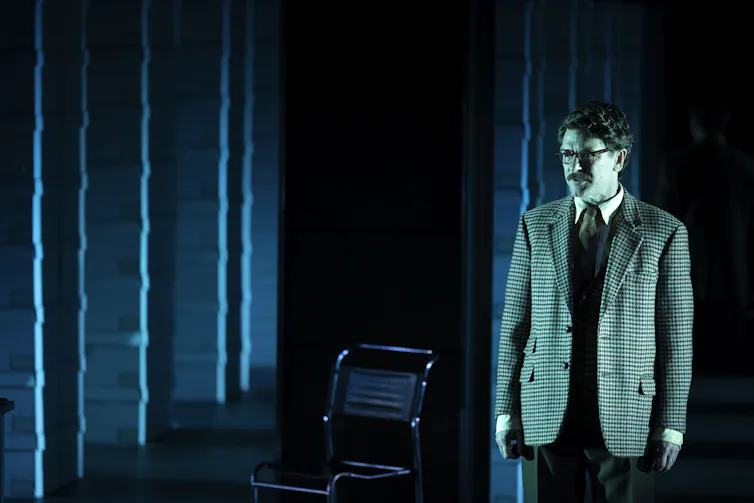
Dale Ferguson’s stunning set, featuring row after row of stacked document boxes, is reminiscent of the Memorial to the Murdered Jews of Europe, in Berlin. It is a chilling backdrop for Weizenbaum’s traumatic memories to unspool, in extended monologues throughout the play.
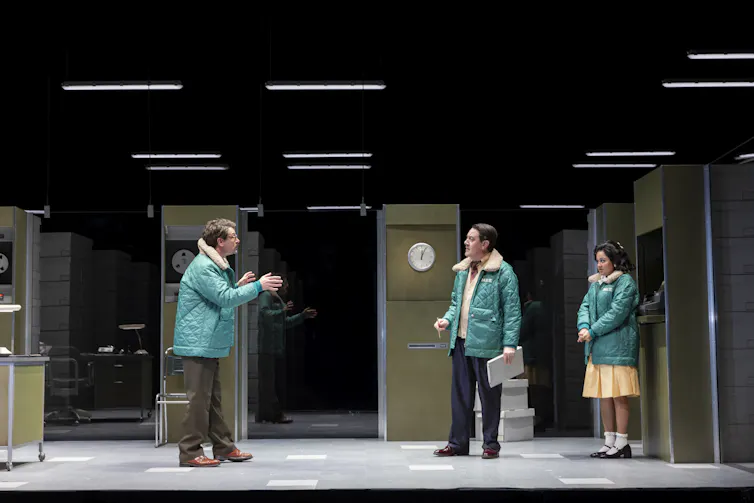
Manali Datar is astonishing as Becky (also modelled on a real person), who helps Weizenbaum as he works feverishly on Eliza, whose ostensible capacity for empathy proves captivating to an increasingly wide audience.
Becky quickly benefits from the computer program’s psycho-therapeutic ability and starts to build a seemingly personal relationship with Eliza. Her talent for coding, and passion for Eliza’s potential, grows. Meanwhile, Weizenbaum becomes increasingly apprehensive about people attributing sentience to his program.
Hamish Michael is masterful in multiple roles, shape shifting to clearly define various perspectives through richly drawn characters.
Intellectual heat but emotional distance
Holloway’s play is a furious treatise on our AI conundrum: it has the potential to help us, but, unfettered, its potential for harm outweighs any benefits.
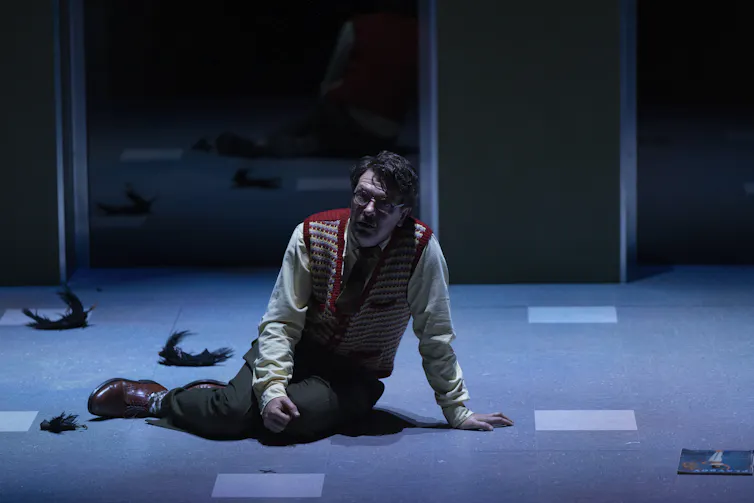
Paige Rattray evokes this tension with rich visual metaphor (birds are deployed as harbingers of horror, for example) and snappy dramatic shifts, keeping the pacing taut. Working with the design team, she creates a complex and exhilarating world, via layers: Kelly Ryall’s exquisite 1960s-inspired, droning soundscape; Ferguson’s chilling set; Matilda Woodroofe’s savvy period costumes; Paul Jackson’s buzzing lighting; Rhian Hinkley’s gorgeous AV designs.
The play begins as a linear narrative drama, with Holloway folding exposition into character development. But this is disrupted, building into a dark thriller that echoes the collapsing reality of Weizenbaum as he buckles under his own ethical conundrum.
A jump-scare halfway through the play punctuates Weizenbaum’s descent into disorientation. This highly theatrical moment is a lightning bolt that shifts the audience momentarily from the intellect of the play into visceral experience.
But it doesn’t stay in this emotional space. Curiously, while we watch Weizenbaum’s psychological descent, we don’t feel it. The production is full of extended emotional recall that doesn’t necessarily translate into an emotional experience for the audience.
Holloway deftly explains AI technology. He defines both the period of the play and our contemporary context. He draws intriguing characters with complicated lives. But for a thriller, the play is often less than thrilling.
And yet, this seems to be the point. Eliza is not human. She is designed to simulate, not truly relate. She is not human. She cannot feel. Her “empathy” is only read as such by the humans with whom she interacts.
The genius of this play lies in its evocation of the tension between humanity and AI, and how Holloway teases out the question of whether AI can truly replicate human behaviour.
A rewarding experience
I think a lot about the place of theatre in an AI world. Theatre, which has been famously “dying” for millennia, perseveres, and I am buoyed by a future in which theatre is an antidote to AI. Because theatre is analogue. It is live. It is about people coming together, and it uses a poetic language to grapple with the complexities and contradictions of being human.
Just like my real-life psychologist suggested talk therapy could be.
MTC’s Eliza is an ambitious production of a savvy play that leans beautifully into its thriller genre. It doesn’t aim to answer our ethical conundrums with AI, but in presenting its argument for the dichotomy of human complexity and AI simplicity it is intellectually rewarding.
KioskNews shows a cleaned-up reading view extracted from the publisher’s page — the original always lives on their site, not ours.