Anduril says its first satellite can see adversaries maneuver in orbital night
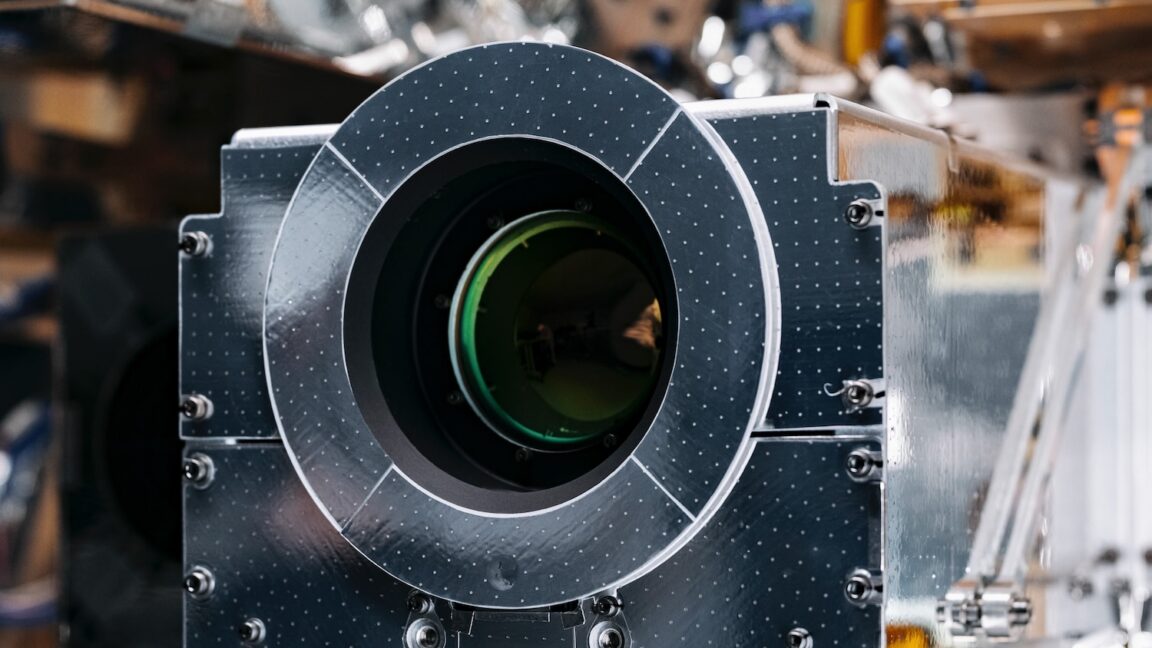
Anduril’s long-wave infrared sensor works by detecting heat signatures from spacecraft, even in periods of eclipse. It provides a “unique capability for us to witness when an adversary or other resident space objects are maneuvering during those eclipse periods, where in the past we’ve been fairly blind,” Thurn said.
In creating the infrared space sensor, engineers applied imaging technology Anduril uses in its autonomous weapons for use in space. Anduril released a single image Tuesday from the sensor on Anduril-216 showing an infrared view of the Moon above Earth’s horizon. The Moon image offers just a taste of what the instrument can do, Thurn said.

The Moon over Earth’s horizon, as imaged by Anduril’s long-wave infrared space sensor.
Credit: Anduril Industries
The Moon over Earth’s horizon, as imaged by Anduril’s long-wave infrared space sensor. Credit: Anduril Industries
“The long-wave infrared capability we have on orbit can do both unresolved and resolved imagery,” Thurn said, suggesting Anduril’s sensor could be used to inspect other satellites in orbit if it flies close enough. For now, Thurn said Anduril is focusing optimizing its tracking sensor for low-Earth orbit, but it could be used in other orbits, and eventually in cislunar space near the Moon.
Apex Space, a satellite-manufacturing startup, built the spacecraft platform for Anduril-216. Subramanian said Anduril has no plans to start its own satellite production line. Instead, Anduril foresees buying third-party satellite platforms and integrating them with sensor and compute modules to perform a range of different missions in space.
“You’re seeing that today with Anduril-216, where we started with a simple mission, which was how do we track satellites, especially in these eclipse periods where the US currently does not have the ability to maintain custody,” Subramanian said. “And we designed a mission around that.”
The compute module on Anduril-216 is designed to fuse data from different kinds of sensors, such as infrared or visible imagers, and generate tracking solutions on its own, without intervention or analysis from the ground.
Subramanian said Anduril’s current focus is on acquiring space domain awareness data for sale to the US military, not selling entire satellites or sensors to the government. “At present, Anduril is not offering this system as a merchant supplier,” he said. “That could change in the future.”
KioskNews shows a cleaned-up reading view extracted from the publisher’s page — the original always lives on their site, not ours.