‘I actually don’t know who that is’: Nonplussed Suaalii brushes off Ashton sledge
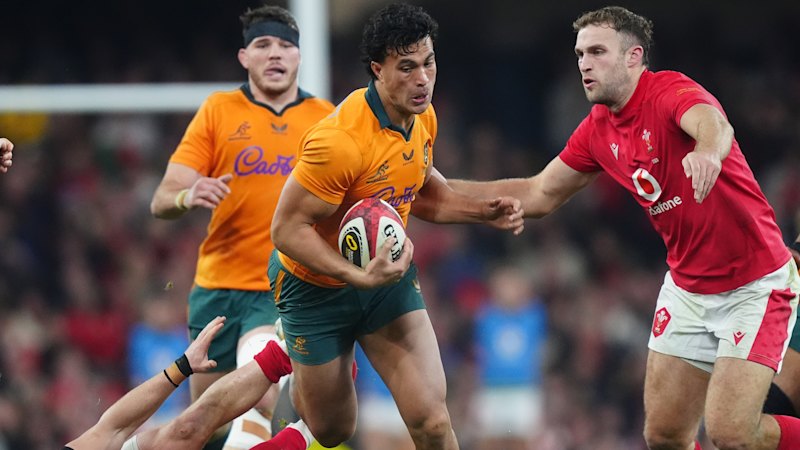
Joseph-Aukuso Suaalii didn’t take the stinging criticism of Chris Ashton to heart earlier this month because firstly he didn’t see it, and secondly he couldn’t pick Chris Ashton out in a two-man line-up.
“I actually don’t even know who that is,” Suaalii said. “No disrespect to him. He’s entitled to his opinion. He probably played in the ’90s. The game’s changed quite a bit, I feel.”
After the Wallabies’ record loss to England, Ashton offered a sharp critique of Suaalii on a BBC podcast, saying he looked lost on a rugby field, that the hyped Aussie wouldn’t make the English side and questioning his $1.6m annual salary.
Coming from any other player, Suaalii’s riposte to Ashton - a former England winger in league and union whose career stretched from 2005 to 2023 - might be viewed as a cold-blooded clap back, three weeks in the making.
But teammates say Suaalii genuinely stays deep within the confines of his own bubble, and doesn’t register most of the external criticism or commentary that has come in a steady stream, from media and the public alike, since he began playing professional sport as a teenager.
“The only way I really hear it is from my partner or my family reading about it, and then I get the “is everything alright?” [phone call],” Suaalii said. “To be fair, I try to be as consistent as I can be as a human, first of all. Then I’m just trying to be the best that I can be for the team. I’ve always had that mindset growing up, and I’m still just carrying that integrity and character for myself.
“[I am] just letting the outside noise be the outside noise, and trying to be the best for the team. It’s really as simple as that. At the end of the day I’m just trying to be the best player I can be.
“I understand everyone has their opinion, you guys [media] have your opinion. But the only opinion that really matters is from the coach, and my teammates. Even from my parents, that’s a little bit different. But I feel like everyone else doesn’t really understand what happens in the four walls.”
Like the Wallabies themselves, Suaalii has arrived in the last week of the spring tour having regained form and confidence recently, after a collectively forgettable start against England.
Having played wing at Twickenham, Suaalii returned to the centres alongside Len Ikitau and the restored midfield combination went a long way to fixing the leaky Wallabies defence against Scotland, and then in a win over Wales. He also turned in a strong game in attack, with contested kick wins, and a long-range run from an intercept that led to a try.
The debate around where Suaalii is deployed on a rugby field has been endless, and will probably continue to be. Suaalii stuck with his stock response on Wednesday in London, ahead of the fifth-placed playoff with Ireland on Friday, saying he is happy to play wherever the coach decides.
“That’s just where I see myself is just growing my game in all that sense—the attack, defence, breakdown, transition. That’s where I’m really just focusing and putting my energy towards. Position-wise it’s just up to the coach,” Suaalii said.
Sitting next to him at the Wallabies’ hotel in London, defence coach Scott McLeod also leapt to Suaalii’s defence as a centre.
“Put it in context. The world’s best midfielders are playing their best rugby when they’re 28, 29, 30, because they’ve learnt about the game. So, the scrutiny (on Suaalii) is pretty harsh, really. It doesn’t need to be that harsh,” McLeod said.
Suaalii only just turned 23 in August. McLeod added that the idea of a single “best” position was too limited, saying: “Our game moves and it requires players to be able to play a couple of different position. You look at (Henry) Pollock, (Leicester) Faingaanuku. Those guys can come on and change a game.
“And Joe’s got loads of skill sets that we can use in different times of the game and in different positions in different games. So, I don’t think it has to be nailed to one position going forward. It’s how you can adapt and use those skill sets against the opposition.“
Suaalii catching towering midfield high balls hoisted by Carter Gordon in Cardiff appeared to be a good example of leveraging the mixed skillsets of both midfielder and winger.
Explaining the turnaround in defence from what was seen in the Bledisloe and England losses, through to staunch efforts against Scotland and Wales, McLeod said the tweaks in systems and coaching he and Kiss had brought in was always going take time to bed down.
“With change — myself as a coach — my language is different, my perspective is different,” McLeod said.
“And takes the players probably a little while to understand that and feel that and what that means under a bit of pressure. And there’s no more pressure with speed than the All Blacks, and then speed and physicality of the English.
“So, we had a couple of weeks there where we learnt, but we didn’t get down on it. We just learnt what it meant under pressure, and what we needed to do and adjust or be better at.
“And I felt we really responded in the last two weeks to be able to do that. Staying in the game longer, working harder for each other, and being able to put the teams under a little bit more pressure. So really happy with those responses.”
News, results and expert analysis from the weekend of sport sent every Friday. Sign up for our Sport newsletter.
KioskNews shows a cleaned-up reading view extracted from the publisher’s page — the original always lives on their site, not ours.