Third US aircraft carrier enters Middle East as Trump heads to China for talks with Xi, Putin

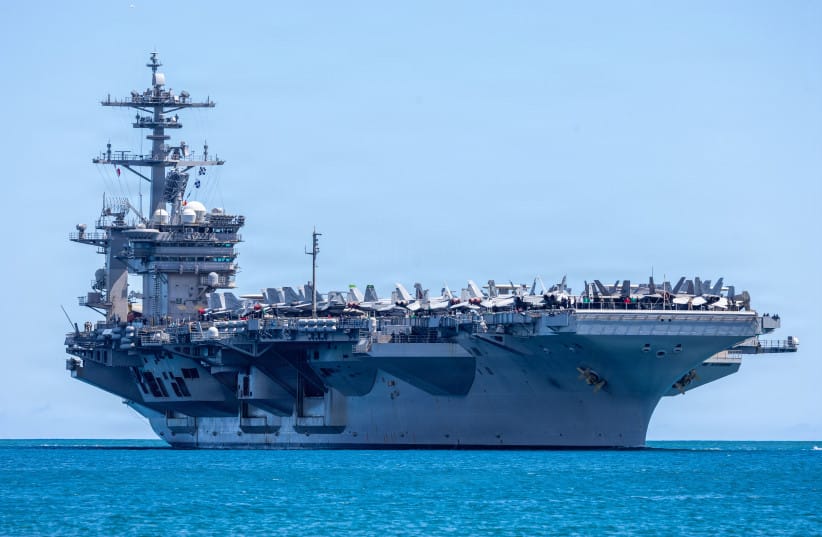
The USS Theodore Roosevelt entered the US Central Command (CENTCOM) area of responsibility on Sunday, bringing the number of American aircraft carrier strike groups in the region to three, a US official said, just hours before US President Donald Trump is scheduled to depart Washington for a diplomatic tour of Asia that will culminate in talks with Chinese President Xi Jinping and Russian President Vladimir Putin.
The Roosevelt joins the USS George Washington and USS George H.W. Bush, which are already operating in the region, amid continuing tensions with Iran and discussions within the Trump administration over whether to resume large-scale military operations against Tehran.
The concentration of three carrier strike groups represents a significant American naval presence in the Middle East. A similar deployment took place earlier this year, in April, when three US carriers operated in the region simultaneously for the first time since the 2003 Iraq War.
It remains unclear how long all three carrier strike groups will remain in the region. The Roosevelt had been expected to replace one of the two carriers already deployed, although American officials said all three could remain if necessary.
The latest military movements come as Trump considers his next steps in the war with Iran.
Trump has told senior advisers that he may refrain from ordering additional strikes unless Iran or the Iranian-backed Houthis launch new attacks against American interests.
The Saudi Crown Prince Mohammed bin Salman and Turkish President Recep Tayyip Erdogan have urged Trump to avoid another round of military escalation.
Israeli officials, meanwhile, have continued pressing Washington to consider renewed military operations against Iran, according to Reuters.
The debate comes amid fresh questions about Iran’s remaining military capabilities.
The Wall Street Journal reported Sunday that US intelligence agencies estimate Tehran still possesses between 1,500 and 2,500 missiles despite extensive American and Israeli strikes against its military infrastructure.
Officials described the estimate as having a low level of confidence because of difficulties determining how many missiles remain operational or in storage.
Nevertheless, the assessment suggests Iran retains substantial capabilities to threaten American forces and regional allies if hostilities intensify.
Iran on the agenda in China
Trump is scheduled to depart Washington early tomorrow, Monday, beginning a trip that will take him first to the Philippines and then to China.
As The Jerusalem Post reported Saturday, following a White House briefing, Trump will participate in meetings with Southeast Asian leaders in Manila on Tuesday before traveling to Shenzhen on Wednesday.
On Thursday, Trump is scheduled to participate in the Asia-Pacific Economic Cooperation (APEC) summit before holding a bilateral meeting and working lunch with Xi Jinping.
Toward the end of his visit to China, Trump is also expected to participate in an unprecedented trilateral summit with Xi and Putin.
The White House confirmed to the Post that Iran will be among the subjects discussed during the meeting, alongside the possibility of reducing the three countries’ nuclear arsenals.
However, senior administration officials cautioned during Friday’s briefing that Washington does not expect the initial trilateral meeting to produce a nuclear arms control agreement.
One senior official described the planned gathering as “the entry point, the first conversation,” emphasizing that the administration views it as the beginning of a potentially longer diplomatic process.
The official also clarified that Trump is not scheduled to hold a separate bilateral meeting with Putin during the visit.
While the war in Iran will be discussed, the administration does not intend to make the conflict in Ukraine part of the trilateral agenda, officials said, noting that separate diplomatic channels already exist between Washington and Moscow.
The juxtaposition of the American military buildup in the Middle East and Trump’s upcoming diplomacy in China underscores the two options still available to the White House: maintaining military pressure on Tehran while exploring potential diplomatic arrangements with other major powers.
For now, no new large-scale American strike campaign against Iran has been announced, even as the arrival of a third carrier strike group expands the military options available to the president.
KioskNews shows a cleaned-up reading view extracted from the publisher’s page — the original always lives on their site, not ours.