Taiwanese artist receives Primetime Emmy for animation
ROOTS OF PASSION: Howard Chen said that as a child, he admired how cartoons could tell stories through drawings without relying heavily on dialogue
By Sam Garcia / Staff writer, with CNA


Artist Howard Chen (陳人豪), who earlier this month won a Primetime Emmy Award, said the cartoons he grew up with in Taiwan planted the seeds for his career in the US.
Chen won for Outstanding Individual Achievement in Animation for his background design on the first episode of The Mighty Nein on Prime Video, titled “Mote of Possibility.”
Chen is one of few artists born and raised in Taiwan to win an Emmy. He moved to the US at the age of 13 with his mother and later studied at the ArtCenter College of Design in Los Angeles.
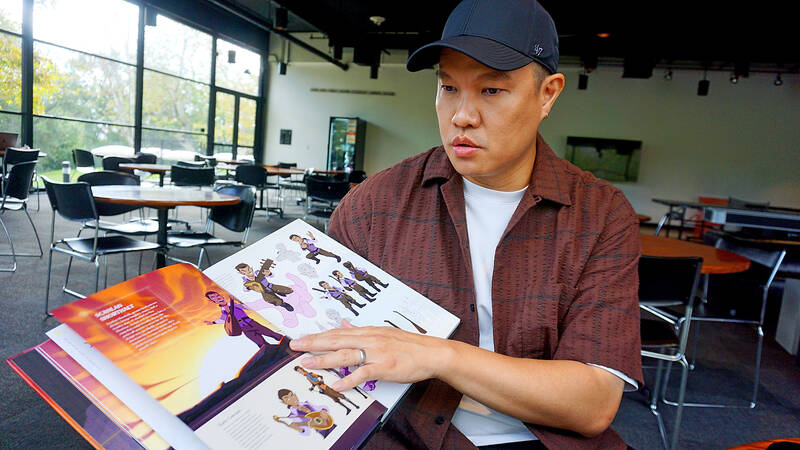
Taiwanese artist Howard Chen shows designs to an interviewer in Los Angeles on Tuesday.
Photo: CNA
He struggled when he first arrived in the US, as he did not speak any English, Chen told the Central News Agency yesterday in an interview at his alma mater.
After graduating in 2011, he worked with the production company Motion Theory before beginning his career in animation with Titmouse animation studio.
He has worked in character and background design over the past 15 years, participating in different styles of animated productions.
Chen said his passion for animation began when he was a child watching cartoons on TV in Kaohsiung.
He said he would check the newspaper every day to see what cartoons were playing on the three TV stations he could watch.
“Back then, I just thought cartoons were interesting. I never thought I would work in animation,” Chen said.
He was a fan of Japanese manga and anime when he was young, including Doraemon, Dragonball and Yu Yu Hakusho, as he admired how manga told stories through drawings, without relying heavily on text and dialogue.
Animation is appealing, as “a team works together to create an imagined world,” Chen said.
Chen created the setting in which The Mighty Nein’s main characters appear.
Since background design is like world-building, Chen said he studies the script and where the characters appear, while also considering the world’s history, culture, geography and building materials.
He also considers how the characters move through the space and how each scene would be framed.
Backgrounds should enhance storytelling without grabbing attention, Chen said, adding that they should blend seamlessly into the story, and be culturally and historically accurate to the setting.
After years of working behind the scenes creating backgrounds for animated stories, Chen stepped into the spotlight to accept the Emmy, saying he felt surprised and grateful for the recognition.
KioskNews shows a cleaned-up reading view extracted from the publisher’s page — the original always lives on their site, not ours.