Musk’s Terafab plan poses no short-term threat to TSMC: Analyst
Elon Musk’s reported plan to build a massive semiconductor fabrication complex in Texas will have no impact on Taiwan Semiconductor Manufacturing Co (TSMC, 台積電) in the short to medium term, as such a project would take five to 10 years to materialize, a veteran semiconductor analyst said yesterday.
Speaking to reporters on the sidelines of a forum in Taipei, Kirk Yang (楊應超), chairman and CEO of Kirkland Capital LLC and a former foreign brokerage analyst, said building a leading-edge chip foundry is highly complex.
Even for TSMC, the world’s largest contract chipmaker, constructing and ramping up a new fab takes several years, Yang said.
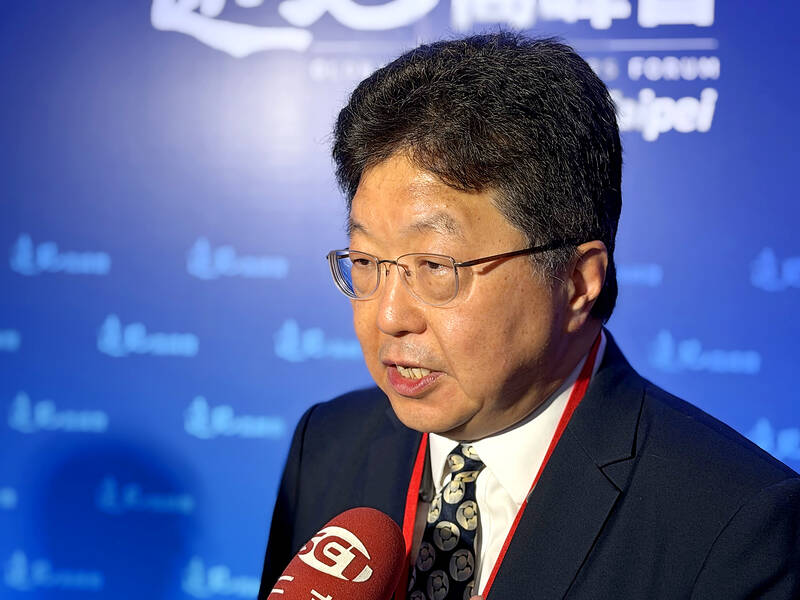
Kirkland Capital LLC chairman and CEO Kirk Yang speaks on the sidelines of a forum in Taipei yesterday.
Photo: CNA
If Musk, who leads companies including Tesla Inc and SpaceX, succeeds in building a chip fab, it will likely be five to 10 years before it becomes operational, Yang said, adding that the project poses “absolutely no impact” on TSMC in the short or medium term.
Musk plans to build “Terafab,” a massive vertically integrated semiconductor manufacturing and artificial intelligence (AI) computing complex in Grimes County, Texas, according to recent media reports.
Yang said many multinational companies had attempted to enter semiconductor manufacturing in the past, but failed because of the industry’s high technological barriers and enormous capital requirements.
He cited IBM Corp’s semiconductor business, where he previously worked, as an example, noting that it was ultimately sold to GlobalFoundries Inc.
Still, Yang said he remains confident in Musk’s long-term ability to execute the project, citing the billionaire entrepreneur’s strong execution record at Tesla and SpaceX, whose businesses span electric vehicles, autonomous driving, robotics, energy storage, AI, satellite communications and space exploration.
The global chip shortage during the COVID-19 pandemic, coupled with US-China trade tensions, has strengthened US companies’ desire to vertically integrate their supply chains, covering chip design, manufacturing and advanced packaging, he said.
Musk’s initial plan to invest about US$3 billion in a pilot fab is likely to involve US partners such as Intel Corp, as Washington still hopes domestic companies will play a leading role in semiconductor manufacturing, he added.
Looking further ahead, Yang said TSMC could benefit if Musk follows through on his proposed sublease model and allows the company to provide technical consulting services or lease space at the facility.
“Intel will sooner or later become a competitor to TSMC. That’s unlikely in the short term, but five or 10 years from now, it’s hard to say,” Yang said. “It wouldn’t be a bad thing for TSMC to get closer to Intel, as the two sides could gain a better understanding of each other.”
TSMC closed unchanged at NT$2,490 in Taipei yesterday after reaching a high of NT$2,535, as investors took profits ahead of the chipmaker’s earnings conference today.
KioskNews shows a cleaned-up reading view extracted from the publisher’s page — the original always lives on their site, not ours.