Families with complex needs to get ‘more coordinated’ support from 2029 as Singapore revamps services

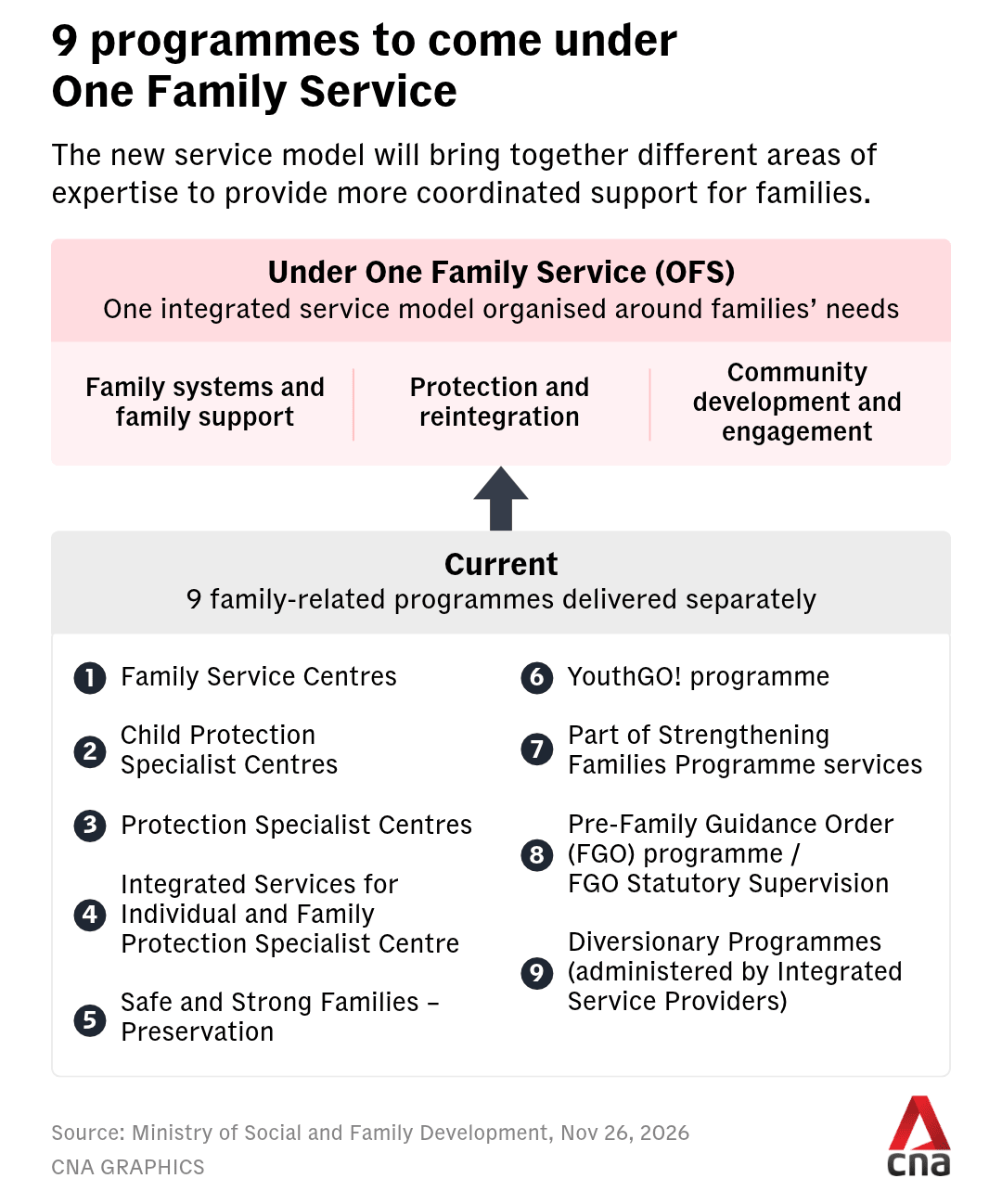
SINGAPORE: Families with complex needs who currently have to navigate multiple services can look forward to more seamless support, with a primary caseworker coordinating their care under a new model that will bring together nine existing government-funded family support, protection and youth programmes from 2029.
Called One Family Service (OFS), the new model aims to provide “more coordinated and responsive support for families as their needs change”, said the Ministry of Social and Family Development (MSF) on Thursday (Nov 26).
It will also place greater emphasis on identifying families' emerging needs earlier, strengthening outreach and connecting them to the right support and professionals before their challenges escalate.
OFS will roll out progressively across seven regions, starting with three in 2029, before expanding to the remaining four over the subsequent few years.
The model was proposed by the Family Services Review Committee, which was convened in June 2024 to examine how Singapore's family services could better meet families' changing and increasingly complex needs.
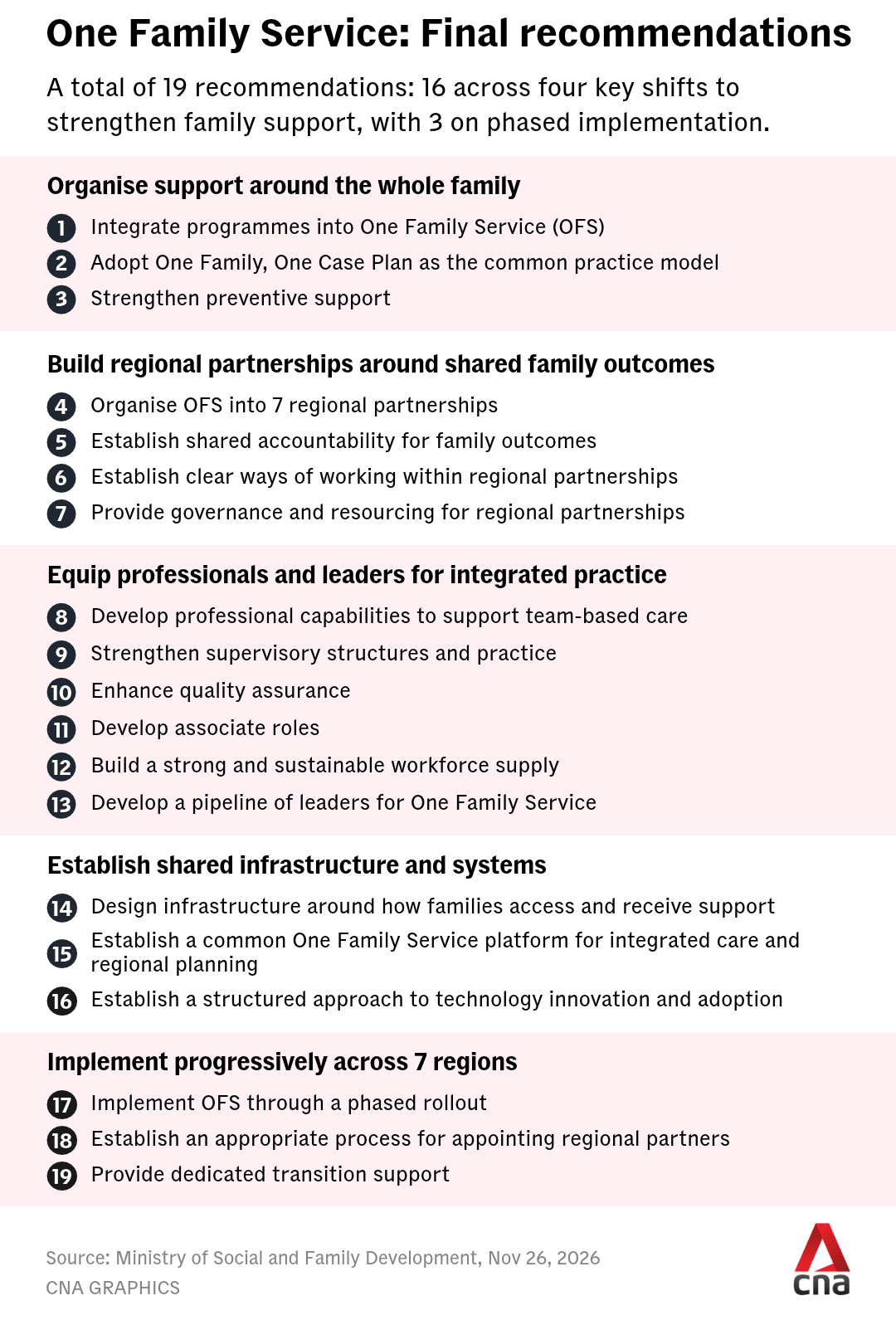
The government has accepted in principle all 19 recommendations in the committee's report released on Thursday.
MSF noted that families with interconnected needs may currently have to engage multiple services and professionals, go through different assessments and work with separate case plans.
All these will change under OFS, with families getting an integrated case plan, with professionals working together as a team where different expertise is needed, said MSF.
“When a family reaches out for help, navigating our services should not become another challenge for them," said Senior Parliamentary Secretary for Social and Family Development Eric Chua, who co-chaired the committee.
“By reaching families earlier and organising support around their strengths, needs and goals, we hope to make their journey simpler and more continuous as their circumstances change.”
The recommendations, which outlined four key shifts in how family services are offered, were developed in close consultation with the social service sector, including all 26 social service agencies running programmes that will come under OFS.
In response to CNA’s queries, MSF said that as of Thursday, social service agencies in five of the seven regions had signed letters of intent to plan for and implement OFS.
“We expect partnerships in the remaining two regions to be finalised by end-December 2026,” the ministry said.
ORGANISING SUPPORT AROUND THE WHOLE FAMILY
The first shift is to organise support around the whole family.
This includes adopting a "one family, one case plan" approach, where each family will have one integrated case plan, a primary caseworker and an interprofessional team providing support based on their needs.
This involves integrating nine existing MSF-funded programmes spanning family support, protection and youth services.
Currently, families with complex needs may have to navigate several programmes, each with its own eligibility criteria, referral pathways and case plans.
Today, the nine programmes collectively serve approximately 35,000 individuals or families each year, MSF told CNA.
Close to one in five families are supported by more than one programme.
“This proportion likely under-represents the proportion of households with multiple needs that could benefit from receiving support from more than one service,” MSF said.
The proportion of family service centre cases assessed as having higher risk or greater complexity increased from 25 per cent in 2019 to 30 per cent in 2025, said MSF, adding that this is expected to grow further.
Under OFS, support will instead be organised around the needs of the family as a whole, rather than individual programmes.
Each family will be assigned a primary caseworker who will oversee its overall support and coordinate the professionals involved.
For instance, a family experiencing domestic violence may currently have one case plan, while an at-risk youth in the same household may have another.
Under the new approach, both the parents and the youth will be supported through a single integrated case plan.
“This goes beyond improving coordination to professionals working together as one synchronised team to provide support centred on the family’s needs as a whole,” the committee said in its report.
"Today, professionals already coordinate with one another where needed, but often work in parallel with separate goals, plans and processes. This is not optimal as the issues a family faces are interconnected."
The committee also recommended making preventive support a core function of OFS, so that agencies can identify emerging needs and reach families before challenges escalate.
BUILDING REGIONAL PARTNERSHIPS
The second shift involves organising OFS into seven regional partnerships, moving away from the current system where individual social service agencies plan and deliver support mainly within their own organisations.
Agencies within each region will work together to plan, coordinate and deliver services, while sharing responsibility for improving the well-being of families in their communities.
The seven regions were drawn with reference to existing geographical planning frameworks, including the Urban Redevelopment Authority's planning areas and the Agency for Integrated Care's planning boundaries, to support coordination with other services.
MSF said that after rolling out the model in 2029, the plan is for the remaining four regions to follow over the next one to two years.
“The sequence will depend on the detailed implementation planning and each region's readiness. Hence, the first three regions have not been decided,” MSF said.
Rather than working as separate agencies delivering individual services, regional partners will be encouraged to pool their strengths and expertise to better meet families' needs.
"This encourages regional partners to view success through the lens of collective impact rather than focus on the performance of individual programmes, while retaining the unique strengths and identities of each regional partner," the committee said in its report.
Another recommendation is to establish a shared outcomes framework, so that agencies are collectively accountable for improvements in family well-being, stability and service experience.
“Alongside these shared outcomes, there should be role-specific outcomes based on what each regional partner is expected to deliver within the regional partnership,” the committee said in its report.
Regional partners will also have access to data on service demand, manpower deployment and emerging needs, allowing them to identify gaps and better plan support for families.
Responding to queries by CNA on how OFS will work for families who stay in rental flats or do not have a fixed address, MSF said programmes with defined service boundaries currently have protocols for managing cross-boundary cases, and OFS will build on these existing arrangements where the approach depends on the family's circumstances and needs.
“For example, when a family moves to another region, the original region could continue supporting the family to maintain continuity of care and avoid an unnecessary transfer, such as where the case is nearing closure.
“Where family members live across different regions, such as where parents and children reside in different regions following a divorce, one region should take the lead in supporting the family, consistent with one family, one case plan,” MSF said.

EQUIPPING PROFESSIONALS AND LEADERS FOR INTEGRATED PRACTICE
The third shift focuses on strengthening the capabilities of social service professionals and leaders to support integrated, team-based care.
The committee recommended adopting a new competency model that would allow professionals to deepen their expertise in their respective disciplines, while developing broader skills to work across different areas of practice.
These include family systems and family support, protection and reintegration, as well as community development and engagement.
Social service professionals will also undergo common foundational training to help them work more effectively across disciplines and agencies.
Another recommendation is to strengthen supervisory structures and practice, so that professionals receive appropriate guidance when handling complex cases involving multiple disciplines.
The committee also proposed expanding the roles of social work associates, allowing them to take on less complex and lower-risk responsibilities under appropriate supervision.
“These mechanisms should enable social work associates to assume greater responsibilities progressively, based on demonstrated competence, while safeguarding practice quality and client safety,” the committee said in its report.
To strengthen the workforce pipeline, the committee recommended closer collaboration with institutes of higher learning and social service agencies to develop training and career pathways.
At steady state, OFS should collectively support at least 150 internships and clinical placements annually, while existing manpower schemes could support around 50 fresh entrants and 90 mid-career entrants each year.
When asked if consolidation will mean fewer social workers are needed, MSF said: “We do not expect redundancies. Service demand is expected to grow, with an increasing proportion of families having more complex needs.”
It added that OFS will also expand areas of work such as preventive support and deeper therapeutic interventions.
Professor Tan Tai Yong, president of the Singapore University of Social Sciences and co-chair of the family services review committee, said the OFS model is not about expecting one professional to address every need, but about bringing together the strengths and expertise of different professionals as one team.
“We will work with practitioners, employers and institutes of higher learning to help professionals deepen their expertise while building the capabilities to work effectively across disciplines.”

ESTABLISHING SHARED INFRASTRUCTURE SYSTEMS
The fourth shift focuses on developing shared infrastructure and digital systems to support more coordinated ways of working across agencies.
The recommendations include a common OFS platform supported by shared digital and data capabilities to enable professionals across different social service agencies to deliver team-based care.
The platform, named CaseCentral, will provide authorised professionals with an appropriate shared view of a family's needs, interventions, progress and case plan, allowing them to coordinate support more effectively.
It will also provide visibility of caseloads and relevant professional capabilities, and aggregated information such as service demand and family outcomes to identify gaps and inform resource deployment.
Separately, the committee recommended developing a network of accessible and welcoming OFS touchpoints, where families can approach any location within their region and be connected to the full range of support they need.
These facilities could also be shared by professionals from different agencies to support joint case discussions, training and service delivery.
MORE SEAMLESS SUPPORT FOR FAMILIES
Director and head of Yishun Family Service at Singapore Children's Society Fang Xin Wei said that under OFS, professionals with different areas of expertise will be able to work more closely together, while families maintain the relationships and trust they have built with the main social worker.
"Families will no longer be passed from one service to another," Mr Fang said.
The new model also gives social workers more room to explore different areas of practice and build deeper expertise.
“For example, a social worker with a strong interest in working with children, or with families affected by violence, will have more opportunities to develop their skills in that area,” he said.
They can also learn from professionals across different disciplines and organisations, allowing them to broaden their perspectives on supporting families.
“Seeing how others understand and work with families helps us reflect on our own practice and recognise that there is often more than one way to help a family,” Mr Fang said.
Looking ahead, Mr Fang hopes OFS would allow agencies to reach families earlier, including those who may be struggling but have yet to seek help.
Closer partnerships with schools, preschools and community groups could also make support more accessible, while helping families build stronger connections within their communities, he added.
“In the long run, I hope families spend less time working out how to navigate the social service system and more time getting the support they need,” he said.
KioskNews shows a cleaned-up reading view extracted from the publisher’s page — the original always lives on their site, not ours.