SpaceX no longer needs NASA, and that's a problem for America's space agency
For nearly a quarter of a century, Elon Musk and his essential partner at SpaceX, Gwynne Shotwell, viewed the United States government as El Dorado, the mythical city of gold.
Like machete-wielding treasure hunters, Musk and Shotwell hacked through a tangled jungle filled with lurking carnivores such as Boeing and Lockheed Martin, as well as bean counters and regulators. Over time, against long odds, the pair cleared a path for SpaceX to contracts at NASA and the US military. They sued when things did not go their way. They hollered about unfair playing fields. Most importantly, they delivered quality space products to the US government for less.
And so, after a while, SpaceX found El Dorado and a city of contracts.
Then they started winning everything. So much so that the relationship between the customer and contractor began to change. Slowly at first, but ever more quickly, SpaceX went from needing the US government as an indispensable customer to becoming an indispensable contractor for the nation.
The pendulum has swung so far now that SpaceX seems increasingly disinterested in the US government for most contracts outside of data services, such as Starshield for military communications and observations.
“I guess I am still in denial that there is a divorce pending,” said Lori Garver, a deputy NASA administrator during the Obama White House years who was instrumental in expanding the agency’s use of commercial contracts with companies like SpaceX. “I literally cannot wrap my head around a future yet where SpaceX stops flying Dragon and Falcon. Not yet.”
But the signs point to at least a partial breakup. Consider the following data points:
- SpaceX has told NASA it will stop flying Crew Dragon, the space agency’s only reliable astronaut transportation to the International Space Station, by or before 2030. Shotwell said in September that NASA should rely instead on Boeing for astronaut transportation. “We’re just gonna let them have some business,” she said of Boeing. “They should fly their capsule. The government paid a lot of money for that.” As a result, NASA is investing more in Boeing.
- Ars reported in October that SpaceX had stopped selling commercial launches on the Falcon 9 rocket for missions after the year 2028.
- SpaceX may also still stop flying Falcon 9 for NASA missions. In late October, during a meeting of NASA’s Safety Advisory Panel, Kent Rominger said if the US Deorbit Vehicle (a modified Dragon spacecraft) launches to the International Space Station after 2030, “it may require” a rocket other than the Falcon 9.
- Politico reported last week that SpaceX told the US Space Force it would not bid on three new launch contracts in the late 2020s that would have gone above and beyond its existing commitments to the US military.
- SpaceX previously provided “Rough Order of Magnitude” estimates, or ROMs, for launch costs to US companies building small landers for NASA’s Moon Base as part of the Commercial Lunar Payload Services program. But according to three sources, SpaceX recently told these lunar companies they will not provide launch services.
To be clear, SpaceX is still fulfilling its existing contracts with NASA, the US Space Force, and other government entities. And it continues to do so at a lower cost and generally higher level of reliability than pretty much anyone else.
But the company is no longer signing many large new contracts for spaceflight services, at least in the traditional launch and in-space flight domains. The shift comes after 15 years in which the US government has grown accustomed to lower costs and rapid innovation that has revitalized the nation’s access to space.
For SpaceX and its shareholders, as shocking as it may seem for a US company to leave billions of dollars on the table in government contracts, this may be the right decision. SpaceX sees the vast bulk of its future revenue coming from artificial intelligence. However, SpaceX’s retreat from the public square comes as both NASA and the Space Force confront growing challenges from a rising space program in China and an aging but still dangerous Russia in space.
So what does it mean if the halcyon days of SpaceX riding to the rescue for America in space—such as in the saga of Butch Wilmore and Suni Williams—seem to be ending?
How we got here
In the early days, Musk and Shotwell sought revenue from various sources as SpaceX developed the scrappy Falcon 1 rocket. But it was NASA that stepped in at two crucial moments in the company’s first decade.
The first came in 2006, with a $278 million award to develop a cargo delivery spacecraft for the International Space Station. It helped SpaceX expand rapidly when it was struggling to develop the Falcon 1 rocket. An even more consequential award arrived in December 2008, $1.6 billion for a dozen Dragon cargo flights to the space station. The funding arrived as SpaceX struggled to meet payroll. Both Musk and Shotwell have said this award probably saved SpaceX from bankruptcy.

NASA Administrator Michael Griffin, left, meets with CEO of SpaceX Elon Musk, right, on April 20, 2005, at NASA Headquarters in Washington.
Credit: NASA/Renee Bouchard
NASA Administrator Michael Griffin, left, meets with CEO of SpaceX Elon Musk, right, on April 20, 2005, at NASA Headquarters in Washington. Credit: NASA/Renee Bouchard
NASA and SpaceX then fell into an increasingly warm and mutually beneficial relationship. During the last two decades, NASA has awarded contracts to SpaceX worth approximately $20 billion, and Musk has been deeply appreciative. In 2017, he revealed that the online password for some of his accounts was “ILoveNASA.” In return, NASA got reliable cargo, eventually crew services into low-Earth orbit, and a revolution in US spaceflight capabilities.
Musk and Shotwell fought to extend their relationship with the federal government in the mid-2010s. In 2014, they filed a lawsuit against the US Air Force for the right to bid for national security launch contracts. Musk contended that United Launch Alliance had a monopoly and said SpaceX should be eligible to bid. “We’re just protesting and saying these launches should be competed,” he said at the time. “And if we compete and lose, that’s fine, but why were they not even competed?”
The effort proved successful. SpaceX won national security contracts, and launch costs for the military plunged. Over time, SpaceX became the dominant player. Even today, with United Launch Alliance and Blue Origin struggling to bring their large Vulcan and New Glenn rockets into service, SpaceX’s Falcon 9 and Falcon Heavy rockets have become a single-point failure for national security launches. If the US military needed to get a dozen large satellites into orbit during the next 12 to 18 months, there is only one company that could credibly pull that off.
The bottom line is that SpaceX, far more often than any other competitor over the last 15 years, delivered spaceflight services to the US government when other contractors were late or overbudget or simply failed. That no other commercial space company has risen alongside SpaceX during this period is a problem. NASA, certainly, sought to support competitors such as Blue Origin, Sierra Space, Rocket Lab, Orbital Sciences, Boeing, and others. The US military supported development of United Launch Alliance’s rocket with $2 billion in funding as an alternative to Falcon.
And still, none have yet come remotely close to matching what SpaceX has done in launch, spacecraft, and in-space data services.
How it all came apart
The relationship dynamic began to change about half a decade ago.
At the height of the pandemic, in mid-2020, SpaceX delivered a huge win for NASA by safely flying astronauts Doug Hurley and Bob Behnken to the space station. It is difficult to overstate the importance of this achievement for NASA. Since 2011, the space agency had swallowed its pride and gone, hat in hand, to Russia for transportation to the space station. Its astronauts spent months in Russia learning the language and training to ride the Soyuz spacecraft into orbit. With a single successful 64-day mission, SpaceX ended all of that.
Less than a year later, NASA again turned to SpaceX. The space agency needed a Moon lander. But Congress had only appropriated beer money for a champagne project. NASA had three options for a privately developed lunar lander. None were ideal. SpaceX’s $2.89 billion proposal to develop Starship as a lunar lander and fly two missions was the only bid that fit NASA’s budget profile. Yes, Starship presented a complicated, oversized, and technically demanding solution. But in 2021, SpaceX was NASA’s only spaceflight contractor consistently delivering big results.
Almost overnight, then, NASA’s two most important and costly programs, the Artemis Program to land humans on the Moon and the International Space Station, became utterly dependent on SpaceX.
This power imbalance continued to grow, breaking into wider public view in June 2025 amid a temporary falling out between Musk and the president he helped elect. After Trump threatened to “terminate” SpaceX’s governmental contracts and subsidies, Musk’s response was essentially so what? In return, Musk threatened to decommission the Dragon spacecraft. He knew—correctly, it turns out—that SpaceX’s role in US government space programs could not be easily replaced. A Pentagon review in July 2025 found most of the company’s contracts with the US Department of Defense were essential.
Trump could still have hurt Musk’s businesses through regulatory review, particularly with the Federal Communications Commission and Federal Aviation Administration. And the two made up. But one indisputable takeaway from this brouhaha is that the US government now needed SpaceX more than SpaceX needed the US government.
“The dust-up with President Trump, when Musk threatened to take away Dragon, was utterly irresponsible,” said Chris Davenport, a professor at Arizona State University and author of Rocket Dreams. “If Falcon and Dragon go away, that is a huge disservice to the US government. NASA desperately needs SpaceX, and SpaceX knows it, and Elon knows it.”
This represented a truly remarkable shift for everyone who watched SpaceX fight so hard, for so long, to get its foot in the door at NASA and the Space Force. But as jarring as it is, this shift is no longer deniable.
What is Elon Musk thinking?
Around the time of his dispute with Trump, Musk came to fully believe that artificial intelligence was not just the next big thing. Rather, it was the industrial revolution of his lifetime. He began vectoring his two biggest companies, Tesla and SpaceX, toward dominating AI software, AI hardware, and computing power on the ground and in space to run it all.
This largely explains SpaceX’s acquisition of xAI and its subsequent IPO. It is also behind the potential merger of SpaceX and Tesla. This will give Musk more direct control over Tesla, something he values. But more critically, it gives him an immense pool of assets to deploy toward building data centers terrestrially and in space, autonomous vehicles, robots, massive rockets, and more.
No other company on Earth has the potential, at least in the near term, to own an entire stack of artificial intelligence. Elon Musk wants to manufacture the chips and electricity infrastructure for data centers, he wants to build the data centers that will power the AI revolution, he wants to develop and train the AI models that will provide its intelligence, and he wants to build physical products that he believes will become the shaping force of the 21st century.
He wants it all.
Such a future, in his mind, does not include a dead-end technology like the Dragon spacecraft—even though Dragon is the only reliable way to get humans into space outside of China and Russia, and only took flight with humans six years ago. He does not want to fly the partially reusable Falcon 9 rocket—even though it is the best, cheapest, and only Western vehicle capable of expanding to meet the growing demand from government and commercial customers for access to space right now.
Musk believes the government moves too slowly and simply isn’t ambitious enough when it comes to space. Often, in meetings at SpaceX, he will describe working with the US government as “like wearing lead shoes and walking through molasses.”
Instead, Musk wants to build bigger things, like Starship. He wants to move fast and break things when necessary. This explains why he has invested something like $15 billion in the development of the Starship rocket, from its engines to a growing number of launch sites in Texas and Florida, to get the massive, fully reusable vehicle off the ground.
For a time, this looked like a win-win situation for the US government and a growing commercial space industry counting on frequent, low-cost access to space. NASA built its Artemis Program around Starships landing on the Moon. The commercial space industry looked forward to abundant, cheap launches. The general sense was that pulling Dragon and Falcon 9 off the market would cause temporary upheaval, but these problems would soon be ameliorated by Starship and its promise of lower cost and even greater capability.
Worrying signs
That was the hope, at least.
In March 2020, SpaceX published its first “Starship Users Guide,” which included a 9-meter payload fairing with a “clamshell” structure that would open once in space to deploy payloads. The company said it would support Falcon-compatible payload adapters.
But in recent years, there has been little evidence that SpaceX is actually developing such a deployment mechanism. Rather, the company has implemented a Pez-like dispenser that releases flattish satellites from a narrow door in the middle of the Starship vehicle. This serves SpaceX’s internal payloads of Starlink and future Starmind (data center) satellites. But it’s unsuitable for deploying more traditional satellites or big NASA payloads, such as large space telescopes.
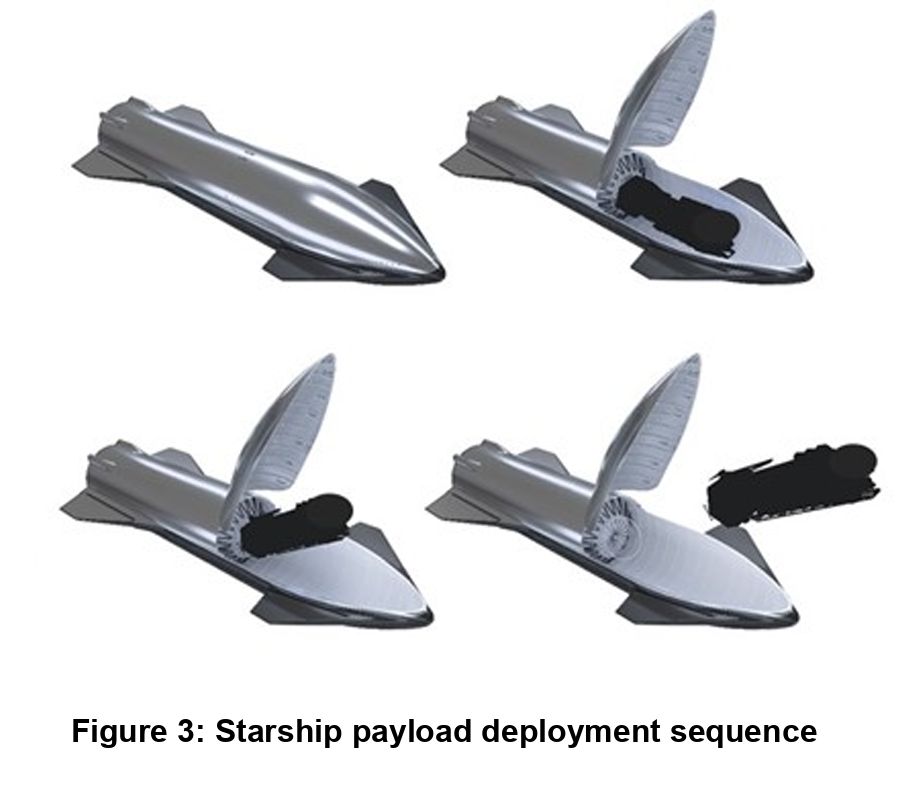
The original version of Starship’s traditional payload fairing, as seen in its 2020 Payload User’s Guide.
Credit: SpaceX
The original version of Starship’s traditional payload fairing, as seen in its 2020 Payload User’s Guide. Credit: SpaceX
Multiple people Ars spoke with for this story said it would be incredibly beneficial if SpaceX publicly committed to developing a large payload door and provided a timeline for its readiness. Ars offered SpaceX the opportunity to make such a commitment, but the company didn’t take it.
And it doesn’t have to. The reality is straightforward. This year’s IPO gave SpaceX a laser-like focus on its core business plan. Reaching stratospheric financial targets requires launching incredible numbers of Starlink and Starmind satellites, all of which can be dispensed like Pez candy into space. Launch services for third parties, which include NASA and other Moon Base customers, represent a rounding error in SpaceX’s revenue in the post-IPO world.
In its recent third-quarter 10-Q financial filing, the company references these launch priorities for Starlink and artificial intelligence: “We allocate a significant amount of launch capacity to our Connectivity segment and expect to allocate a significant amount to our SI segment in the future.”
An argument often made about SpaceX’s decision to end the Falcon 9 and Falcon Heavy rocket is that these programs—which operate with unprecedented efficiency in the history of launch—consume valuable engineering time. This talented team pushed Falcon 9 above 150 launches a year and helped make SpaceX globally dominant. Musk has said he would like to redirect these talented engineers to bring similar launch-operation efficiency to the Starship program.
Great engineers are certainly a finite resource. And SpaceX faces fierce competition in the US space industry for talented engineers, with higher salaries offered by Blue Origin, and attractive alternatives such as Stoke Space, Rocket Lab, Firefly, and Relativity Space all recruiting.
The question is whether Musk would devote his Falcon engineering team solely to Starship. Perhaps not. During the company’s third-quarter earnings call in October, Musk made a striking comment while musing about how the company aimed to deploy 10 GW of compute (on Earth) in 2027.
“What we’ve done at SpaceX is we’ve taken a team that has been able to achieve a market share in mass to orbit that is almost 90 percent,” Musk said. That team, he added, “has been able to achieve results that are an order of magnitude greater than the rest of all competitors in space combined.” Now, he said, SpaceX was applying that same team to the deployment of terrestrial compute. They would not be sent to Starbase for Starship, in other words, but to places like Memphis, Tennessee.
“This is a bit like the New York Yankees playing in Little League,” Musk said. “It’s not fair. But the net result is being able to deploy power, cooling, and infrastructure at a rate that is vastly faster than anyone else and may at some point be faster than everyone else combined.”
So yeah.
What happens to the Human Landing System?
SpaceX can do what it wants. But there are consequences, and some people at NASA are starting to wonder how serious SpaceX is about the Human Landing System contract it won from NASA in 2021. Landing on the Moon is wholly tangential to the company’s near-term AI future, and fulfilling the contract will almost certainly be a net negative from a financial perspective.
SpaceX, of course, says it is working assiduously on a lunar lander. And publicly, NASA officials say the company is a good partner. In an interview with Ars last week, the manager of the Artemis Program for NASA, Jeremy Parsons, said he regularly visits SpaceX facilities in Hawthorne, California, and Starbase, Texas. “Their management team is definitely committed to the lunar missions,” he said. Parsons credited the SpaceX engineers working on Starship as “some of the smartest individuals” he had ever met.
No one I have spoken to at NASA, both on and off the record, says SpaceX has given them a reason to believe the company will not eventually meet its Human Landing System commitments. And to date, SpaceX has had a remarkably good track record of delivering for NASA on its contracts. Nevertheless, the road ahead may be rocky in an era when SpaceX is pulling back from government involvement.
SpaceX has consistently told NASA it must get Starship flying orbital missions regularly. It has to get to full reusability, or nothing else matters. It has to do propellant transfer. All of that must come before finalizing the lander. And sure, it’s totally fair to say that the most important thing SpaceX can do for NASA right now is getting Starship to a very high flight rate. In SpaceX’s view, in a few years, Starship will be flying so often—the company recently told the Federal Aviation Administration it plans to launch 10,000 Starships a year by the 2030s—that fueling depots for missions to the Moon and Mars will be trivial.
Such a launch cadence surely would change everything, but nothing in aerospace ever happens as fast as one thinks or wants. And for now, the real issue is just how committed SpaceX is to the lander project and NASA’s competition with China. At SpaceX, projects deemed most important by leadership get the most resources. That is, the best engineers, the most software support, the most funding, and so on. Those projects are currently things like Starmind, the Colossus data center project in Memphis, and Starship engineering. It’s not the Human Landing System, multiple sources told Ars.
As SpaceX has struggled through the Starship test flight program, NASA has been waiting for an in-space fueling test, which has slipped its schedule many times. Testing propellant transfer and storage at a large scale is critical, and it has never been done in space. Successfully completing this test would reduce much of the risk for the kinds of refueling operations needed to send a fully loaded Starship to the Moon.
The latest target for such a test is “early” 2027, according to NASA and SpaceX. But this date seems aspirational. According to Parsons, the test requires one Starship to launch from Starbase in Texas and another to launch from Launch Complex 39A at Kennedy Space Center in Florida. Starship has not yet flown from there. Presently, a debut Florida launch is not expected until at least January. According to Parsons, the in-orbit fueling test is the third launch planned from Florida.
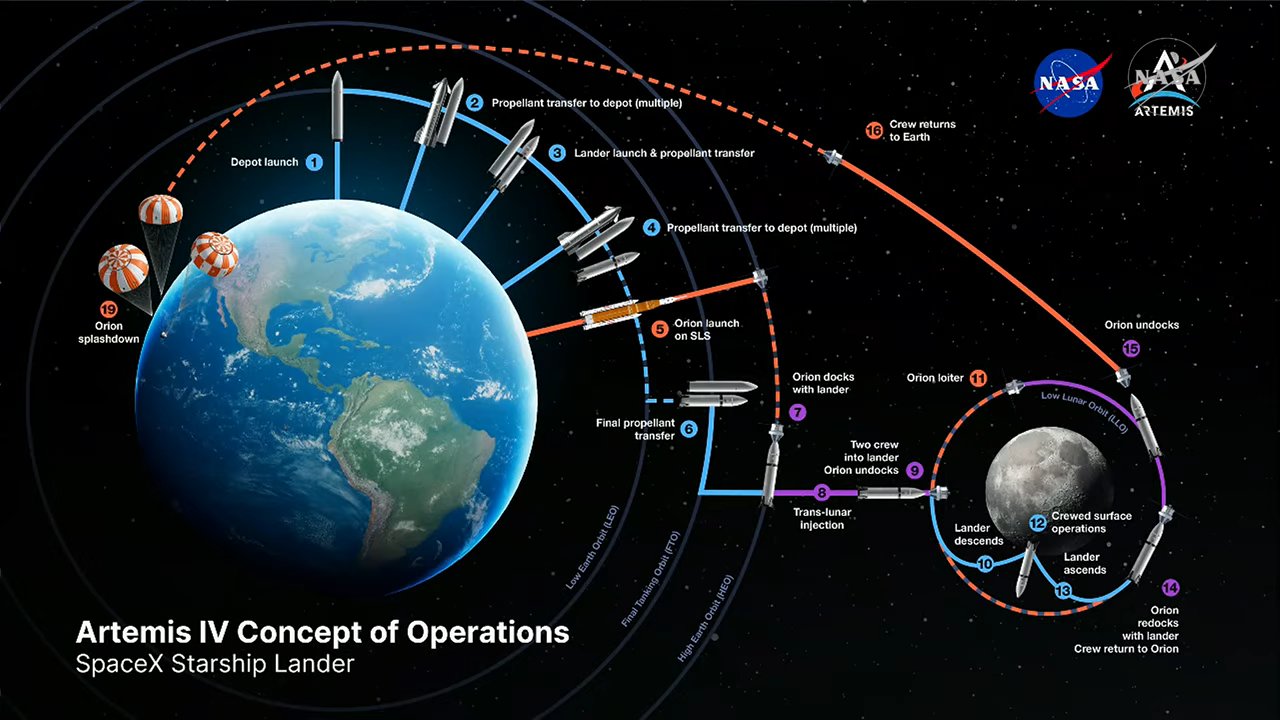
Starship lunar lander concept of operations.
Credit: NASA
Starship lunar lander concept of operations. Credit: NASA
Once SpaceX demonstrates in-orbit refueling, it could begin planning a campaign to send an uncrewed Starship to land on the Moon as a demonstration. How many tanker launches would this take? The internal estimate at NASA’s Johnson Space Center is “about 22” Starship launches, Ars reported last week. Musk followed that up by saying the actual number “will be more like 6 to 8.”
So what’s the truth? In the near term, given Starship’s lift capacity, a lunar landing will probably require about 20 launches, which is the most current publicly disclosed government planning figure. With improvements to Starship and Raptor engine performance, and as SpaceX gets a better handle on in-space refueling operations, that number will assuredly come down. So at some point in the future, it could be as low as six. NASA Administrator Jared Isaacman appeared to confirm this last week when he characterized Musk’s estimate of six to eight refueling flights as the “ultimate potential end state” of Starship.
Unfortunately, to beat China back to the Moon by 2030, NASA can’t wait for Starship to reach its final form. If SpaceX were to fly a lunar demonstration in the next year or two, a necessary precursor to human landings, it probably would take something like 20 Starship launches. Starship has flown 14 times in the last three and a half years. Its flight rate will undoubtedly accelerate in the coming months, but even at a weekly launch cadence, fueling a Starship for a lunar landing would still require more than four months of dedicated launches.
Frankly, it’s difficult to envision SpaceX dedicating 20 Starships to a NASA mission anytime soon. The opportunity cost is enormous. Those same rockets could launch hundreds of revenue-generating Starlink V3 satellites into orbit. A single Starlink launch on Starship delivers the same amount of bandwidth as 10 Falcon 9 launches—bandwidth SpaceX can sell to customers for years to come. And as SpaceX expands into artificial intelligence, the company has even greater incentives to reserve Starship’s capacity for its own growing constellation of satellites.
And then there’s the financial burden. Let’s assume an unoptimized launch cost of $100 million for early Starship flights—still a phenomenally low number for a super heavy lift vehicle. At that price, a lunar landing campaign requiring 20 launches would cost approximately $2 billion in launch expenses alone. Recall that SpaceX’s original Human Landing System contract was valued at $2.89 billion and included both an uncrewed demo and crewed landing.
The actual cost of a single lunar landing mission remains uncertain, and some of the investments needed to fulfill the contract will benefit Starship more broadly. But the larger point is clear: NASA is asking SpaceX to devote substantial resources to a program that offers comparatively little financial upside at a time when the company’s own commercial ambitions are growing exponentially.
Imagine a world where SpaceX had gone all in on developing a lunar lander. Would the company be taking a different approach to the immense technical challenges of getting Starship to the Moon, perhaps with a stubby Starship variant? Would it be devoting more of its best engineers to the program? Would it consider using an expendable tanker Starship to reduce the total needed?
SpaceX very well might still get to the Moon in the next five years, and the company has enormous technical capacity. Its history suggests that when Musk makes something an overriding priority, things happen quickly. All it would take for SpaceX to go full throttle on a lunar Starship would be for Musk to text a technical leader at the company something like, “Do HLS.”
Last year, Ars asked Musk if it mattered to him that China gets back to the Moon before NASA with the Artemis Program.
“I think the United States should be aiming for Mars, because we’ve already actually been to the Moon several times,” he replied. “Yeah, if China sort of equals that, I’m like, OK, sure, but that’s something that America did 56 years ago.”
The enthusiasm gap
In November of last year, Ars posed a similar question to Blue Origin’s chief executive, Dave Limp. “We just want to help the US get to the Moon,” he said. “If NASA wants to go quicker, we would move heaven and Earth, pun intended, to try to get to the Moon sooner.”
Multiple NASA sources said Blue really is doing whatever it takes to help NASA and that what once appeared as a rocky relationship is now flourishing.
After SpaceX won a sole-source contract for the Human Landing System in 2021, Blue Origin sued NASA. This pressure, along with NASA’s desire for a second provider, led Congress to eventually add funding for a second lander. As with Starship, Blue Origin’s original design under this new contract also involved refueling operations in low-Earth orbit for the large Blue Moon Mark 2 vehicle.
As it became increasingly clear that China was on course to land humans on the Moon by or before 2030, Blue Origin’s large and ambitious Blue Moon lander did not serve NASA’s more immediate needs. It would take too long.
In 2025, Ars was first to report that Blue Origin might be able to develop a lunar landing system that involved a smaller version of the Blue Moon Mark 2 vehicle and multiple transfer stages based on the existing Mark 1 lander. This involved a significant redesign to the Blue Moon program, but critically, it removed the need for in-space refueling. Eventually, this became the new plan. Blue Origin, without any guarantee of new funding, changed its design when NASA needed something faster.
“I will tell you, they are absolutely fantastic partners,” Parsons, NASA’s Artemis manager, said of Blue Origin. “They have leaned forward at every step, and they are all in on the mission.”
NASA’s upcoming Artemis III mission is illustrative of the differences.
The mission is intended to test both Blue Origin and SpaceX’s lunar landers in space. Blue Origin is building a special “test” version of its Blue Moon lander to demonstrate a host of capabilities for NASA. After docking, the crew will exit the Orion spacecraft and spend time aboard the Blue Moon vehicle. By contrast, SpaceX is pulling a “ship off the line” of its Starship program for the flight. Orion will rendezvous and dock with Starship, but there will be no ingress into the vehicle and hence no life support equipment.
Can the tortoise beat the hare?
Earlier this year, NASA revealed a major new initiative to develop a Moon Base. Not long after, New Glenn exploded on its launch pad. In the aftermath, Blue Origin has moved with uncharacteristic speed to repair its launch pad to get New Glenn flying again, while investing $3 billion in Florida facilities to support a much higher launch cadence.
This matters because New Glenn is superseding Starship as the essential rocket powering NASA’s lunar ambitions.
Beyond the Human Landing System, there are myriad robotic elements of the Moon Base that need to get to the surface, and NASA has contracted with a host of US space companies to develop smaller cargo landers. Some of these providers are growing nervous about launch. At least two of these companies had “rough order of magnitude” estimates and other types of launch agreements with SpaceX for Falcon 9s to deliver elements of NASA’s Moon base later this decade. But in the last several weeks, SpaceX, the only company that can offer reliable launch dates, has told them it will no longer sell rides to the Moon.
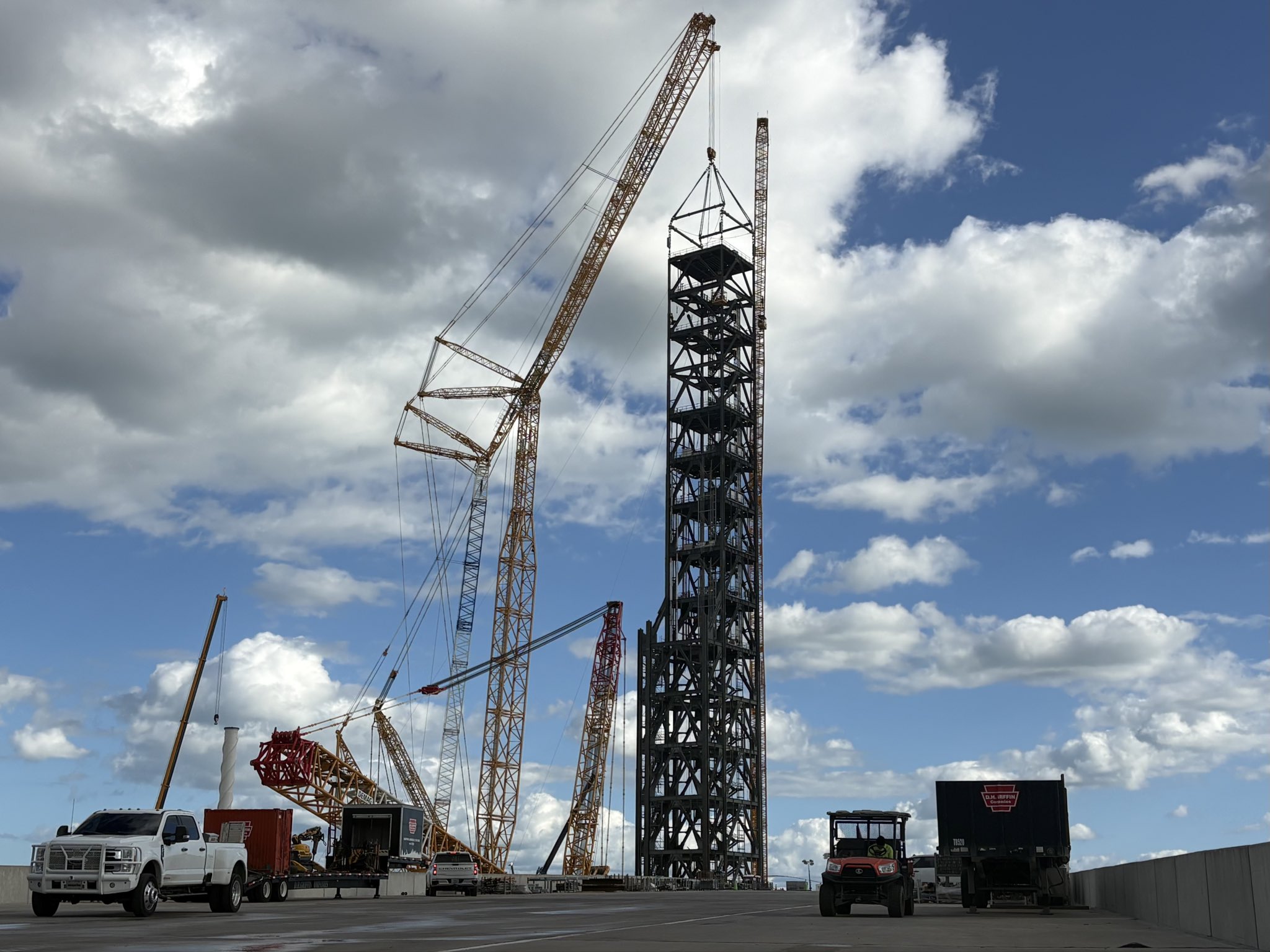
Less than five months after a catastrophic New Glenn failure in Florida, Blue has nearly rebuilt its vehicle access tower.
Credit: Blue Origin
Less than five months after a catastrophic New Glenn failure in Florida, Blue has nearly rebuilt its vehicle access tower. Credit: Blue Origin
This has sent shockwaves through the Artemis community. It is not the behavior of a partner being broadly supportive of NASA’s lunar efforts. These smaller lander companies now must hope that New Glenn can pick up the slack or a company like Relativity Space can bring its Terran R rocket to readiness quickly.
Ars pressed Parsons on how committed SpaceX really was to NASA’s lunar activities. For example, did he really believe SpaceX would be willing to sideline its profitable Starlink and Starmind launches for the extended period to support an Artemis landing? “It’s a fair question, especially as they have gone public,” he acknowledged.
For more than a decade, NASA more or less turned its spaceflight fortunes over to one billionaire. That partnership now appears to be unraveling, and there seems to be a growing sense that if the space agency is to achieve its considerable lunar ambitions in the next decade, it may need another billionaire to bail it out.
“This could end up being a very big opportunity for Blue Origin and Jeff Bezos, who would absolutely relish the role of coming to the country in its time of need,” said Davenport, the author who has written about the rocket billionaires. “Bezos has been public in saying he wanted to serve his country, particularly if it meant in doing it instead of SpaceX and Elon.”
Bezos, of course, is not doing this out of the goodness of his heart or because he bleeds red, white, and blue. He stands to gain Artemis customers, national security launch contracts, and commercial business. He is chasing SpaceX’s enormous valuation with his own space company. But no one thinks Bezos would pull his rockets off the market if NASA were desperate to get to the Moon.
The real question is whether Blue Origin can succeed. The company has a long, long list of things to achieve to make Artemis a reality, from rockets to landers to in-space operations. And for all the many billions of dollars Bezos has invested, Blue Origin has a short track record of execution. It has only ever launched three orbital missions.
Now it is being called on to spearhead the landing of humans on the Moon. On a rocket that recently blew up. Aboard a lander that doesn’t yet exist. At the 11th hour.

Eric Berger is the senior space editor at Ars Technica, covering everything from astronomy to private space to NASA policy, and author of two books: Liftoff, about the rise of SpaceX; and Reentry, on the development of the Falcon 9 rocket and Dragon. A certified meteorologist, Eric lives in Houston.
KioskNews shows a cleaned-up reading view extracted from the publisher’s page — the original always lives on their site, not ours.