The special commissioner for lawn-mowing with one eye on a senate spot
Welcome to Brisbane Times’ Queensland public sector column, Public Circus. This week: Andrew Cripps eyes a regional public servant push – and the senate, voluntary assisted dying board wants scheme eligibility changes considered, and election watchdog’s warning on IR changes.
Now seven months into a plum post as Crisafulli and Co’s hand-picked Special Commissioner for Regional and Rural Queensland, it seems Andrew Cripps has finally hit (some form of) a stride.
The question now is what inroads the Newman-era minister will be able to make on delivering more public sector roles to the regions before another opportunity knocks: a jump to federal politics.
Estimates hearings in July taught us Cripps’ exact work plan for the reportedly $392,000-a-year role was still being hashed out – as had a formal “landing page” for his non-Hotmail inbox.
Department of Premier and Cabinet director-general Damien Walker said at the time he had “no doubt” there would be a “level of communication around what the special commissioner will be focused on as a result of concluding the work program itself”.
Since then, however, it’s been relative crickets from Cripps and the three full-time staff he was handed from two departments.
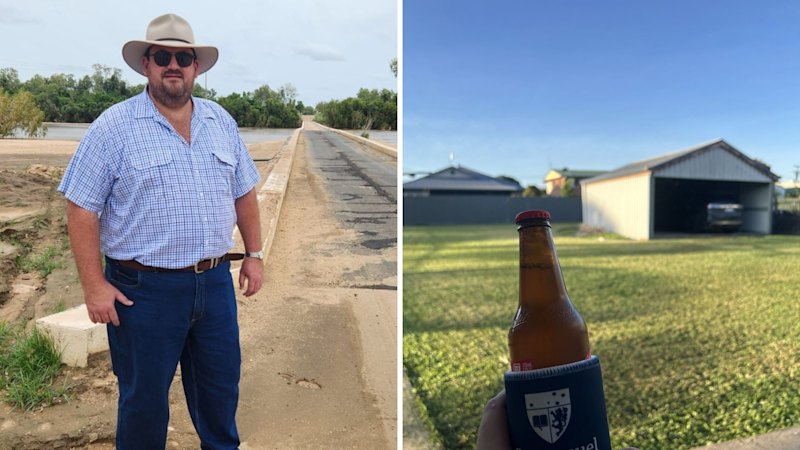
We say relative crickets because Cripps has still managed to maintain his series of post-mowing beverage philosophising, with a recent admission he’d forgotten to keep his fridge stocked.
“With my sensibilities impaired, I sourced a glass of water and perched myself on the back steps to survey my freshly maintained square footage,” Cripps recounted in early October on LinkedIn, while asking for follower feedback.
“What emerged from my disorientation was a question: ‘If you cut the grass in the Deep North, but can’t enjoy a cold beer afterwards, have you really mowed the lawn?’ I think not.”
Thought-provoking stuff. Following up a few weeks later with a post at 4.30pm on a Tuesday, Cripps – previously appointed by government to co-ordinate the north’s 2025 flood recovery – said he was “suitably chastised and humbled” by the ribbing in the comments and “fully intend[s] to plan better, with the appropriate supplies at hand”.
So what else has Cripps been up to? The Department of Premier and Cabinet has told us only that his work plan has been approved by the Public Sector Governance Council chaired by Walker, but skimped on any real detail.
Luckily, Circus has also learned that despite Walker’s dancing around estimates questions of whether Cripps might have a role in a push to see more public servants set up in the regions, the man has been busy writing to each of the state’s directors-general and commissioners.
This forms part of what’s been described as an initial consultation phase from Cripps seeking feedback on barriers and opportunities around the idea, and how it might happen – if it does.
Given the current squeeze on departmental budgets, however, we can only imagine any systemic (and costly) program to shift bureaucrats from Brisbane would be off-the-cards.
Which brings us back to the more capital P politics of the moment. Circus has also heard from those elements of the tent that Cripps is expected to raise his hand for the party’s second federal senate ticket spot when Matt Canavan leaves to run for the lower house at an election due by early 2028.
While holding strong internal party support, sources granted anonymity to discuss internal LNP rumblings said the former senate preselection candidate has become somewhat of a lightning rod in state politics after landing the special commissioner gig.
Some sources said a senate tilt would ruffle feathers among state colleagues given the media scrutiny that followed. He’s also likely to come up against a “Melbourne Cup field” for the once-prized second Senate spot.
The other likely challenger is Toowoomba mayoral advisor Michael Duff – currently at fourth position on the ticket and with the support of Canavan as a factional heavyweight from the Christian far right.
How prized the preselection remains will depend on the scale of support bleeding to One Nation in the Sunshine State. The one certainty is that Cripps, who we contacted for comment, would appear to have his work cut out for him. It’s enough to make you thirsty.
Voluntary assisted dying board wants LNP to look at eligibility changes
Its one of the topics the government would rather not have to talk about: the state’s now almost four-year-old voluntary assisted dying scheme.
Unlike with abortion or uranium mining, however, the Crisafulli LNP – while coming to power promising no changes to euthanasia laws – is required by those very laws to review the scheme.
“As soon as practicable” after its three-year milestone, even. We’re now into month 11, and have no news except assurances by the government the review will happen, and that no change will come of it.
We can only hope public cash isn’t being spent paying some external firm to do the doomed work.
A Right to Information application by Circus for any to-and-fro between responsible minister Tim Nicholls and the scheme’s independent oversight body has turned up little cabinet-excluded detail except a letter from members of the Voluntary Assisted Dying Review board confirming they spoke to Nicholls about the looming review at a meeting one year ago (and got little insight themselves).
Since then, the associate professor Helen Irving-chaired board has lobbed its 2025-26 annual report, which landed among the avalanche of other agency updates in late September and managed to slip media attention at the time.
Inside, however, is a handful of new recommendations from the board. One explicitly calls for the minister to ensure the review involves “broad consultation with the public and other stakeholders to determine the desirability and feasibility of amending existing eligibility criteria”.
Currently, adults must be diagnosed with an advanced condition that would cause death within 12 months, be assessed by two doctors, and make three separate requests to access the scheme.
Federal laws mean this all has to be done in-person, too. Advocates nationwide have long called for this pre-existing roadblock to be lifted – and for changes to improve the scheme and its accessibility.
At least one anti-VAD group, Right to Life, has clocked the remarks and data from the report to urge that Nicholls instead call an “urgent inquiry” into the state’s scheme, citing the increased number of deaths (1082) and fact this placed Queensland at the higher end of Australian jurisdictions.
We reached out to Nicholls’ office for an update on the review last week. They pointed us to the government’s statement – unchanged from late July. Feel free to tweak your working definitions of “ASAP” accordingly.
Electoral watchdog’s plea to government on ‘not insubstantial’ IR overhaul
While the government’s controversial proposed industrial relations overhaul is given an air of public consultation via parliamentary committee, one official has made a particularly pointed plea.
Electoral Commissioner Pat Vidgen, in a written submission, has made clear he had no prior heads-up about the broadened union election program his team would have to oversee with new, so-far vaguely described “electronically assisted voting”.
With only a short time to prep feedback as a result, Vidgen warned the “not insubstantial” changes would have the effect of “rendering ECQ’s current staffing for industrial elections inadequate” and require the commission to set up something it doesn’t even currently do: online voting.
The commission currently oversees elections for fewer than 20 employer and employee organisations with a full-time equivalent team of two people. Under the draft changes, this could balloon to 74 groups – some with up to 50,000 members.
On top of this, from next year the team enters a “critical preparation stage” for the four-yearly statewide council and state government elections in 2028, and carry out 11 council divisional boundary reviews before October.
“Given those constraints, ECQ cannot presently administer the amendments as proposed, without additional time, funding and staff,” Vidgen wrote in his covering letter, urging the relevant changes be delayed until he had enough resources – or until at least October 2029 for any online system.
“Upfront funding will be required to expand capacity and make the necessary preparations, which may be recouped once the amendments [for a user-pays model] are in force.
“However, significant funding will be required to implement and maintain the online voting system, which may not be recoverable as a user pays cost.”
Vidgen, like the rest of us, will have to wait and see what – if any – tweaks might be made to the bill by Deputy Premier and Industrial Relations Minister Jarrod Bleijie before it sails into law.
Have a curiosity for the Circus tent? Email on m.dennien@nine.com.au. For more security, sing out with a non-work device and network via Signal (mattdennien.15 or here) and mattdennien@protonmail.com.
KioskNews shows a cleaned-up reading view extracted from the publisher’s page — the original always lives on their site, not ours.