Data link trial: Chinese team finds hollow-core fibre cuts lag 30% across 1,000km
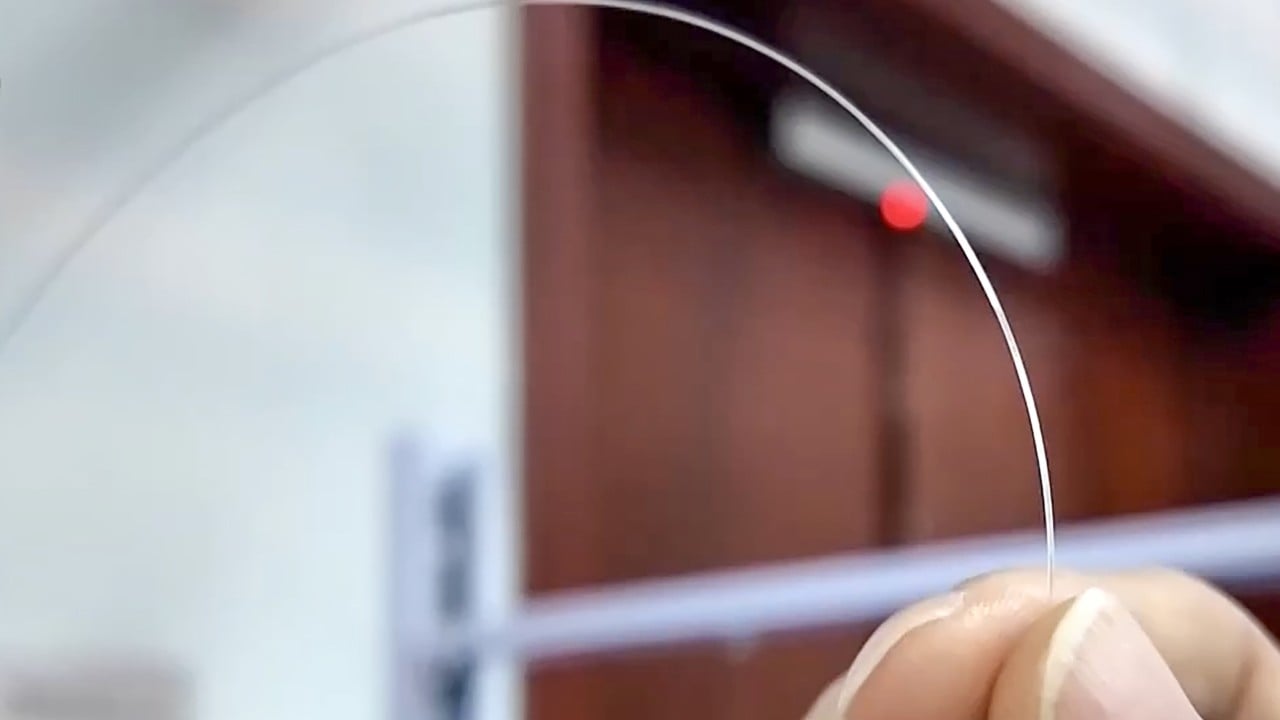
Light travels through conventional optical fibres at about 200,000km per second – about two-thirds the speed it travels in a vacuum – because the signals are passing through solid glass.
When vast amounts of data are exchanged between computing centres hundreds or thousands of kilometres apart, this difference amounts to a substantial delay.
Now, Chinese researchers have unveiled optical fibre that replaces the solid glass core with air, cutting the data transmission delay by about 30 per cent over 1,000km (621 miles), they say.
The advance could help build more powerful artificial intelligence (AI) infrastructure by improving connections between geographically dispersed data centres.
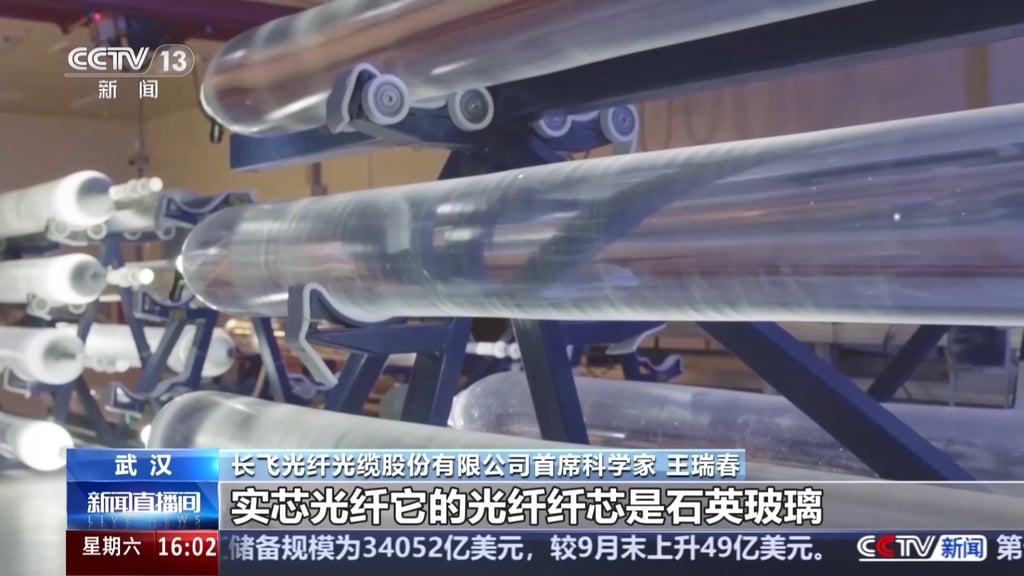
Hollow-core fibre – which guides light through a microscopic air-filled channel instead of conventional glass – has been developed by international researchers for decades.
“The core of hollow-core fibre is air, and light travels through air at close to the speed of light in a vacuum, about 300,000km per second,” Wang Ruichun, chief scientist at Yangtze Optical Fibre and Cable (YOFC), told state broadcaster CCTV in a report on Sunday.
In a joint experiment, China Telecom Research Institute, YOFC and Chinese telecommunications equipment maker ZTE achieved simultaneous two-way transmission at 64 terabits per second (Tbps) in each direction over a 1,007.5km hollow-core fibre link, according to an announcement from China Telecom on November 2.
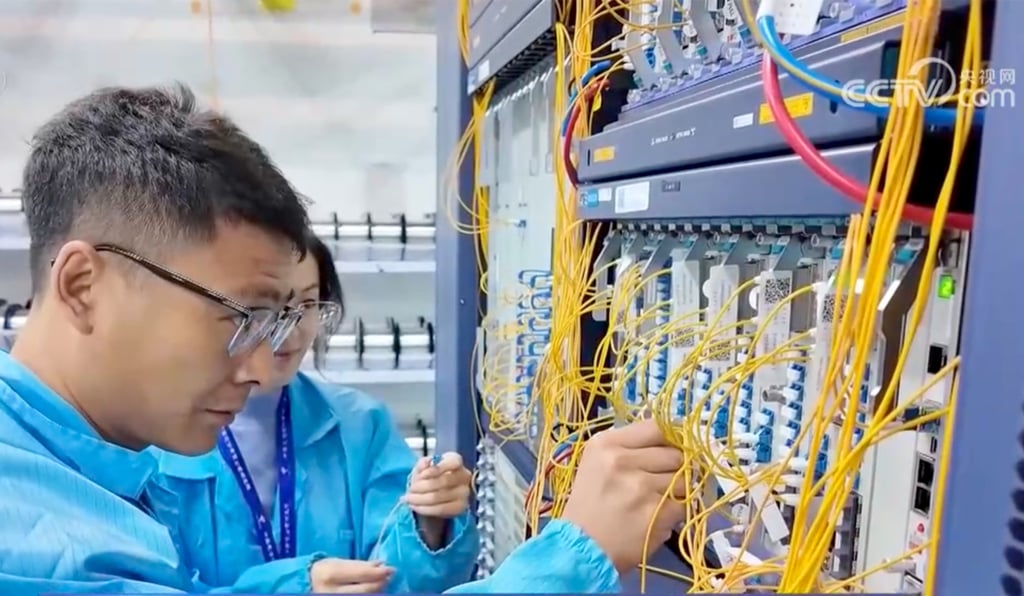
The combined transmission capacity reached 128Tbps, equivalent to uploading and downloading 160 feature films in 4K resolution per second in each direction, assuming each film occupies 50GB of storage.
More importantly, the signal took about 3.4 milliseconds to travel 1,000km in one direction, compared with about 5 milliseconds through conventional solid-core fibre. The researchers said the experiment set a world record for real-time hollow-core fibre transmission distance.
While the results appeared promising, the trial was conducted using more than 300 spools, each containing 2km to 5km of hollow-core fibre, assembled into a continuous test link rather than a deployed 1,000km telecommunications route.
Achieving such high-speed transmission over long distances remains technically challenging because optical losses, gas absorption and interference can degrade signal quality.
The Chinese team said it addressed these problems by refining the fibre manufacturing to suppress absorption caused by carbon dioxide and carbon monoxide within the operating wavelength bands.
It also used commercially available optical amplifiers rather than specialised high-powered equipment, alongside signal pre-equalisation techniques to maintain clear quality across channels.
Huo Xiaoli, chief expert in next-generation information and communication at China Telecom, said the experiment showed “long-distance, large-capacity and low-latency transmission capabilities” while reusing existing transmission equipment.
According to CCTV, the system doubled transmission capacity and increased transmission distance by 60 per cent compared with leading solid-core fibre systems. It asserted that the transmission distance was 50 times that of comparable previous hollow-core fibre experiments, although the state broadcaster’s claims have not been verified.
The advance could be particularly significant for China’s “East Data, West Computing” initiative, a project that was launched in 2022 to shift some of the computing workload from economically developed eastern regions to western areas with more abundant energy resources.
The programme involves eight national computing hubs and 10 data centre clusters, including facilities in Inner Mongolia, Guizhou, Gansu and Ningxia, connected through high-speed telecommunications networks.
According to an article published by China’s National Development and Reform Commission on August 24, the country built 145 backbone optical-fibre links connecting its eight computing hubs by the end of 2025, reducing network transmission latency between provincial regions and the hubs to less than 20 milliseconds.
However, the physical distance between data centres remains a challenge, particularly for AI workloads requiring frequent exchanges of large amounts of data.
“AI data centres have very demanding latency requirements, and the speed of optical connections and transmission is also very important,” Wang told CCTV.
01:36
Rural Inner Mongolia takes centre stage in China’s data centre boom
The technology could help overcome some of these limitations by allowing geographically separate computing facilities to communicate more quickly.
Wang said it could also improve computing efficiency and cut investment in hardware; however the experiment did not quantify such savings.
CCTV said the technology had entered limited commercial use, including in a hollow-core fibre financial communications link between Shenzhen and Hong Kong, while more than 10 commercial and pilot projects had been deployed across Asia and Europe.
KioskNews shows a cleaned-up reading view extracted from the publisher’s page — the original always lives on their site, not ours.