Cerebral Josh King plots unusual route into Tuchel’s England plans

Josh King is talking with pride about how his mother, Michelle, a university lecturer, has almost finished her PhD in sickle cell disease. The Fulham attacking midfielder, who is in the England squad for the Nations League matches against Croatia and Spain this week, mentions that his father, Steve, is a lawyer and says he might have liked to follow in his footsteps if it had not worked out for him on the pitch.
King’s background is not that of a typical footballer. Privately educated at Hampton School in south-west London, he aced his GCSEs, achieving A or A* in his 10 subjects. He went on to study part-time for A-levels in French, maths and psychology, getting grades of A, C and D – pretty impressive, especially when you consider he sat the exams in a hotel suite in Romania in the summer of last year while playing for England at the European Under-19 Championship.
Is there a link between King’s academic prowess, whether nature or nurture, and his success as a player? He thinks so and it goes beyond the basic eye test of what you see in his game – the appreciation of the spaces, the quicksilver cuteness.
“It definitely has an impact … I know my mum would probably say so,” the 19-year-old says with a smile. “The most important thing about being good academically and education-wise is you’re able to take on information much more quickly. You can almost take on information which might take a bit longer for other people. That definitely helps. It’s always been something that has helped me. Being able to communicate with my teammates, sometimes younger players, sometimes older players – it’s a massive part of football. Having those skills is really important.”
King’s rise has been rapid. He enjoyed his breakthrough season in 2025-26, appearing in 32 of Fulham’s 38 Premier League matches, starting 15 of them, and it led to Thomas Tuchel giving him a first England call-up for the pre-World Cup camp in Florida. King did not play in either of the friendlies but the experience was invaluable and motivating. This season, he has been an ever-present in Fulham’s starting league team and it is no exaggeration to describe him as one of the country’s most exciting teenage talents.
Tuchel has a wealth of options in the No 10 position: Jude Bellingham, Morgan Rogers, Eberechi Eze and Morgan Gibbs-White. He cannot find room for Phil Foden or Cole Palmer, as much as he would like to involve the former. But he wanted to see King during this camp and has noted that he can be an option off the wings; also as a No 9 in training. Tuchel even used King as a full-back during the sessions in Florida and, although he has promised not to do that this week, it is a further example of the player’s flexibility.
“There were a lot of people I learned from in Florida and Jude [Bellingham] was a standout,” King says. “He took me under his wing and really tried to make me feel welcome. Harry Kane did, as well. The main thing you take [from all the players] is the standards they set. The way they perform every day. The will to win, the competitive edge. Then there were the technical things – the way some people strike the ball, the way they pass. It was little things that you almost take without thinking but they have an impact.”
King was due to be in Florida on a family holiday because his mother was booked to speak at a conference about her PhD. He was delighted to make it a work trip of his own. “My mum is very close to finishing her PhD in sickle cell disease, which is a disease that usually affects the black and mixed community,” King says. “She’s an incredible woman, someone I really look up to. Her work ethic and the way she holds herself is incredible. She’s someone I strive to be more like.”
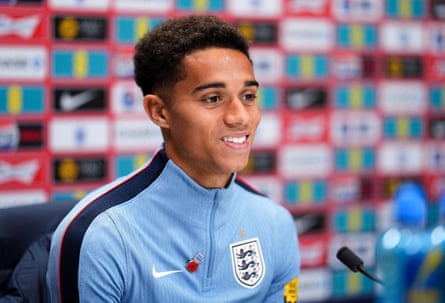
King’s influences are varied. In his younger days, he played as a rugby union fly-half. “That’s definitely contributed,” he says. “In terms of your movement, your ability to manoeuvre the ball, hand-eye coordination and foot-eye coordination … obviously as a fly-half, I used to do a lot of kicking. Football was always my passion and I was better at football. I would love to play a bit of rugby after my career because it’s quite physical. I don’t want to get injured!”
after newsletter promotion
It is no surprise to hear King name the Bayern Munich No 10, Jamal Musiala, and the Barcelona playmaker Pedri as stars from whom he has taken his cues. He has previously spoken of his admiration for the Barcelona midfield great Andrés Iniesta. “There are a lot of players that I’ve enjoyed watching over the last years,” King says. “And one of them is in the dressing room with me now. Jude is incredible – the way he plays and conducts himself, his energy, his passion. His quality is really top. He’s someone I definitely look up to.”
King joined Fulham at the age of eight, roughly when Tom Cairney arrived from Blackburn and began to establish himself as a club favourite. King idolised Cairney; as an 11-year-old, he was a mascot and walked out at Craven Cottage holding Cairney’s hand. It is a nice detail of King’s story that he can now call Cairney a teammate.
“I’ve said it before but Fulham is like a second home to me,” King says. “It’s a club which really feels like a family to me. Being there throughout my career has been massive. I had a lot of coaches and some of them stayed with me as I came up. I remember one called Charlie Turnbull who I had for five straight years from under-10s to under-14s. Having that continuity of coaching and that place you can almost call home is really important for your development.”
KioskNews shows a cleaned-up reading view extracted from the publisher’s page — the original always lives on their site, not ours.