KNMP opens wider markets, boosts tuna prices for Sinjai fishers
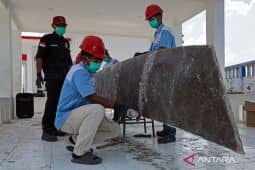
Jakarta (ANTARA) - Before the establishment of the Red and White Fishermen's Village (KNMP), the fish landing area in Tongke-Tongke Village, Sinjai District, South Sulawesi, lacked adequate facilities to support fishermen's activities.
The site, which has now become the center of the fishing village's activities, was previously an empty plot of land with muddy road access during rainy weather.
The only available structure was a fish landing facility that was in poor condition. Fishermen also lacked adequate supporting facilities to prepare their fishing supplies, ranging from fuel to ice blocks needed to keep their catch fresh.
These conditions made fishing activities less practical. Fishermen had to transport various supplies to their boats through poorly maintained access roads.
Yet, ice and other fishing supplies are essential for maintaining fish quality from the time they are caught until they reach the market.
That began to change after KNMP Tongke-Tongke was built in 2025 and started operating in May 2026. The area is now equipped with several facilities, including cold storage, air blast freezers (ABF), an ice factory, a culinary center, a supply center, a fishers' workshop, and a fish landing site. The facilities are managed by a cooperative.
"The KNMP program is not limited to building fisheries infrastructure, but is about bringing economic transformation to coastal villages to strengthen food self-sufficiency, the competitiveness of fishery products, and of course improve fishers' welfare," said Marine Affairs and Fisheries Minister Sakti Wahyu Trenggono.
For local fishers, the facilities not only make it easier to go to sea, but also help maintain catch quality and obtain fairer prices. The impact is starting to show in the marketing of tuna, the main commodity of Tongke-Tongke fishers.
The number of fishers in Tongke-Tongke Village is estimated at 500. Meanwhile, based on KNMP management data, around 218-220 vessels of 25-30 gross tonnage (GT) operate in the area.
KNMP manager and Tongke-Tongke Village Merah Putih Cooperative (KDMP) Chair Muh Aidil Putra said the selling price of tuna, previously around Rp30,000-Rp35,000 per kilogram, has risen to around Rp45,000-Rp47,000 per kilogram. At certain times, the price can even reach Rp50,000 per kilogram.
According to him, the increase is related to the growing number of buyers coming to the fishing village area. KKP recorded that fishers' average income rose 76.2 percent, from around Rp2.6 million to Rp4.6 million per fisher per month.
Aidil explained that before KNMP began operating, fishers' catches were in fact already being bought. However, existing buyers' capacity was not enough to absorb all of the fishers' catches.
From KNMP Tongke-Tongke, tuna has been shipped five times, totaling 65 tons worth around Rp2.54 billion. As the storage and processing facilities at KNMP began operating, a number of buyers started coming to source fish from Tongke-Tongke.
One partner that manages the cold storage and ABF facilities at KNMP also processes tuna into other products to be marketed outside the region, including Jakarta. The growing number of buyers gives fishers alternative markets while also opening up competition to secure fish supplies.
This gives fishers more choice in deciding whom to sell their catch to. The competition has also influenced the prices offered to fishers.
Role of the cooperative
To widen market access, the local Merah Putih Village Cooperative (KDMP) plays a role in connecting fishers with buyers and coordinating transactions.
Buyers can come directly to the KNMP area to offer cooperation or state their supply needs. Managers then connect them with fishers and help match the prices offered.
If a price is agreed, the buyer transfers payment through the cooperative. The cooperative then passes the payment on to fishers.
In collecting and shipping fish, the cooperative also uses the vehicles and supporting facilities it owns.
Aidil said that before KNMP began operating, some fishers even marketed their catch to Bali and Lombok when prices there were more attractive.
Now, as more buyers come to Tongke-Tongke and the prices offered are more competitive, most fishers choose to market their fish locally.
Even so, the cooperative has not yet been able to take on a bigger role as a direct buyer. Aidil said limited capital is one of the main obstacles.
To buy the catch of a single vessel, which can reach around 4-5 tons, the cooperative estimates it would need capital of around Rp200 million to Rp250 million.
Currently, management of KNMP facilities is also not yet fully in the cooperative's hands.
The cooperative manages the ice factory, culinary center, and supply center, while the cold storage facility is still run by a partner because the cooperative lacks sufficient capital.
Another challenge relates to operations, as the cooperative still needs stronger human resources, especially for business development, administration, and secretarial work.
Improving record-keeping, business documents, and area management, including cleanliness, is also work that needs to be completed so that business activities can run in a more orderly way.
Development needs do not stop at institutional management and capital.
KNMP Tongke-Tongke managers have also requested additional facilities, including a four-ton-capacity ABF and cold storage with a capacity of around 50-60 tons.
The additions are expected to increase the capacity to store and handle catches, in line with the area's fish production potential.
Sustainability
Tongke-Tongke's experience shows that building physical facilities can help improve fishing activities and attract more buyers.
However, buildings and equipment alone are not enough to ensure that economic benefits are felt sustainably by fishers.
Cooperative expert and business management lecturer at Bina Nusantara University Agung Sudjatmoko assessed that the increase in selling prices and fishers' incomes is a positive development if it is truly felt by coastal communities.
Even so, the mechanisms driving the increase need to be clarified and sustained.
According to him, the cooperative should not stop at being a link between fishers and buyers. It needs to be strengthened so it can manage the business professionally, gather catch supplies, build market networks, and forge partnerships with buyers or offtakers that can absorb fishers' products on a sustained basis.
Supply chain strengthening is also needed so that absorption of catches does not depend only on buyers' demand for fresh fish.
For that, storage and processing facilities need to be backed by clear market access, so that catches still have alternative outlets when demand for fresh fish weakens.
The cooperative also needs to be encouraged to develop its own processing business units to add value to fishery products. The processing could involve producing fishmeal, sardines, or canned fish, as long as adequate raw materials, capital, technology, and markets are available.
KNMP Tongke-Tongke is one of 65 Merah Putih Fishing Village locations that have been operating in 2026. The Ministry of Marine Affairs and Fisheries (KKP) targets building 1,369 KNMP sites through 2027, as part of a long-term plan to build 5,000 fishing villages across Indonesia.
In line with that, the government is also pushing to strengthen the community economy through the Village/Urban Village Merah Putih Cooperative (KDKMP) program. Of the 30,000 KDKMP already built, the government targets 10,000 to be operating well by the end of 2026.
The development of KNMP Tongke-Tongke shows that better facilities can open fishers' access to wider markets and encourage competition among buyers.
However, facility improvements need to be followed by strengthening fishers' economic institutions.
The next challenge is ensuring the cooperative not only acts as a link between fishers and buyers, but is also able to develop productive businesses that deliver greater added value and economic benefits to its members.
KioskNews shows a cleaned-up reading view extracted from the publisher’s page — the original always lives on their site, not ours.