UN climate summit enters final day
MORE HELP NEEDED: Leaders of countries ravaged by climate change are seeking more funding, but that is hard to ask for without the world’s richest nations in the discussions
As this year’s UN climate talks wrap up in Turkey, negotiators are still debating over how to address global warming, even as warnings are growing that only slashing fossil fuels can avert its most catastrophic effects.
Yesterday marked the scheduled end of the two-week summit, known as COP31, in Antalya. The talks have so far failed to advance any big ideas on how to move away from fossil fuels — mainly coal, oil and gas — that contribute to disasters such as Europe’s deadly heat waves and Nepal’s devastating flooding.
These summits often end with a final text or cover decision, which is then adopted by nearly 200 nations participating in the process. Although yesterday was the official last day, negotiators often go into overtime to iron out these often voluntary and non-binding agreements.
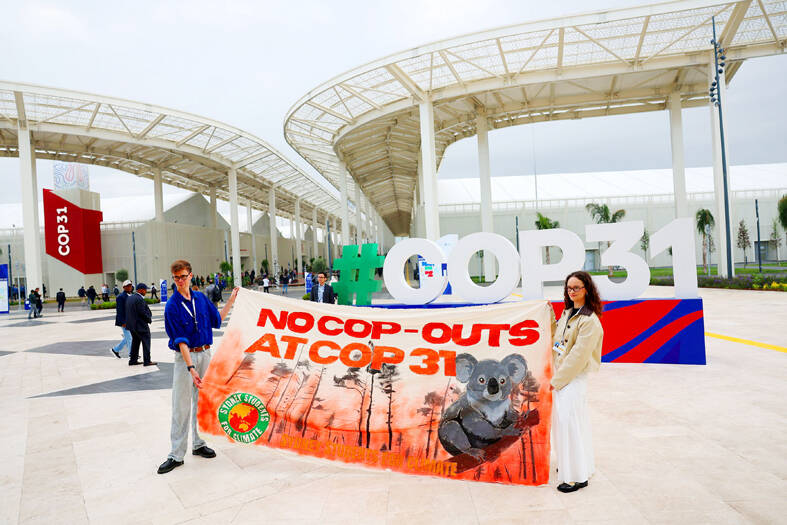
Australian activists hold a banner during a demonstration at the UN Climate Change Conference (COP31) in Antalya, Turkey, yesterday.
Photo: Reuters
Past COPs have failed to agree on how to transition away from fossil fuels, which is still a sticking point this year.
“It’s about time we tell the truth to our citizens and to ourselves. The COPs need to be reformed,” Panamanian Minister of Environment Juan Carlos Navarro said.
The Panama delegation has vowed to block any outcome that does not meet several demands, including a cap on oil production.
One of the main deals on the table is an electrification goal that aims to increase the share of electricity in total global energy consumption from about 21 percent today to 35 percent by 2035.
While the agreement prefers that this goal is reached through renewable energies, such as solar and wind, it does not spell that out. This means power plants running on coal and other fossil fuels could be used to supply power grids, at least initially.
“The removal of explicit language on transitioning away from fossil fuels in the cover decision is concerning,” said Ghiwa Nakat, executive director of Greenpeace in the Middle East and North Africa. “At a time when the climate crisis demands decisive action, weakening commitments on fossil fuel phase-out risks undermining the progress.”
Leaders from countries ravaged by climate change — mostly poorer, vulnerable nations that do not emit a lot of greenhouse gases — are also at COP31 and have said that a UN fund set up to help them recover from climate disasters and adapt to a warmer world is not nearly large enough.
Many of the world’s most-polluting nations did not participate directly at COP31, including the US, the world’s largest economy and a major emitter. The US is absent for the second year in a row.
It is richer nations, such as the US, that vulnerable countries want funding from. That is hard to ask for without the US government officially in the room.
Efforts to slow global warming have essentially stalled for the past five years, a Climate Action Tracker report showed.
In the lead-up to COP31, the UN announced that the world is dangerously close to missing its goal of limiting global warming to 1.5°C above pre-industrial temperatures.
“Disappointment is rife,” said Iskander Erzini Vernoit, an adviser to African negotiators in Turkey. “Hope is not lost, but absent a course correction, we are headed toward a low-ambition set of outcomes at COP31.”
Next year’s climate summit is scheduled to take place in Addis Ababa in November.
KioskNews shows a cleaned-up reading view extracted from the publisher’s page — the original always lives on their site, not ours.